

















10 High-Impact AI in Manufacturing Solutions Delivering Immediate Value
As manufacturing continues to evolve, AI is no longer simply an innovation initiative. It has become a practical business tool delivering measurable results today and creating the foundation for the smart factories of tomorrow.
For years, artificial intelligence was viewed as a futuristic technology that promised to transform industries someday. Today, that future has arrived. Across manufacturing facilities worldwide, AI is no longer an experimental concept—it is a proven business tool delivering measurable returns.
Imagine a production line where equipment failures are predicted weeks before they happen, quality defects are detected instantly, and production schedules adjust automatically based on demand fluctuations. These are not theoretical possibilities. They are real-world applications of AI in Manufacturing that are helping companies reduce costs, improve efficiency, and increase profitability.
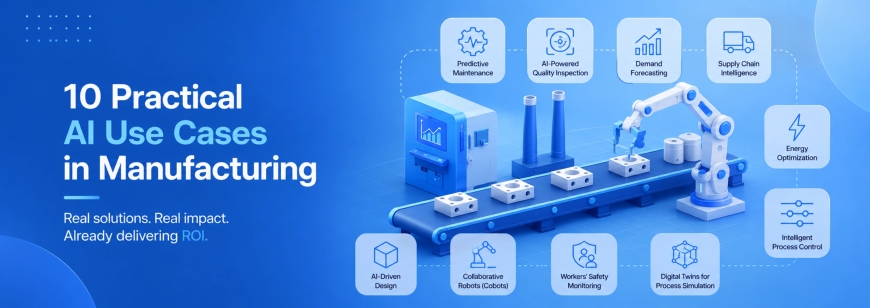
As manufacturers face rising operational costs, labor shortages, supply chain disruptions, and increasing customer expectations, Industrial Artificial Intelligence is becoming a critical competitive advantage. Here are ten practical use cases already generating significant ROI for manufacturers.
1. Predictive Maintenance
One of the most successful applications of AI in Manufacturing is predictive maintenance.
Manufacturing equipment continuously generates data through sensors that monitor vibration, temperature, pressure, and performance. AI algorithms analyze this data to identify early warning signs of potential failures before breakdowns occur.
Instead of reacting to unexpected downtime, maintenance teams can schedule repairs during planned maintenance windows. This reduces costly disruptions, extends equipment lifespan, and improves overall productivity.
Many manufacturers report substantial reductions in maintenance costs and unplanned downtime after implementing AI-powered predictive maintenance systems.
2. AI-Powered Quality Inspection
Traditional quality inspection methods often rely on manual checks, which can be slow, inconsistent, and prone to human error.
With Industrial Artificial Intelligence, machine vision systems use high-resolution cameras and AI models to inspect products in real time. These systems
can identify scratches, assembly defects, dimensional inaccuracies, and surface imperfections within milliseconds.
By inspecting every product rather than random samples, manufacturers improve product quality while reducing scrap and rework costs.
3. Demand Forecasting and Production Planning
Accurate forecasting remains one of the biggest challenges in manufacturing.
Overestimating demand can lead to excess inventory and increased carrying costs, while underestimating demand can result in stock shortages and missed sales opportunities.
AI-powered forecasting models analyze historical sales data, seasonal trends, customer behavior, market conditions, and external factors to generate more accurate demand predictions. This enables manufacturers to optimize production schedules, inventory levels, and resource allocation.
The result is improved operational efficiency and better customer satisfaction.
4. AI-Assisted Product Design
Product development is becoming faster and more efficient through the use of AI in Manufacturing.
Generative design tools allow engineers to input requirements such as weight limits, material constraints, strength requirements, and performance objectives. AI then generates multiple design alternatives that meet those specifications.
These designs often use less material, reduce manufacturing costs, and improve product performance. Engineers can evaluate multiple optimized solutions in a fraction of the time required using traditional design methods.
5. Supply Chain Risk Intelligence
Modern supply chains face constant uncertainty, from supplier delays and material shortages to transportation disruptions and price volatility.
Industrial Artificial Intelligence helps manufacturers proactively manage these risks by continuously monitoring supplier performance, logistics data, commodity pricing, weather events, and market trends.
AI systems can identify potential disruptions before they impact production, allowing businesses to adjust procurement strategies and maintain operational continuity.
This proactive approach helps minimize supply chain disruptions and improve resilience.
6. Energy Consumption Optimization
Energy costs represent a significant expense for many manufacturing operations.
AI systems can analyze energy consumption patterns across machines, production lines, shifts, and facilities to identify inefficiencies and optimization opportunities.
By adjusting production schedules, detecting abnormal energy usage, and optimizing equipment performance, manufacturers can significantly reduce energy costs without affecting output.
Industries with high energy requirements, such as chemicals, metals, glass, and heavy manufacturing, often achieve substantial savings through AI-driven energy management.
7. Intelligent Collaborative Robots
Collaborative robots, commonly known as cobots, are becoming more capable with the integration of AI technologies.
Unlike traditional automation systems that follow fixed instructions, AI-powered cobots can adapt to changing environments, product variations, and workflow conditions.
These intelligent robots assist with assembly, packaging, picking, sorting, and material handling tasks while safely working alongside human employees.
This flexibility makes them particularly valuable in facilities that produce a wide range of products or frequently change production requirements.
8. Workplace Safety Monitoring
Employee safety remains a top priority for manufacturers.
AI-powered safety systems use cameras, sensors, and computer vision technologies to monitor workplace conditions in real time. These systems can identify missing personal protective equipment (PPE), unsafe behaviors, hazardous zone violations, and ergonomic risks.
Rather than replacing safety teams, AI provides additional visibility and faster response capabilities.
Many manufacturers implementing AI-based safety monitoring have reported reductions in workplace incidents and improved compliance with safety standards.
9. Digital Twins for Process Optimization
A digital twin is a virtual representation of a physical machine, production line, or manufacturing process.
Using real-time operational data, digital twins enable manufacturers to simulate process changes, evaluate improvements, and test different scenarios before making physical modifications.
This reduces risk, minimizes downtime, and accelerates decision-making.
As Industrial Artificial Intelligence continues to evolve, digital twins are becoming an increasingly valuable tool for process optimization and continuous improvement.
10. AI-Powered Knowledge Management
Manufacturing organizations often depend heavily on the experience and expertise of veteran employees.
Unfortunately, much of this knowledge exists only in people's memories and is not properly documented.
AI-powered knowledge management systems can organize maintenance records, operating procedures, troubleshooting guides, training materials, and technical documentation into searchable knowledge repositories.
When technicians need information, AI can instantly surface relevant insights, reducing troubleshooting time and helping preserve critical organizational knowledge.
The Real Challenge: Deployment and Integration
The success stories above demonstrate that the technology behind AI in Manufacturing is already mature. Sensors are widely available, machine learning models have been proven, and ROI is increasingly well documented.
However, the biggest challenge for many manufacturers is not the AI itself—it is deployment.
Successfully implementing Industrial Artificial Intelligence requires connecting AI systems with factory data sources, integrating them into existing operational workflows, and ensuring employees can use them effectively.
Organizations that overcome these implementation challenges are gaining significant advantages in efficiency, quality, safety, and profitability.
As manufacturing continues to evolve, AI is no longer simply an innovation initiative. It has become a practical business tool delivering measurable results today and creating the foundation for the smart factories of tomorrow.
What's Your Reaction?
 Like
0
Like
0
 Dislike
0
Dislike
0
 Love
0
Love
0
 Funny
0
Funny
0
 Angry
0
Angry
0
 Sad
0
Sad
0
 Wow
0
Wow
0