3D Hologram Displays: 8 Facts Behind the Technology
Learn what a 3D hologram really is, how true holography works, why hologram fans differ, and where these displays are actually used.
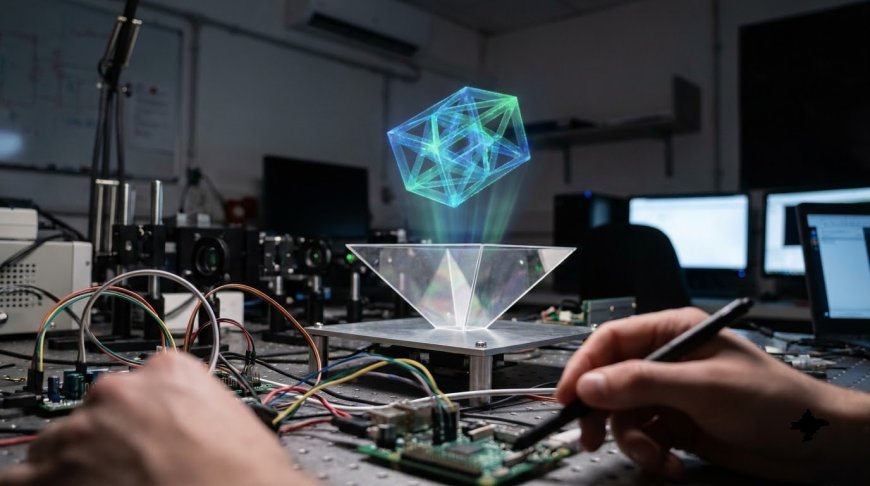
How true holography differs from hologram fans, Pepper's Ghost effects and the other technologies sold under the same name.
Walk through any large trade show and you will pass a car model turning slowly in mid-air with a small crowd around it. Someone will call it a hologram. Sometimes that is accurate. Often it is not, and the difference matters if you are specifying hardware, writing a brief, or just working out what you are looking at.
The phrase 3D hologram now stretches across at least half a dozen unrelated technologies. Here are eight things worth knowing before you use the word.
What is a 3D hologram display?
A 3D hologram display is any system built to make an image appear to occupy real space instead of sitting flat behind glass. In strict optical terms, a hologram is a recorded interference pattern replayed by diffraction to rebuild the original light wave. Plenty of products create a convincing floating image without doing any of that.
1. Most displays marketed as holographic are not holograms
Researchers sort glasses-free 3D systems by the physics involved: ray optics for light-field displays, point sources for volumetric displays, and wave optics for genuine holographic displays. Much of what is sold as hologram technology sits outside all three. Transparent LED panels, angled-foil projection rigs and spinning LED fans solve real problems, but they are not holography. The word is doing marketing work, not technical work.
2. A true hologram records the phase of light, not just its brightness
Ordinary photography records how bright light is at each point and discards the rest. Holography also records phase: where each wave sat in its cycle when it arrived. Dennis Gabor received the 1971 Nobel Prize in Physics for the holographic method, which captures phase by letting light from the object interfere with a coherent reference beam. Illuminating the developed pattern diffracts that light back into the original wavefront. That is why a hologram shows real parallax and real focus cues rather than a picture of them.
3. Some real holograms need no laser, no glasses and no dark room
Yes, everyday holograms exist, and you almost certainly own one. Reflection holograms, developed by Yuri Denisyuk, act as their own colour filter and replay under an ordinary light bulb. Stephen Benton's rainbow hologram of 1969 did the same for transmission holograms, and embossed versions became the security patches on credit cards and banknotes.
The MIT Museum holds the largest such collection in the world, with more than 2,000 pieces. The catch is that a recorded hologram is fixed: extraordinary depth, but no live content.
4. The floating performer at an event is usually a reflection trick
When a musician appears on stage years after their death, the effect almost always comes from Pepper's Ghost. A nearly invisible transparent foil hangs at an angle across the stage, and a bright image is bounced off a surface below into it, so the audience sees a reflection that appears to stand among the live performers.
The 2012 Coachella appearance of Tupac Shakur worked this way; the production company said at the time that the image was neither 3D nor holographic.
The practical consequence is lighting. The foil reflects only a small fraction of the light striking it, so the illusion collapses in a bright room.
5. Hologram fans draw pictures with spinning LEDs
A 3D hologram fan is a persistence-of-vision device. LEDs on rotating blades switch on and off at precisely timed moments, and because the blades move faster than the eye can follow, the flashes blend into an image that appears to hang in the air. Nothing floats; the light is painted along a circular path.
Two things follow. The blades spin at speed, so public installations normally need a guard and careful placement, and the image works best against a dark backdrop, because the black areas of the artwork are simply LEDs switched off.
6. Volumetric and light-field displays reach depth in different ways
A volumetric display fills a physical volume with lit points, or voxels, so viewers can walk around it and see genuine motion parallax without eyewear. A light-field display instead emits many directional rays from a flat surface, so each eye intercepts a slightly different set. Both are glasses-free, and neither is holography.
Not every product using the label follows that route. Large planning systems branded as holographic are often stereoscopic tables: a digital twin of the Noida International Airport masterplan let stakeholders review construction phases using 3D glasses. A useful format, but worth identifying correctly.
7. Viewing angle is the hardest limit in genuine holographic displays
How widely a holographic image can be seen depends on how finely the display bends light, which depends on the pixel pitch of its spatial light modulator. Commercial modulators have pixels several micrometres across, so conventional systems manage a viewing angle of only around seven degrees. A 2025 research prototype using a custom liquid crystal grating reached roughly 65 degrees.
There is also a trade-off: for a fixed information capacity, a wider viewing zone means a smaller image. That is the main reason genuine holographic screens stay small.
8. Moving holograms are a computing problem as much as an optical one
Working out what pattern to put on the modulator means simulating diffraction for every point in the scene at its own depth, which is costly enough that dynamic holography was long considered impractical. Work at MIT on tensor holography showed a trained neural network producing photorealistic colour holograms from a single colour-plus-depth image in real time on consumer hardware.
Content pipelines differ sharply by hardware as a result. Holographic and light-field systems want depth data or multi-view geometry, while a fan needs flat artwork on a black field, sized to a circle.
What should you check before calling a display a 3D hologram?
Ask three questions. Does the image reconstruct a light wave, or reflect a flat picture? Does the effect survive normal room lighting? Does depth change correctly as you move, or only from one fixed spot?
None of these technologies is fake, and hologram-like displays earn their place in museums, showrooms and planning rooms. Being precise about which one you mean makes for better briefs, better budgets and fewer disappointed audiences.
What's Your Reaction?
 Like
0
 Dislike
0
 Love
0
 Funny
0
 Angry
0
 Sad
0
 Wow
0