

























Balanced Trim Pressure Regulators for High Flow, Low Control Pressure Applications
JRHF Series high flow pressure regulators: balanced trim, Cv 1.5 to 1.9, 230 psi inlet, ANSI Class VI shutoff, four spring ranges, sizes 1/2" to 1".

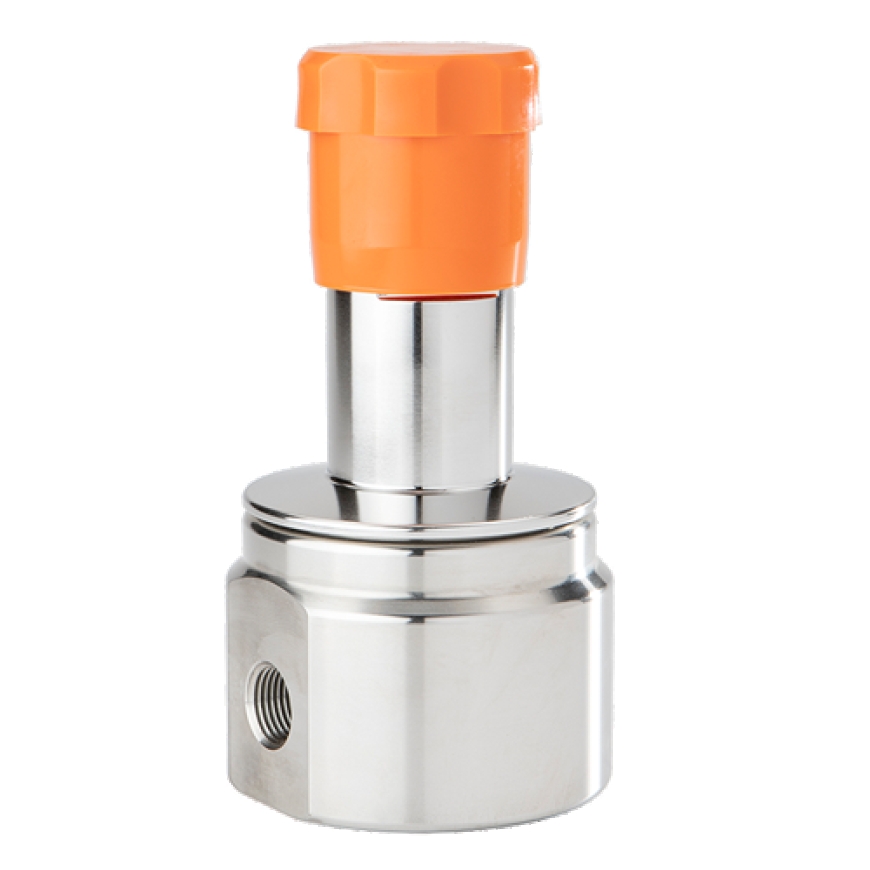
Many pressure regulators are designed for small flows at high pressure. Others are built for large flows at high pressure. Some processes need something different: a lot of flow at a low, stable control pressure. Gas cabinets, laboratory gas delivery, and injection molding lines are typical examples. In these systems, a regulator that is too small starves the process, and one that is poorly designed lets the outlet pressure drift. The JRHF Series from LowFlow Valve is a diaphragm operated, balanced trim pressure regulator built for this duty.
Understanding the Regulation Challenge
Two performance issues matter most when a regulator must pass high flow at low set pressure.
Droop. Outlet pressure falls below the setpoint as flow demand rises, because the spring extends and the force balance shifts. A regulator with sufficient flow capacity keeps droop small across the working range.
Lockup. When flow drops to zero, the outlet pressure rises slightly above the setpoint, because the seat needs extra force to seal. Minimizing lockup matters where downstream equipment is sensitive to pressure overshoot.
A third factor is supplying pressure effect. In a regulator without a balanced trim, changes in inlet pressure push on the poppet and shift the outlet pressure. A balanced trim reduces this effect by offsetting the inlet pressure force on the poppet, so the outlet pressure stays steadier as the supply changes. The JRHF Series uses balanced trim for this reason and delivers high flows with minimal lockup.
How the JRHF Series Works
The JRHF is a diaphragm operated regulator. Pressure at the outlet acts on one side of a diaphragm, and an adjustable spring load acts on the other. When downstream pressure falls below the spring setting, the diaphragm moves and opens the poppet to admit more flow. When downstream pressure rises above the setting, the poppet closes. This continuous adjustment holds the outlet pressure at the setpoint.
Diaphragm actuation gives good sensitivity at low set pressures, because a large diaphragm area produces enough force to respond to very small pressure changes. LowFlow uses its Jorlon diaphragm material in the JRHF, and the majority of LowFlow regulators carry a lifetime diaphragm warranty.
Flow Capacity and Pressure Range
The JRHF offers two flow coefficients:
- 1/2" (DN15): Cv 1.5 (Kv 1.3)
- 3/4" and 1" (DN20 and DN25): Cv 1.9 (Kv 1.6)
Cv is the flow of water in US gallons per minute at 60°F that produces a 1 psi pressure drop across the valve. The higher the Cv, the more flow the regulator can pass at a given pressure drop. These Cv values apply across an inlet pressure range of up to 230 psi (15.8 bar). Four spring ranges are available, with a maximum set pressure of up to 150 psi (10 bar). Choosing the lowest spring range that covers your setpoint generally gives the best resolution and stability.
Sealing and Shutoff
The JRHF uses a soft seat, with PTFE or PEEK available, to provide ANSI Class VI shutoff. Class VI is the tightest seat leakage class in ANSI/FCI 70-2, and it is important for gas service, where even small leaks waste product or allow downstream pressure creep. PTFE offers broad chemical compatibility. PEEK is a harder engineering thermoplastic that suits applications where the seat needs more mechanical strength. Seat and soft goods should be selected based on the fluid and operating conditions. USDA and FDA approved soft goods are available on request for applications with hygiene requirements.
Construction and Materials
- Top entry design allows in-line cleaning and maintenance, so the body can stay in the pipeline.
- Barstock construction gives consistent material integrity and a good surface finish.
- Optimized internal volume helps in systems where purge time and dead volume matter.
- Body materials include 316L stainless steel, Hastelloy C, Monel, and Alloy 20, with others available for corrosive or high-purity fluids.
- End connections include threaded, socket weld, and flanged, among others.
- Sizes are 1/2", 3/4", and 1" (DN15, DN20, DN25).
- Approvals: ATEX certified.
Typical Applications
- Research and development: Laboratory and pilot systems needing stable low-pressure gas or liquid delivery at higher flow.
- Gas cabinets: Controlled delivery of process gases to downstream equipment.
- High pressure gas systems: Staged pressure reduction where a final regulator must supply a high flow at a low, stable pressure.
- Injection molding: Consistent pressure control on process lines.
Selection Checklist
Before specifying a regulator, confirm:
- Fluid type (gas or liquid) and compatibility with body and seat materials
- Maximum inlet pressure, which must not exceed 230 psi (15.8 bar)
- Required outlet pressure, which must fall within a spring range up to 150 psi (10 bar)
- Minimum and maximum flow demand, checked against the Cv of 1.5 or 1.9
- Shutoff requirement (ANSI Class VI)
- Connection type and line size
- Any hygiene, cleaning, or hazardous area requirements (USDA/FDA soft goods, ATEX)
Conclusion
The JRHF Series combines balanced trim, generous Cv, a soft seat, and a range of materials in one regulator family. It suits applications that need high flow at low control pressure with tight shutoff.
For specifications, data sheets, and selection tools, visit the JRHF Series high flow pressure regulating valves page at LowFlow Valve.
What's Your Reaction?
 Like
0
 Dislike
0
 Love
0
 Funny
0
 Angry
0
 Sad
0
 Wow
0




