















Best Ceramic Fiber Blankets Ideal for Energy-Efficient Furnaces
Ceramic fiber blankets are popularly used in industrial heating due to their great thermal insulating properties, lightness, and high temperature resistance.
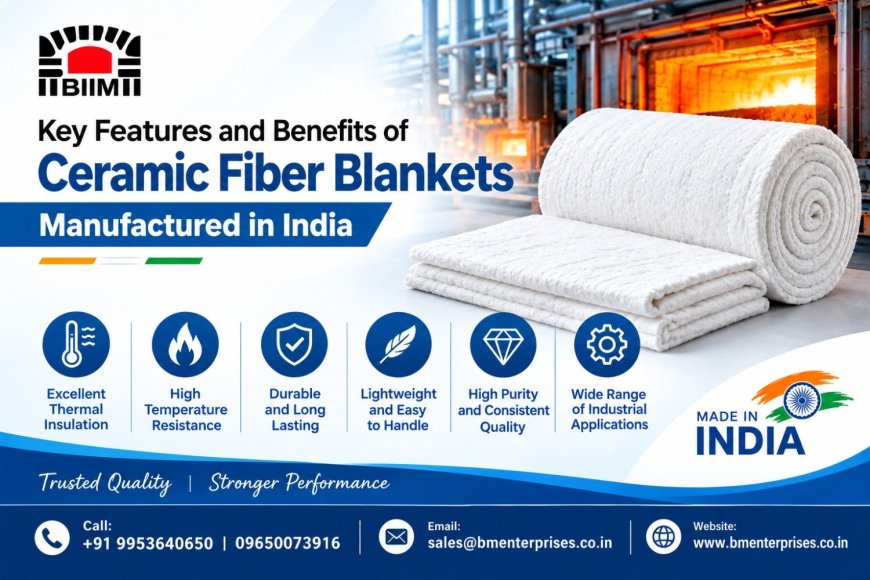
Modern-day industrial furnaces need proper insulation material in order to keep the temperatures at high levels while lowering energy requirements. Choosing the right type of refractory insulation can greatly affect furnace efficiency, cost-effectiveness, and productivity. Ceramic fiber blankets are popularly used in industrial heating due to their great thermal insulating properties, lightness, and high temperature resistance.

BM Enterprises offers high-quality ceramic fiber insulation blankets that are specifically designed for use in industrial furnaces, boilers, kilns, heat treatment systems, and other high-temperature applications. The ceramic blankets assist industries in reducing heat loss and maintaining consistent temperatures.
What Are Ceramic Fiber Blankets?
Ceramic fiber insulation blankets are lightweight, flexible insulation materials made from high-temperature aluminosilicate ceramic fibers. Ceramic fibers are processed into a consistent blanket form with excellent heat transfer resistance.
As compared to traditional refractory bricks and conventional insulation material, ceramic blankets provide low thermal conductivity and low thermal mass; hence enabling the furnace to get heated and cooled more quickly without wasting energy.
The ceramic fiber insulation blankets are available according to their use in various temperature grades, densities and thicknesses such as 6mm, 12mm, 20mm, 25mm and 50mm.
Typical specifications of ceramic fiber blankets include a maximum operating temperature range between 1260°C and 1400°C, along with availability in various grades according to industrial demands. Some of the standard densities available are 64kg/m³ and 128 kg/m³.
Why Are Ceramic Fiber Blankets Ideal for Energy-Efficient Furnaces?
1. Superb Thermal Insulation Properties
The major advantage of using ceramic fiber blankets lies in their reduced heat flow property. This is due to the very low thermal conductivity of ceramic fiber blankets, which ensures that heat is retained in the furnace while minimizing heat loss from furnace walls, roofs, and doors.
This ensures improved efficiency of the furnace as well as reduced energy costs.
2. Lightweight Material Helps to Lower Structural Load
The refractory insulation materials traditionally used for furnace insulation may impose an additional burden on the structural frame of furnaces. Since ceramic fiber blankets are lightweight and flexible materials, their use is easy and convenient. Their lightness helps to lower the structural load on the furnace lining.
3. Quick Heating and Cooling Process
The thermal mass of a ceramic fiber insulation blanket is considerably lower than that of ordinary dense refractory lining materials. Therefore, furnaces equipped with such insulating blankets will be heated up and cooled down very fast in case it is needed.
This property becomes especially valuable for heat treatment furnaces, batch furnaces, ceramic kilns, and other similar industrial applications, where frequent heating/cooling operations are needed.
4. Decreased Energy and Fuel Consumption
Energy losses in furnaces occur mainly due to heat losses from the furnaces. To minimize heat losses, ceramic blankets ensure good thermal insulation of the furnace.
Depending on many factors, such as furnace design, insulation blanket thickness, operating parameters, and others, the use of appropriate ceramic blankets may decrease fuel and energy consumption.
5. Flexibility and Simple Installation
Ceramic fiber blankets are flexible and can be shaped, cut, and installed as per the various shapes of the furnaces. These are useful for insulation on irregularly shaped areas such as curves, furnace doors, expansion joints, furnace walls, roofs, and others.
This feature makes these ceramic fiber blankets a useful option for use on new and old furnaces.
6. High Heat Shock Resistance
Temperature changes are common in industrial furnaces during their start-ups and operation. Ceramic fiber blankets have good heat shock resistance.
This property enables effective insulation even under difficult operating conditions.
Technical Specifications of Ceramic Fiber Blankets
Selecting the correct ceramic blanket requires understanding its technical specifications. The following are commonly available specifications for industrial ceramic fiber blankets.
Parameter
Typical Specification
Material
Alumino-silicate ceramic fibre
Temperature grades
1260°C–1400°C
Density
64 kg/m³ and 128 kg/m³
Thickness
6, 12, 20, 25 and 50 mm
Standard width
610 mm
Standard roll length
7.30 metres (application-dependent)
Thermal conductivity
Grade and temperature-dependent
Application
Industrial furnace and boiler insulation
Form
Flexible blanket rolls
Note: Specifications vary by manufacturer, product grade, and application. Always check the manufacturer's technical datasheet before selecting an insulation material.
Industrial Applications of Ceramic Fiber Insulation Blankets
As a result of their superior insulating and flexibility properties, ceramic fiber blankets are applied in many different industrial applications.
- Furnaces in Industrial Applications: For use in insulating furnaces, including their walls, roof, doors, and either hot face or backup lining systems, based on the chosen grade.
- Boilers: For reducing losses of heat from boiler enclosures and corresponding high-temperature areas.
- Furnaces for Heat Treatment: For furnaces that require precise heating processes.
- Ceramic and Glass Industries: For use in kilns, heating chambers, and high-temperature furnaces.
- Steel and Metal Industries: For use in reheating furnaces, annealing furnaces, and other thermal processing applications.
- Petrochemical Industries: For use in appropriate high-temperature equipment, ducts, and process heating.
- Thermal Power Plants: For insulating appropriate high-temperature equipment and pipes.
Ceramic Fiber Blankets vs Traditional Refractory Insulation
The insulating requirements of ceramic fiber blankets and refractory bricks differ. Ceramic blankets are lightweight and flexible materials, making them ideal for installations where there is a need for quick heating with lower heat capacity.
On the other hand, refractory bricks act as a rigid and strong lining material, thus becoming an appropriate lining material in situations where there is a high level of abrasion and impact or mechanical stress.
In several industrial furnaces, the combination of ceramic blankets with appropriate refractory brick or castables forms an efficient insulating system.
How to Choose the Right Ceramic Fiber Blanket?
Before buying ceramic fiber blankets, take into account the following aspects:
Operational Temperature: Choose a temperature range that is optimal for your particular furnace operational conditions, taking into account temperature variations and possible hot spots.
Density: There are various densities such as 64 kg/m³ and 128 kg/m³. Your selection will depend on insulation requirements, heat transfer, and installation conditions.
Thickness: Choose an optimal thickness based on the required thermal resistance and installation space.
Application Conditions: The walls of a furnace, boiler insulation, doors, and joints can have different insulation requirements.
Quality of Product: Take into account the quality of the fibre, density, thermal conductivity, shrinkage properties, and manufacturer test reports before purchasing.
Proper installation is also crucial. Wrong jointing, gaps, compression, or anchoring can deteriorate the insulation effect.
Why Choose BM Enterprises for Ceramic Fiber Blankets?
BM Enterprises – House of Refractories, which was founded in 1988, provides refractory and insulating products for different types of industrial applications. We are aware of how crucial it is to provide reliable thermal insulation in order to increase furnace efficiency and ensure industrial production operations on a consistent basis.
BM Enterprises provides a wide selection of high-quality ceramic fiber insulation blankets of different grades, such as 1260°C and 1400°C, and densities, including 64 kg/m³ and 128 kg/m³, depending on availability.
Our company is a reliable supplier of ceramic blankets in Delhi, serving our clients throughout Delhi NCR, Faridabad, Gurugram, Ghaziabad, Noida, and many other industrial cities.
Also, we have a variety of other products available, including refractory fire bricks, high alumina bricks, refractory castables, mortars, calcium silicate boards, ceramic fiber boards, etc.
If you need to install ceramic blankets for a new furnace or replace old insulation, we will be able to recommend the most suitable product for you.
Conclusion
The ceramic fiber blanket is an excellent choice for insulation in modern-day industrial furnaces due to its low thermal conductivity, low weight, flexible nature, and ability to withstand high temperatures.
It is important to make proper selection with regard to the grade, density, and thickness required for effective insulation performance.
In case you are looking for ceramic fiber blankets or a good ceramic blankets supplier in Delhi, then you should approach BM Enterprises for more information about the products.
BM Enterprises – Your Refractories & Insulation Material Specialist.
BM Enterprises – House of Refractories
Phone: +91 9953640650 | 09650073916
Email: [email protected]
Website: www.bmenterprises.co.in
Address: Faridabad, Haryana – 121015, India
What's Your Reaction?
 Like
0
 Dislike
0
 Love
0
 Funny
0
 Angry
0
 Sad
0
 Wow
0




