
























Beverage Sector Drives Over 50% Share in the Global Aseptic Packaging Market
The Aseptic Packaging Market size was valued at USD 72.06 Billion in 2025 and the total Aseptic Packaging revenue is expected to grow at a CAGR of 9.71% from 2026 to 2034, reaching nearly USD 165.92 Billion.

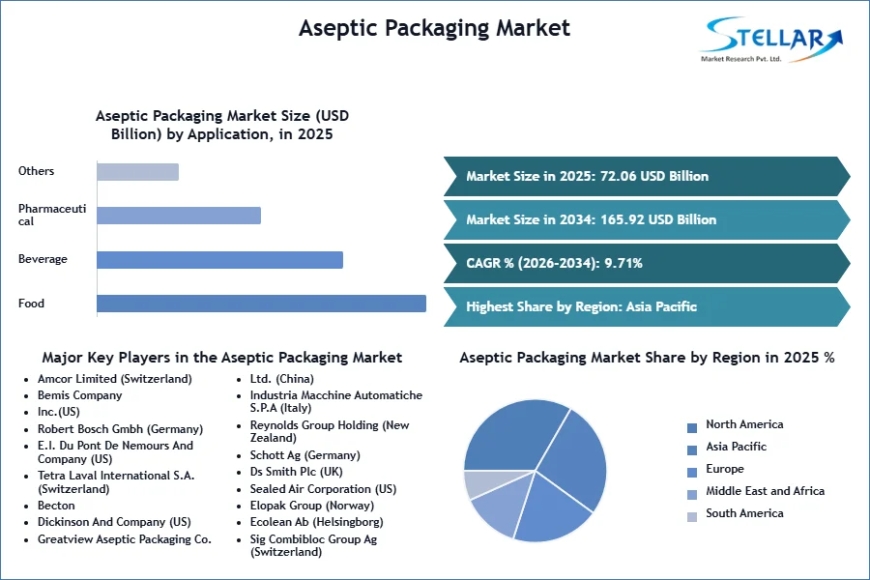
The global Aseptic Packaging Market is experiencing a profound structural evolution, propelled by the rising demand for ambient, preservative-free shelf-stable foods and sensitive biopharmaceuticals. According to a comprehensive market intelligence report released by Stellar Market Research, the market was valued at USD 72.06 Billion in 2025 and is projected to scale new heights through the forecast period, backed by a strong compound annual growth rate (CAGR). This strategic study highlights how aseptic packaging has transitioned from a basic preservation technique into a critical supply chain pillar for mitigating cold-chain vulnerabilities and cutting carbon footprints across global industries.
Key Findings from the Report
-
Market Valuation: The global aseptic packaging market reached a valuation of USD 72.06 Billion in 2025, showcasing sustained year-on-year expansion.
-
Dominant Product Segment: Paper and paperboard cartons continue to command the largest market share, anchored by deep-rooted applications in UHT milk, juices, and liquid dairy alternatives.
-
Fastest-Growing Segment: Bags, pouches, and composite laminates are projected to register the fastest growth rates, driven by material-saving initiatives and optimal space utilization in transit.
-
Leading Application: The beverage sector remains the primary revenue generator, accounting for over 58% of total consumption, spearheaded by functional drinks, plant-based milks, and ready-to-drink (RTD) teas/coffees.
-
Emerging Application Vector: Pharmaceutical and clinical nutrition packaging is scaling rapidly at a double-digit CAGR, fueled by rising global demand for pre-filled syringes, IV solutions, and sterile vials.
-
Geographic Dominance: Asia-Pacific leads the global hierarchy, supported by massive dairy processing expansions in India, ready-to-drink beverage booms in China, and expanding modern retail channels.
-
Investment Relevance: Capital expenditures are increasingly steered toward automation, IoT-enabled sterilization monitoring, and localized manufacturing footprints to counter cross-border tariff and freight volatility.
For further information, click the following link:https://www.stellarmr.com/report/req_sample/Aseptic-Packaging-Market/364
Market Drivers and Restraints
-
Driver 1: Rising Demand for Shelf-Stable, Preservative-Free Products
Consumers increasingly favor minimally processed foods that retain nutritional value without chemical additives. Aseptic technology utilizes ultra-high-temperature (UHT) processing coupled with sterile containers to ensure safe, long-term ambient storage.
-
Driver 2: Expansion of Biopharmaceuticals and Sterile Injectables
The proliferation of temperature-sensitive biologics, vaccines, and monoclonal antibodies demands airtight, contamination-free containment solutions, driving heavy institutional adoption in the healthcare sector.
-
Driver 3: Breakdown of Traditional Cold-Chain Economics
In emerging economies and remote geographies, fluctuating power grids and soaring diesel expenses render refrigerated transport economically unviable, making ambient aseptic delivery a cost-saving necessity.
-
Restraint 1: High Initial Capital and Setup Costs
Deploying fully automated aseptic filling lines and sterilization systems demands multi-million-dollar capital investments, restricting small and medium-sized enterprises (SMEs) in developing regions.
-
Restraint 2: Complex Recycling of Multi-Layer Laminates
Traditional aseptic packages consist of tightly bonded layers of paper, plastic, and aluminum, presenting mechanical separation hurdles that challenge municipal recycling streams.
Technology, Regulation, and Sustainability Trends
Environmental compliance is reshaping material design. Regulatory frameworks such as the European Union’s Packaging and Packaging Waste Regulation (PPWR) are forcing converters to innovate mono-material structures and plant-based barrier coatings.
On the technological front, artificial intelligence (AI) and machine learning are being integrated into form-fill-seal (FFS) machinery to monitor sterilization parameters in real time, drastically reducing batch contamination risks. Sustainability is no longer optional; circular initiatives—such as chemical recycling partnerships and hydropulping technologies designed to recover high-grade paper fibers and aluminum fractions—are rapidly becoming competitive prerequisites.
Regional Insights
-
Asia-Pacific (Leading Region): Holding the highest market share, APAC’s momentum is propelled by rising disposable incomes, urban migration, and surging consumption of packaged dairy and functional drinks across India, China, and Southeast Asia.
-
Africa & Latin America (Emerging Regions): Africa is emerging as a high-growth frontier due to infrastructural shifts away from cold-chain dependency. Meanwhile, Latin America exhibits steady demand for ambient dairy items, balancing currency fluctuations against resilient everyday consumer needs.
-
North America & Europe: Driven heavily by advanced medical packaging demands in the U.S. and strict eco-regulations in Europe, these mature regions focus intensely on lightweighting, PCR (post-consumer recycled) plastic content, and smart-packaging integrations.
Recent Industry Developments
-
Tetra Pak (2025): Launched a certified commercial line of fiber-based barrier cartons, cutting polymer layers by 50% and improving overall carton recyclability across European test markets.
-
Amcor plc (2025): Expanded its aseptic blow-molding footprint in North America through a multi-million-dollar facility upgrade, boosting output for dairy-free and liquid nutrition bottles by 25%.
-
SIG Combibloc (2024): Introduced an AI-driven aseptic filling machine capable of performing rapid format changes in under 15 minutes, cutting operational downtime by 30% for beverage manufacturers.
-
UFlex Limited (2024): Commissioned a new high-capacity aseptic liquid packaging material plant in India, aiming to capture surging local demand for affordable ambient dairy packaging.
-
Sealed Air (2025): Partnered with a major European dairy cooperative to deploy sustainable, recyclable bag-in-box aseptic solutions, eliminating over 1,200 metric tons of virgin plastic annually.
Competitive Landscape
The global aseptic packaging market features a medium-to-high level of concentration, dominated by multinational giants like Tetra Pak, SIG Combibloc, Amcor plc, UFlex Limited, Mondi Group, and Sealed Air.
Leading players are utilizing inorganic growth strategies—including cross-border joint ventures, long-term supply agreements with global beverage brands, and aggressive R&D spending on mono-material substitution. Differentiation increasingly hinges on offering end-to-end turnkey solutions, ranging from filling line maintenance to smart-tracking digital labels.
Analyst Commentary
"The aseptic packaging industry has crossed a critical threshold where mechanical reliability must seamlessly intersect with circular economy mandates," said a Senior Research Analyst at Stellar Market Research. "As brand owners face stricter environmental penalties and rising expectations for preservative-free shelf life, market leaders will no longer compete solely on barrier performance. Long-term market dominance will belong to those who successfully commercialize fully circular, digital-ready aseptic structures that lower total cost of ownership for both food processors and pharmaceutical giants."
Future Outlook
Through the forecast period, the aseptic packaging market is poised for steady, high-value expansion. Demand will increasingly pivot toward high-purity pharmaceutical applications and nutrient-dense liquid foods.
Technological integration—such as IoT-enabled seal tracking, predictive maintenance, and biodegradable barrier coatings—will redefine operational standards. While high initial equipment costs remain a hurdle, rising regulatory pressures and the fundamental necessity of reducing food and drug wastage will secure aseptic packaging's position as an indispensable technology of the future.
For further information, click the following link:https://www.stellarmr.com/report/req_sample/Aseptic-Packaging-Market/364
About Stellar Market Research
Stellar Market Research is a multifaceted market research and consulting company with professionals from several industries. Some of the industries we cover include medical devices, pharmaceutical manufacturers, science and engineering, electronic components, industrial equipment, technology and communication, cars and automobiles, chemical products and substances, general merchandise, beverages, personal care, and automated systems. To mention a few, we provide market-verified industry estimations, technical trend analysis, crucial market research, strategic advice, competition analysis, production and demand analysis, and client impact studies.
Address
Phase 3, Navale IT Zone, S.No. 51/2A/2, Office No. 202, 2nd floor, Near, Navale Brg, Narhe, Pune, Maharashtra 411041
Email
[email protected]
Mobile
+91 9607365656
What's Your Reaction?
 Like
0
 Dislike
0
 Love
0
 Funny
0
 Angry
0
 Sad
0
 Wow
0




