













The Role of a Bile Acid Library in LC-MS-Based Metabolomics
Discover how bile acid reference standards support LC-MS analysis, bile acid profiling, and gut microbiome research.

The gut microbiome plays an important role in human health by influencing digestion, metabolism, immune function, and communication between the gut and other organs. One important way gut microorganisms affect the body is through their interaction with bile acids. These molecules help digest and absorb dietary fats while also acting as signaling molecules that influence several biological processes.
Researchers studying the gut microbiome increasingly investigate bile acid composition to understand how microbial activity affects host metabolism and disease-related processes. Accurate analysis requires reliable analytical methods and suitable reference compounds. This is where bile acid reference standards become valuable, supporting compound identification, analytical method development, and the evaluation of experimental results.
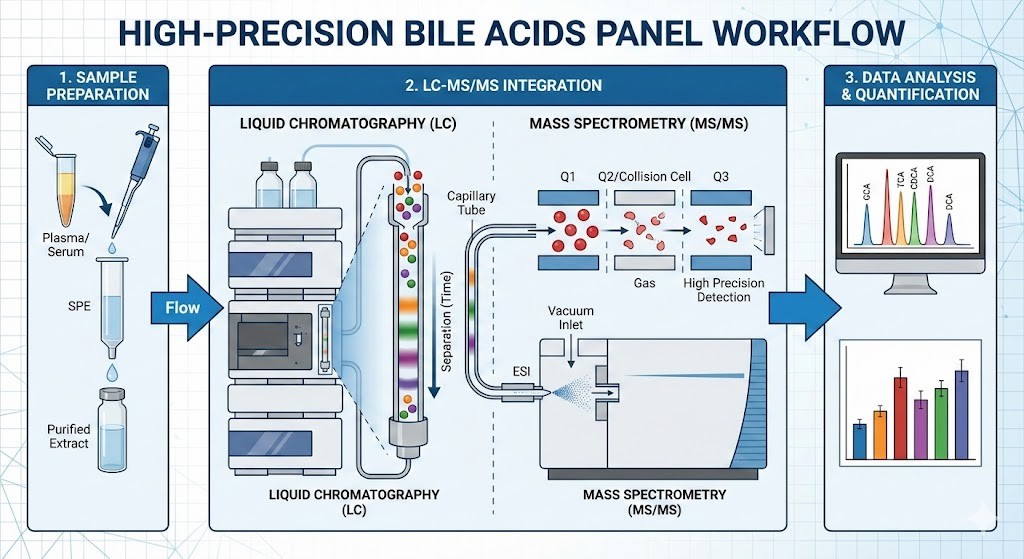
Mass spectrometry-based techniques, particularly liquid chromatography–mass spectrometry (LC-MS), allow researchers to study complex bile acid profiles in biological samples. When combined with appropriate standards and carefully designed experiments, these techniques provide valuable insights into the relationship between gut microorganisms, bile acid metabolism, and human health.
Understanding Bile Acids and the Gut Microbiome
Bile acids are compounds produced primarily in the liver from cholesterol. They are released into the digestive system, where they help emulsify dietary fats and support the absorption of fat-soluble nutrients. Most bile acids are reabsorbed in the intestine and returned to the liver through enterohepatic circulation.
The gut microbiome modifies many bile acids through microbial metabolic activities. Primary bile acids produced by the host can be transformed into secondary bile acids by certain intestinal microorganisms. These transformations influence the overall bile acid pool and can change the biological activities of individual bile acid molecules.
The composition of this pool depends on several factors, including diet, host physiology, medication use, intestinal microbial communities, and disease status. By analyzing different bile acids, researchers can investigate how these factors interact and influence metabolic processes.
However, bile acid analysis can be challenging because related compounds may have similar chemical structures and mass spectrometric characteristics. Reliable reference materials are therefore important for distinguishing target compounds and improving confidence in analytical findings.
Why Bile Acid Reference Standards Matter
Bile acid reference standards are characterized compounds used to support the identification and analysis of bile acids. They provide comparison points for evaluating experimental measurements and establishing reliable analytical workflows.
In gut microbiome research, these standards can help researchers determine which bile acids are present in a sample and assess differences in their measured abundance. Their usefulness is particularly important when investigating structurally related compounds that may be difficult to distinguish using mass information alone.
Appropriate standards can support several aspects of bile acid research, including chromatographic separation, retention time assessment, fragmentation-pattern comparison, quantitative analysis, and analytical quality control. The exact application depends on the characteristics of the standard and the analytical method.
Applications of Bile Acid Reference Standards in Gut Microbiome Research
1. Identifying Primary and Secondary Bile Acids
One important application is distinguishing primary bile acids from secondary bile acids and other related compounds. Primary bile acids are synthesized by the host, while secondary bile acids are formed through microbial transformations in the intestine.
Researchers can use LC-MS data to examine the mass, fragmentation patterns, and chromatographic behavior of detected compounds. Comparing these observations with suitable reference standards provides additional evidence for compound identification.
Accurate identification is essential when studying microbial metabolism because different bile acids can be associated with different biochemical pathways and biological effects. Reliable reference comparisons help researchers interpret bile acid profiles more confidently, although final identification should consider all available analytical evidence.
2. Investigating Host–Microbiome Interactions
The gut microbiome and its host influence each other through multiple biochemical pathways. Bile acids are one important part of this relationship because microorganisms can transform host-produced compounds, while bile acids can also influence the intestinal microbial environment.
Researchers can analyze bile acid profiles in samples such as stool, intestinal contents, plasma, or other suitable biological materials. Comparing these profiles across experimental groups may reveal changes associated with microbial composition, diet, disease, or treatment.
Bile acid reference standards support these studies by helping researchers identify relevant compounds and evaluate the quality of their measurements. When combined with microbiome sequencing, metabolomics, and appropriate statistical analysis, bile acid profiling can contribute to a more comprehensive understanding of host–microbiome interactions.
3. Studying Metabolic and Gastrointestinal Disorders
Altered bile acid metabolism has been investigated in several metabolic and gastrointestinal conditions. Researchers may examine whether bile acid profiles differ between healthy controls and experimental or clinical groups.
For example, studies may explore relationships between bile acid composition, intestinal function, liver-related processes, and metabolic regulation. These investigations can help generate hypotheses about biological mechanisms and identify candidate biomarkers for further research.
Reference standards are useful because reliable measurements are necessary to compare bile acid profiles across samples. They can help researchers evaluate whether detected differences reflect biological variation rather than analytical inconsistencies.
However, an association between a bile acid and a disease does not establish that the compound causes the condition. Additional experimental and clinical evidence is needed to determine the significance of observed changes.
4. Improving LC-MS Method Development
LC-MS is widely used for bile acid analysis because it combines chromatographic separation with mass-based detection. However, structurally similar bile acids may produce overlapping signals or similar fragmentation patterns.
During method development, researchers must optimize chromatographic conditions, instrument settings, sample preparation, and data-processing procedures. Suitable reference standards can help evaluate retention times, peak shapes, signal responses, and fragmentation behavior.
These comparisons may reveal whether a method can distinguish the compounds of interest under the selected conditions. Researchers can then refine the method to improve separation and analytical performance.
A well-developed method is particularly important when analyzing complex biological samples containing many metabolites. It helps establish a consistent foundation for comparing bile acid profiles across experiments.
5. Supporting Quantitative Bile Acid Profiling
Qualitative analysis helps researchers determine which bile acids may be present, while quantitative analysis estimates their concentrations or relative abundance. Both approaches can contribute to gut microbiome research.
Reference standards with suitable characterization can support calibration and help researchers evaluate analytical response. Stable isotope-labeled internal standards may also be used in appropriate quantitative workflows to account for some variation during sample preparation and measurement.
Reliable quantification makes it easier to compare bile acid concentrations between experimental groups, treatment conditions, or time points. The choice of calibration approach should match the analytical objective, and researchers should validate method performance in the intended sample matrix.
6. Improving Reproducibility and Data Quality
Reproducibility is essential for metabolomics and microbiome studies. If analytical measurements vary substantially between runs, researchers may struggle to distinguish real biological changes from technical variation.
Reference standards can help laboratories monitor analytical performance and assess consistency. When incorporated into suitable quality-control procedures, they can support the evaluation of retention time stability, signal response, and compound identification.
Researchers should also standardize sample collection, storage, preparation, instrument conditions, and data analysis. Combining these practices with appropriate standards helps produce more dependable results and supports comparisons across studies.
Best Practices for Bile Acid Analysis
To obtain reliable results in gut microbiome research, laboratories should consider several important practices.
First, select reference standards that match the bile acids and analytical objectives of the study. A standard is most useful when its identity, purity, and intended application are appropriate for the method.
Second, optimize sample preparation and chromatographic separation. Biological samples can contain complex mixtures, so consistent handling and suitable separation conditions are important for minimizing analytical problems.
Third, use appropriate quality controls and validate the analytical method. Researchers should evaluate relevant performance characteristics, including precision, accuracy, selectivity, and sensitivity, according to the purpose of the analysis.
Finally, interpret results alongside other biological information. Bile acid profiles can provide important clues about microbial metabolism, but combining them with microbiome data, experimental controls, and relevant clinical or physiological information can lead to stronger conclusions.
How IROA Technologies Supports Bile Acid Research
Researchers studying bile acid metabolism need suitable reference materials to support analytical workflows and improve confidence in their measurements. Metabolite libraries can provide organized collections of compounds for applications in mass spectrometry-based research.
IROA Technologies offers a bile acid metabolite library designed to support analytical investigations involving bile acids and related compounds. The library can be relevant to researchers working on metabolomics, compound identification, and bile acid profiling, depending on their experimental requirements.
Researchers can explore the available bile acid reference standards to learn more about IROA's reference materials and their potential applications in analytical research.
For additional information about metabolite libraries and mass spectrometry resources, visit iroatech.
Conclusion
Bile acid analysis offers valuable opportunities to investigate the relationship between gut microorganisms, host metabolism, and biological health. By examining changes in primary and secondary bile acids, researchers can explore microbial transformations, investigate metabolic pathways, and identify potential biomarkers for further study.
Bile acid reference standards support this work by providing comparison points for compound identification, analytical method development, quantitative measurements, and quality control. When used with validated LC-MS methods and consistent experimental procedures, they can improve the reliability and reproducibility of bile acid profiling.
Although reference standards strengthen analytical evidence, meaningful biological interpretation also requires appropriate controls, careful data analysis, and independent confirmation. Together, these approaches help researchers build a more reliable understanding of bile acid metabolism and its role in gut microbiome research.
What's Your Reaction?
 Like
0
 Dislike
0
 Love
0
 Funny
0
 Angry
0
 Sad
0
 Wow
0




