

























Commercial Landscaping Melbourne: Planning Outdoor Spaces That Work
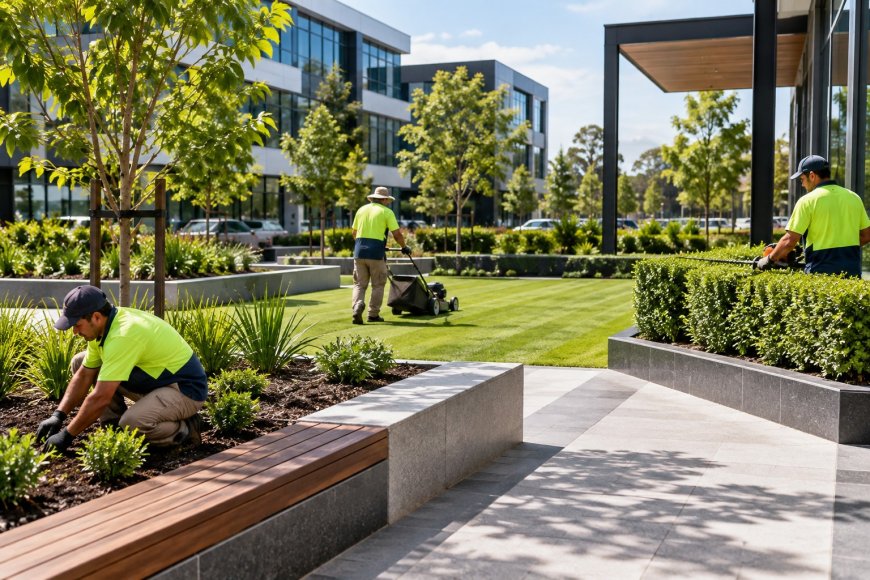
Commercial landscaping is very different from landscaping a private backyard. A business property has people arriving, parking, walking, working and using the outdoor areas every day. Schools and childcare centres have additional safety and supervision requirements, while retail sites need to stay presentable without landscaping work getting in the way of trading.
For businesses across Melbourne, good commercial landscaping starts with understanding how the site is actually used. At Garden More, our approach covers landscape construction, planting, turf, irrigation, garden lighting, synthetic lawn, vertical gardens and specialist rubber surfacing for suitable outdoor areas.
What Should Commercial Landscaping Actually Achieve?
A commercial landscape needs to do more than look tidy from the street. It should support the way people move through the property and remain practical to maintain after construction is finished.
Before selecting plants or paving, consider:
- Where customers, staff and visitors enter the site
- How deliveries and service vehicles move through the property
- Areas that receive heavy foot traffic
- Existing drainage problems or water pooling
- Sun, shade and wind exposure
- Irrigation requirements
- Maintenance access
- Areas requiring additional safety consideration
This site-first approach is particularly important in Melbourne's established eastern suburbs. A commercial property in Kew, Camberwell or Hawthorn may have mature trees, restricted access and established surrounding properties, while a newer site may have different soil, drainage and access conditions.
The landscape needs to be designed around those conditions rather than forcing the same specification onto every project.
Commercial Landscaping Melbourne Projects Need Better Site Planning
One of the most common mistakes with commercial landscaping is treating the planting plan as the main project. In reality, much of the long-term performance is determined underneath and around the planting.
A sensible construction sequence is generally:
- Confirm levels, access, drainage and existing site conditions.
- Prepare the ground and resolve drainage requirements.
- Install required edging, retaining structures and hardscape elements.
- Prepare planting areas and soil.
- Install irrigation infrastructure.
- Complete planting and turf or synthetic grass installation.
- Add lighting, finishing elements and final presentation work.
- Establish a practical maintenance routine.
This sequencing matters on occupied commercial sites. If drainage is installed after paving, or irrigation is planned after planting, the project can require unnecessary rework.
Our existing commercial landscaping guidance also emphasises resolving drainage, sub-grades, irrigation and other infrastructure before the finishing layers are installed.
Choosing Materials for Melbourne's Commercial Sites
Material selection should follow expected use rather than appearance alone.
A retail frontage with constant pedestrian traffic needs a different approach from a quiet office courtyard. A school or childcare site also needs materials selected around how children use the space, supervision requirements and the relevant project specifications.
For hardscape areas, commercial-grade paving, appropriate edging and properly prepared sub-bases can help create surfaces capable of handling regular use. For garden beds, planting should be selected according to available sunlight, exposure, soil conditions and the maintenance resources available to the property.
Synthetic grass can also be useful where a consistently green surface is required in a high-use or difficult-to-maintain area. However, the installation is only as good as the preparation underneath it. Excavation, a compacted free-draining base, appropriate falls, edging, seams and drainage all need to be considered before the turf is laid.
Irrigation Should Be Planned, Not Added Later
Commercial landscapes can contain substantial planting areas, turf and garden beds, so irrigation needs to be considered during design and construction.
A practical system can be divided into zones according to plant type, exposure and water requirements. Drip irrigation may suit garden beds, while other areas may require different delivery methods.
Victoria's current permanent water-saving rules also place requirements on watering systems, including permitted watering times for residential and commercial gardens. That makes sensible irrigation design and programming an important part of commercial landscape planning.
For a facilities manager, this is more useful than simply being told a landscape is “water efficient”. The irrigation system should be accessible, documented and straightforward to inspect when something stops working.
When Rubber Surfacing Makes Sense
Commercial landscaping can also include specialist outdoor surfacing. This is particularly relevant to childcare centres, schools, playgrounds, fitness areas and other spaces where impact absorption and surface performance are important considerations.
Wet pour rubber surfacing is made by combining rubber granules with a polyurethane binder and forming the mixture into a continuous surface. Garden More's existing material describes a coarse rubber base layer followed by a fine EPDM rubber and resin top layer, with site preparation and drainage forming important parts of the installation process.
Consider a childcare centre in Kew where an outdoor play area needs to be renewed. The important question is not simply which colour rubber looks best. The project needs to consider the equipment, available fall height, existing substrate, drainage, access and the applicable playground surfacing requirements before the final material and build-up are confirmed.
Where a project requires Australian Standards to be referenced, the exact standard and installation specification should be confirmed for the particular equipment, surface and project rather than making a blanket compliance claim.
Synthetic Turf for High-Use Commercial Areas
Natural turf can be attractive, but it also requires mowing, irrigation and seasonal care. On a commercial property where presentation needs to remain consistent, synthetic turf can be worth considering.
The base preparation is critical. A typical installation involves removing unsuitable organic material, building and compacting a free-draining crushed-rock base, establishing falls, preparing a bedding layer, installing and joining the turf, securing the perimeter and applying the appropriate infill.
For a Melbourne commercial site, the surrounding design also matters. Turf can be combined with paving, planting or seating rather than covering every available square metre. This can reduce visual monotony and create more practical zones for visitors and staff.
Maintenance Is Part of the Landscape, Not an Afterthought
A commercial landscape can look excellent when it is handed over and deteriorate quickly without a realistic maintenance plan.
Maintenance should be based on the site rather than a generic schedule. Depending on the property, this can include:
- Lawn or synthetic turf care
- Irrigation inspections
- Weed control
- Pruning
- Mulching
- Plant replacement
- Garden-bed maintenance
- Drainage inspections
- Seasonal clean-up
- Lighting checks
For larger commercial sites, it can also help to define measurable expectations such as response times, plant replacement requirements and scheduled inspection frequencies.
Garden More's commercial landscaping material recommends regular maintenance rhythms covering irrigation checks, weed control, pruning, plant health, mulch and lighting inspections.
Commercial Landscaping for Schools, Childcare and Public Areas
Education and childcare properties require particularly careful planning because the landscape is being used by children, staff, families and visitors.
The design should consider visibility, circulation, access, planting, shade, surface selection and maintenance. Playground areas may also require specialist surfacing and project-specific safety assessment.
Garden More works across commercial landscaping applications including childcare, schools, parks, public spaces and other commercial environments. The company's existing project information also references childcare work in Melbourne, including sites in Ringwood and Kew.
The key is to treat the landscape as an operating environment rather than simply an attractive garden.
What Should You Ask a Commercial Landscaper?
Before accepting a quote, ask for more than a total project figure.
A useful commercial landscaping quote should make it clear:
- What site preparation is included
- Which materials and grades are proposed
- How drainage will be handled
- What irrigation equipment is included
- Who coordinates other contractors
- How access and staging will be managed
- What maintenance is included after completion
- What exclusions or provisional items apply
Comparing itemised scopes makes it much easier to understand why two apparently similar quotes may have different prices.
It also helps avoid a common commercial landscaping problem: choosing a low initial price only to discover that important preparation, drainage or maintenance work was excluded.
Commercial Landscaping Melbourne: Build for the Site You Actually Have
The strongest commercial landscapes are not necessarily the most elaborate. They are the ones that work properly for the people using them and for the team responsible for maintaining them.
Whether the project involves a commercial entry, school grounds, childcare play area, retail frontage, office garden or larger public space, the same principle applies: understand the site first, specify materials carefully, build the underlying infrastructure properly and plan maintenance before handover.
At Garden More, we provide commercial landscaping, landscape construction, turf and synthetic lawn, irrigation, planting, vertical gardens and specialist rubber surfacing across Melbourne.
Get a Quote from Garden More on 0415 090 719 or contact our team to discuss your commercial landscaping requirements.
What's Your Reaction?
 Like
0
 Dislike
0
 Love
0
 Funny
0
 Angry
0
 Sad
0
 Wow
0






