






















Complete Dentures vs Partial Dentures: What to Expect at Every Step
Wondering which dentures suit you? Explore the key differences, step-by-step process, and timelines for complete and partial dentures—so you know exactly what to expect.

Losing teeth—whether one, several, or all of them—can feel overwhelming. But the good news is that modern dentistry offers reliable, comfortable solutions to restore your smile and your confidence. Dentures remain one of the most widely used tooth replacement options, and for good reason: they are non-invasive, cost-effective, and have improved enormously in fit and aesthetics over the years. Still, many people arrive at their first consultation unsure of the
difference between complete and partial dentures, or what the entire process actually involves. This article walks you through both options from a practical standpoint—the steps, the timeline, and how to prepare yourself at each stage.
Understanding the Core Difference
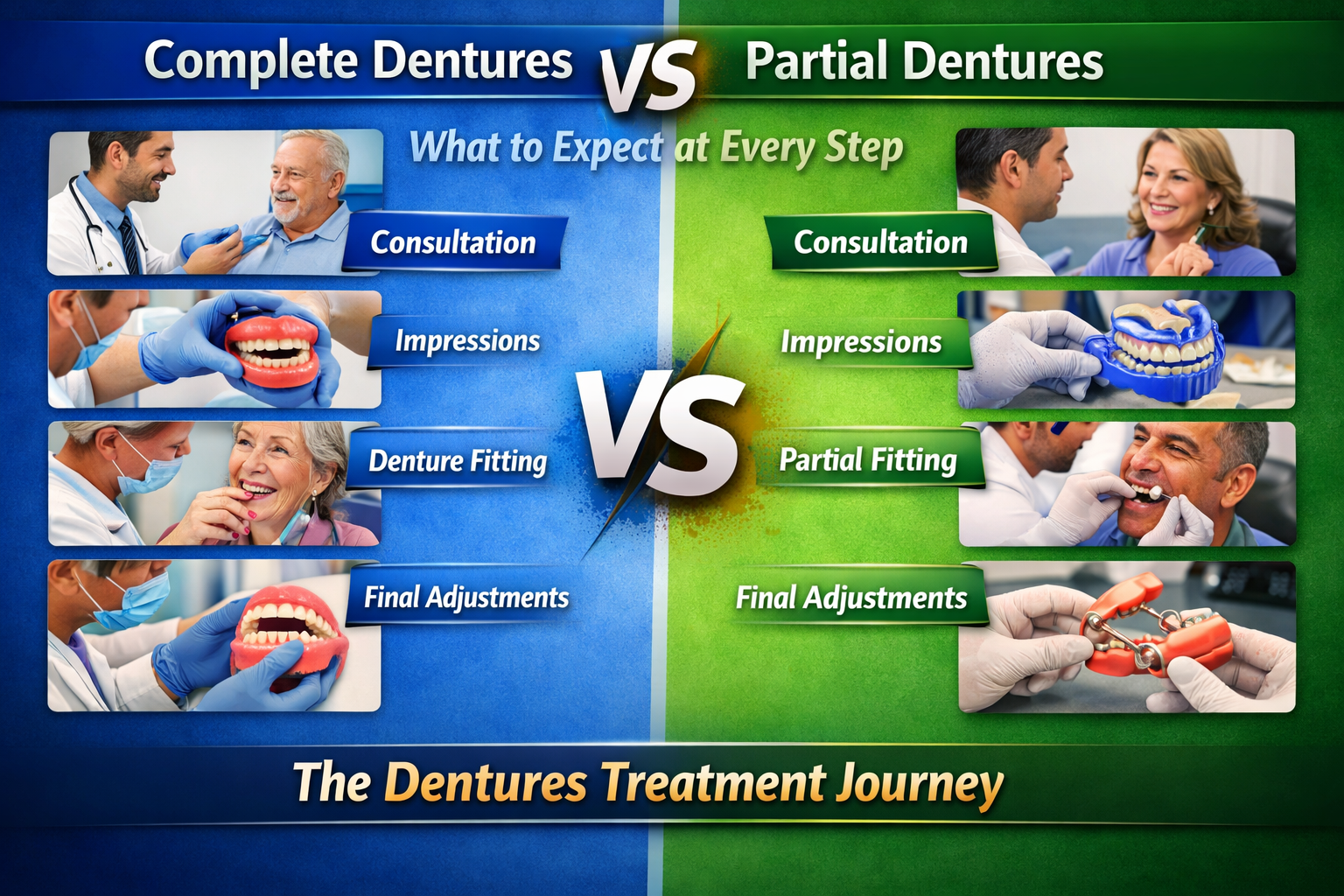
The simplest way to distinguish the two is this: complete dentures replace all the teeth in an arch (upper, lower, or both), while partial dentures replace only some missing teeth when healthy natural teeth still remain.
Complete dentures rest directly on the gum tissue and the underlying bone ridge. They rely on suction, the natural shape of your mouth, and sometimes denture adhesive to stay in place. Partial dentures, on the other hand, are anchored by metal clasps or precision attachments that grip your existing teeth, giving them far more stability by design.
Neither option is universally "better"—the right choice depends entirely on how many teeth you have lost, the health of your remaining teeth, your bone structure, and your budget. A qualified dentist will assess all of these factors before recommending a path forward.
The Step-by-Step Process for Complete Dentures
If you need complete dentures, the journey typically involves more preparatory work, especially if teeth still need to be extracted. Here is what the process generally looks like.
Initial Examination and Treatment Planning
Your dentist begins with a thorough oral examination, including X-rays, to assess your bone density and gum health. If any remaining teeth need removal, a timeline for extraction and healing is mapped out. This first visit sets the foundation for everything that follows.
Extractions and Healing Period
Once teeth are extracted, you typically wait eight to twelve weeks for the gum tissue and bone to stabilise. Attempting to fit permanent dentures before this healing is complete almost always leads to poor fit later, because the ridges continue to change shape as they recover.
Impressions and Bite Registration
After adequate healing, your dentist takes precise impressions of your gum ridges. Bite registration records how your jaws relate to each other—this data is essential for creating dentures that allow you to chew comfortably and speak naturally.
Try-In Appointments and Final Fitting
A wax trial denture is made first so you can preview the look and feel before anything is finalised. Adjustments are made to tooth position, shape, and bite. Once you and your dentist are satisfied, the final acrylic dentures are fabricated and fitted. Minor adjustments after this stage are perfectly normal and expected.
The entire process for complete dentures—from extraction to final fitting—can take anywhere from three to six months, sometimes longer depending on how quickly you heal and how many try-in sessions are needed.
The Step-by-Step Process for Partial Dentures
Partial dentures move through a somewhat similar sequence but involve an additional layer of planning because your natural teeth play an active role in the design.
Assessment of Remaining Teeth
Your dentist carefully evaluates the teeth that will serve as abutments—the anchor points for the clasps. If any of those teeth have decay or structural concerns, those issues are addressed first. This stage can add a few extra weeks to the overall timeline but is non-negotiable for a stable outcome.
Impressions and Framework Design
Detailed impressions are taken of both arches. For a cast-metal partial denture—generally the most durable and precise option—a metal framework is custom-designed in a dental laboratory. This framework is tried in your mouth before the artificial teeth and acrylic base are added to it.
Fitting and Adjustment
Once the partial denture is complete, it is fitted and any pressure points are relieved. The clasps may need minor tightening or loosening to achieve the right balance between retention and comfort. Most patients need one or two follow-up visits before things feel truly natural.
The partial denture process usually takes four to eight weeks from impressions to final delivery, making it a faster journey than complete dentures in most cases.
Immediate Dentures: A Note on the "Same-Day" Option
Some patients opt for immediate dentures—prosthetics placed on the very day of extraction so they never have to go without teeth. While this sounds ideal, it is worth understanding the trade-off. Because these dentures are made before your gums have fully healed, they will almost certainly need significant relining or replacement several months later. They are best thought of as a transitional solution rather than a permanent one. Discuss the cost implications of this route with your dentist upfront.
Practical Tips to Prepare for Denture Treatment
Knowing what is coming makes the experience considerably less stressful. A few practical steps can help you move through the process more smoothly.
Prepare Your Diet
After extractions, you will be on soft foods for several weeks. Stock your kitchen in advance with soups, yoghurt, mashed vegetables, and eggs. Once your dentures are in place, reintroducing solid foods should be gradual—start with small, soft pieces and work your way up over a few weeks.
Set Realistic Expectations for the Adjustment Period
New dentures almost always feel bulky and strange at first. Increased saliva flow, minor speech changes, and occasional soreness at pressure points are entirely normal in the first two to four weeks. Most people adapt well within a month, especially if they wear their dentures consistently during waking hours.
Commit to Proper Care
Remove and clean your dentures nightly. Soak them in a denture-cleaning solution or plain water—never hot water, which can warp the acrylic. Give your gums a nightly brush and rest while the dentures are out. Good hygiene extends the life of your prosthetic and protects your gum tissue.
If you are exploring your options and looking for Affordable Dentures in Vijayawada, it is worth scheduling a consultation early—ideally before you have lost the tooth or immediately after—so the treatment timeline can be planned properly.
What Makes a Good Denture? The Role of Customisation
There is a considerable difference between a well-made, properly fitted denture and a generic, poorly adapted one. Custom Dentures are shaped and shaded to match your facial structure, skin tone, and natural bite—not just a standard mould pulled off a shelf. The shade and size of the artificial teeth, the contour of the gum-coloured base, and the precise occlusion all contribute to how natural the final result looks and how comfortably you can eat and speak. Investing in quality craftsmanship at this stage pays dividends for years.
Conclusion
Whether you need complete or partial dentures, the journey is manageable when you understand each step in advance. The process takes time—especially for complete dentures—but patience during the healing and adjustment phases consistently leads to better long-term results. Knowing what to eat, how to care for your prosthetic, and what sensations are normal removes much of the anxiety from the experience. If you are based in the Krishna district region and would like expert guidance tailored to your specific situation,
the team at Yashwanth's Lotus Dental Care – Trusted Dental Clinic in Vijayawada can walk you through your options and create a treatment plan that fits both your clinical needs and your schedule. A confident smile is absolutely within reach—and it starts with a single consultation.
Frequently Asked Questions
How long does it take to get used to new dentures?
Most people adjust to the feel and function of new dentures within three to four weeks of consistent wear. Speech and chewing typically normalise within this period, though some patients—especially those new to complete dentures—may take up to six weeks to feel fully comfortable.
Can I sleep with my dentures in?
Dentists generally recommend removing dentures at night. Giving your gum tissue several hours of rest each day reduces the risk of sore spots, bacterial buildup, and accelerated bone resorption beneath the denture base. Soaking them overnight also helps maintain their shape.
How often do dentures need to be replaced or relined?
Dentures typically last between five and ten years before they need replacing. However, as your jaw bone and gum tissue naturally change over time, the fit will loosen—often within two to four years. Relining (adding material to the inner surface) can restore a snug fit and extend the useful life of the denture.
Is there any difference in cost between complete and partial dentures?
Costs vary depending on the materials used, the number of teeth being replaced, and the complexity of the case. Partial dentures with a cast-metal framework are often comparable in cost to a single complete denture arch, while flexible or acrylic partials tend to be less expensive. Your dentist will provide a detailed estimate after the initial examination.
What should I do if my denture breaks or becomes loose?
Do not attempt to repair a broken denture at home with household adhesives—these can alter the fit and may be toxic. Contact your dentist promptly. A loose denture is also worth addressing quickly, as continued use can irritate and damage the underlying gum tissue. Many clinics offer same-day or next-day emergency denture repairs.
Source: site123.me
What's Your Reaction?
 Like
0
Like
0
 Dislike
0
Dislike
0
 Love
0
Love
0
 Funny
0
Funny
0
 Angry
0
Angry
0
 Sad
0
Sad
0
 Wow
0
Wow
0