















Controlling Very Small Flows: What to Look for in a Fractional Flow Control Valve
Mark 708 Series control valves handle micro flow with Cv 0.00001 to 4.0, sizes 1/4" to 3/4", pneumatic or electric actuation. Ideal for R&D and pilot plants.

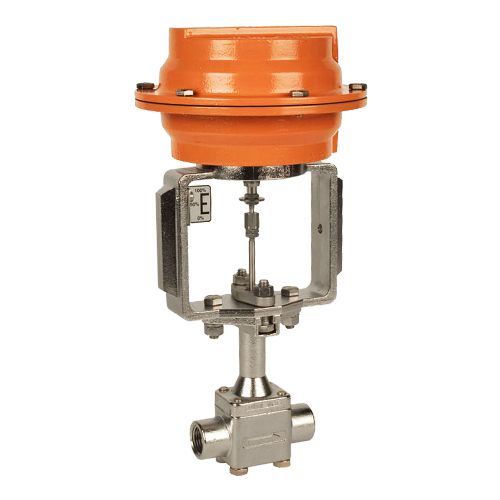
Anyone who has tried to control a few millilitres per minute with an ordinary globe valve knows the problem. The valve is sized for a much larger flow, so it spends its life barely cracked open. The process wanders, the controller hunts, and the numbers on your test report never quite settle. Micro flow work needs a valve designed for it from the start.
That is the space fractional flow control valves occupy. Here is how they work, what to check when choosing one, and where the Mark 708 Series fits.
Why small flows are hard to control
Valve capacity is expressed as Cv: the number of US gallons per minute of water at 60°F that will pass through a valve with a 1 psi pressure drop. A typical 1/2" control valve might have a Cv of several units. A fractional flow process may need a Cv of 0.01, 0.001 or even less.
If you put a large-Cv valve on that duty, the plug sits very close to the seat. A tiny change in stem position then produces a large change in flow, and the loop becomes unstable. A valve with a properly scaled trim lets the plug travel through a useful part of its stroke at the flow you need. Any friction in the stem or packing also matters more, because it causes sticking and hysteresis, which show up as poor repeatability.
Design features that matter at low Cv
When comparing valves for micro flow, I would look at the following.
Guided trim. A guided plug stays centered in the seat as it moves. At very small openings, even slight misalignment changes the flow area.
Low-friction actuation. The Mark 708 uses a rolling diaphragm, which gives smooth, consistent travel with little of the friction you get from sliding seals. That helps a positioner hold a setpoint.
Packing that stays sealed. Spring-loaded TFE chevron packing keeps load on the stem seal as the packing wears. That helps limit fugitive emissions and cuts down on re-tightening.
Seat leakage class. The Mark 708 is a globe-style valve offered with Class IV or Class VI shutoff. Class IV allows a small, defined leakage (0.01% of rated capacity), while Class VI is the soft-seat, bubble-tight standard. Which one you need depends on whether the valve must isolate the line or only regulate it.
Serviceability. Research rigs and pilot plants change often, and so does the trim. A threaded bonnet and quick-change trim (available from 0.05 Cv upward) make swaps faster. A secondary stem connection also means you do not have to readjust the stroke after changing trim.
The Mark 708 Series briefly
The Mark 708 from LowFlow Valve is a line of pneumatic and electrically actuated control valves built for fractional flow service. The main specifications are:
- Cv range: 0.00001 to 4.0 (Kv 0.000009 to 3.4)
- Sizes: 1/4" to 3/4" (DN8 to DN20)
- Seat type: Globe, Class IV or VI
- End connections: Threaded, socket weld, integral tube, welded flange
- Body materials: Carbon steel, stainless steel, Hastelloy C, Monel, Alloy 20 and others
- Pneumatic signal ranges: 3-15 or 6-30 psi, with split ranges available when a positioner is fitted
- Positioner options: Side-mounted or top-mounted
- Approvals: CRN and ATEX certified
The wide Cv span is the practical advantage. One valve family covers anything from a micro-dosing line to a modest process stream, so you are not changing platforms as a project scales up.
Material choice matters as much as capacity. Stainless steel suits most general service. Hastelloy C, Monel or Alloy 20 are the usual choices when the process fluid is corrosive enough to attack 316 stainless. Always check the actual fluid, concentration and temperature against a compatibility chart before specifying.
Where these valves are used
Typical applications for fractional flow control include:
- Pilot plant installations and test stands
- R&D and laboratory facilities
- Chemical injection and dosing
- Venting and small-bore process control
- Aerospace and test-equipment applications
- Chemical, refining, petrochemical, and oil and gas processes
In pilot plants especially, the flow rates are small, but the control requirements are not. Data collected at the pilot stage drives scale-up decisions, so a valve that holds its setpoint cleanly makes the results more trustworthy.
Practical tips for specifying a micro flow valve
- Size from real process data. Use the actual flow, inlet and outlet pressure, fluid and temperature rather than a rule of thumb. Oversizing is the most common mistake.
- Check the turndown. If you expect a wide range of flows, make sure the Cv you pick keeps the plug in a controllable part of its travel at both ends.
- Decide on a positioner early. For tight control, or if you need split-range operation, a positioner is worth the added cost.
- Match end connections to your tubing or piping. This avoids adapters, which add dead volume and leak points on small lines.
- Think about maintenance. If the trim will be changed often, quick-change features save real downtime.
Learn more
Full specifications, the data sheet, installation and maintenance documentation, and 3D STEP files for the Mark 708 are on the manufacturer’s product page: Mark 708 Series Fractional Flow & Research Control Valves. If you are unsure which configuration suits your application, you can send your process details to the team through the quote form for a recommendation.
What's Your Reaction?
 Like
0
 Dislike
0
 Love
0
 Funny
0
 Angry
0
 Sad
0
 Wow
0






