















Flow Control Without Compressed Air: A Look at the Mark 708MV Motor Control Valve
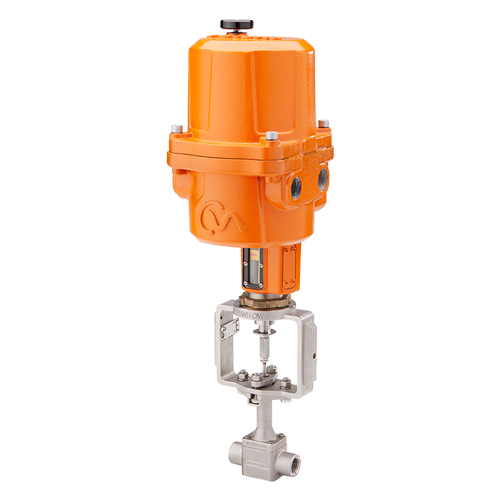
Looking for accurate low-flow control without an air supply? The Mark 708MV motor control valve offers Cv 0.00001-4.0, 4-20mA input and fail-safe operation.

Anyone who has tried to control a very small flow, such as a few milliliters per minute of additive going into a process line, knows that a standard control valve doesn’t work well at that scale. Most valves are sized for flows far larger than this. When they’re pushed down to the bottom of their range, the plug sits barely off the seat, and a tiny change in position causes a large swing in flow. The loop hunts, the operator gets frustrated, and the process drifts.
Fractional-flow valves are built to avoid this problem. One option in this category is the Mark 708MV, a motor-driven globe control valve from LowFlow Valve designed for very small flow coefficients and fine positioning.
What “low flow” means in valve terms
Valve capacity is expressed as the flow coefficient, Cv. It is the number of US gallons per minute of water at 60°F that will pass through the valve with a 1 psi pressure drop. Many industrial control valves have a Cv in the double or triple digits. The Mark 708MV covers a range of 0.00001 to 4.0 (Kv 0.000009 to 3.4), which suits applications where flow is measured in drops, cc/min, or small fractions of a gallon per minute.
Reaching these tiny Cv values takes carefully machined trim. Fine orifice geometry and guided trim help keep the plug aligned on the seat, which matters when the flow area is only a few thousandths of an inch.
Why a motor-driven actuator?
Many low-flow valves use pneumatic actuators, which work well but need a clean, regulated air supply and often a positioner. In a lab, a pilot plant, or a skid with no instrument air, that can be a nuisance. The Mark 708MV uses an electric motor drive instead, so it only needs a power supply and a control signal.
Some practical points about the design:
- 4-20mA input signal. This is the standard analog control signal, so the valve can connect directly to most PLCs, DCS systems and loop controllers.
- Switch-selectable power supply. The same valve can be set up for different supply options, which helps OEMs and skid builders who ship to different regions.
- Fail-safe behavior on loss of signal. If the input signal is lost (not if power is lost), the motor is designed to either lock in place or move to the minimum input signal position. Which is appropriate depends on the process: in some cases, holding the last position is safer, and in others returning to a defined position is.
- Hand knob for manual operation. Operators can position the valve manually during commissioning, calibration or troubleshooting, without needing a signal source.
- Position feedback. 4-20mA position feedback is possible with the standard motor, and no external power source is needed for the feedback signal.
- Unrestricted modulating duty. The motor can modulate continuously, which matters for closed-loop control where the valve is constantly making small corrections.
Construction details
The valve is a globe-style design in sizes from 1/4″ to 3/4″ (DN8 to DN20). The seat is available in Class IV or Class VI shutoff. In ANSI/FCI 70-2 terms, Class IV allows a small, defined metal-seat leakage rate, while Class VI is the tightest class and typically uses a soft seat. For dosing and chemical injection, where unwanted passing flow can upset a batch, tight shutoff is often a requirement.
Other construction features include:
- Output shaft with soft-seating mechanism
- Spring-loaded TFE/Chevron packing to keep the stem sealed over time
- Bolted body/bonnet connection
- Guided trim for stable positioning
Body materials include carbon steel, stainless steel, Hastelloy C, Monel and Alloy 20, with other materials available. This helps with compatibility when the process fluid is corrosive, such as acids, caustics or solvents. End connections can be threaded, socket weld, integral tube ends or welded flanges, so the valve can be fitted into an existing tubing or piping arrangement. The valve is also listed with CRN registration and ATEX certification, which can matter for projects in regulated or hazardous-area environments.
Where is this type of valve used?
Typical applications include:
- Chemical injection and dosing, such as treatment chemicals, inhibitors and additives
- Pilot plants and research labs, where experiments need repeatable flow setpoints
- Skid-mounted systems, where a compact, self-contained control valve saves space and utilities
- Test equipment and service, as well as work in aerospace, oil and gas, chemical processing and refining
For water treatment chemical addition and polymer or resin production, where small flows of reactive material must be controlled accurately, the combination of fine Cv and tight shutoff is the main attraction.
Selection tips
Before choosing a valve like this, it’s worth checking a few things:
- Calculate the required Cv at your minimum, normal and maximum flow, using your actual pressure drop and fluid properties. Don’t just pick a valve based online size.
- Match the seat class to your shutoff needs. Class VI is not always necessary, but if leakage when closed would cause trouble, specify it.
- Confirm wetted materials against your process fluid and temperature.
- Decide on fail behaviour. Think about whether your process is safer if the valve holds position or goes to minimum when the signal drops.
- Check the power and area-classification requirements for your site.
The manufacturer’s data sheet and installation and maintenance manual give the full specifications, and their team can help with sizing when the application is unusual.
Final thoughts
Controlling tiny flows well takes a valve designed for the job: very small Cv trim, good guidance of the plug, tight shutoff and a drive that can make small, repeatable moves. The Mark 708MV is built around those needs, and being motor driven it can be used where compressed air isn’t available. If you’re working on dosing, injection or lab-scale process control, you can find the full specifications and documentation on the Mark 708MV Series product page.
What's Your Reaction?
 Like
0
 Dislike
0
 Love
0
 Funny
0
 Angry
0
 Sad
0
 Wow
0