
























How to Hire Taxi App Developers and Launch Your App Quickly
Learn the key factors businesses should consider when hiring taxi app developers, from technical expertise and relevant experience to project timelines, features, and scalability. The article highlights practical considerations for choosing the right development team and preparing a taxi booking app for a faster, smoother market launch.

Launching a taxi app sounds straightforward until you start looking at everything happening behind the screen. A passenger opens the app, enters a destination, sees an estimated fare, requests a ride, watches a driver approach in real time, completes the trip, and pays digitally. At the same time, the driver needs a separate experience for accepting rides, navigating to passengers, managing earnings, and staying available.
Behind this apparently simple journey is a combination of mobile development, GPS technology, real-time communication, payment processing, maps, notifications, security, and an administration system.
That is why choosing the right taxi app developers can have a major impact on how quickly and efficiently your product reaches the market.
The good news is that you do not need to build every feature before launching. With a well-defined scope, an experienced development team, and a practical MVP strategy, you can move from an idea to a working taxi booking platform much faster.
This guide explains how to hire taxi app developers, what skills to look for, how to evaluate development teams, what features to prioritize, and how to avoid common delays during the development process.
Start With a Clear Taxi App Concept
Before contacting developers, define what you are actually building.
“Taxi app” can mean very different things. You might be creating a local ride-hailing service, a corporate transportation platform, an airport transfer application, a traditional taxi dispatch system, or a multi-service mobility platform. Choosing the Best taxi App Development company can help businesses select the right technology, features, and development approach based on their specific transportation model.
Your business model will influence the technology, features, and development timeline.
Begin by answering a few practical questions:
-
Who will use the application?
-
Which city or region will you serve initially?
-
Will you work with independent drivers or taxi companies?
-
Will customers book immediately or schedule rides?
-
How will drivers receive ride requests?
-
How will you make money?
-
Which payment methods will you support?
-
Will you launch on Android, iOS, or both?
-
Do you need a web-based administration panel?
These answers give developers something much more valuable than a vague product idea: a defined development direction.
A clear concept also prevents scope creep. If new ideas continue appearing during development, the project can quickly become larger, more expensive, and slower to launch.
Decide Which Features Belong in Your MVP
One of the biggest mistakes businesses make is trying to launch with every imaginable feature.
Your first version does not need to compete with the world's largest ride-hailing platforms feature for feature. It needs to solve the primary transportation problem reliably.
A practical taxi app MVP generally includes three major components: the passenger application, the driver application, and the admin panel.
Passenger App
The passenger side may include:
-
Account registration and login
-
Location detection
-
Pickup and destination selection
-
Fare estimation
-
Vehicle selection
-
Ride booking
-
Driver information
-
Real-time driver tracking
-
Ride status updates
-
In-app notifications
-
Digital payment
-
Ride history
-
Ratings and reviews
-
Customer support
Driver App
The driver application commonly requires:
-
Driver registration
-
Profile and document submission
-
Availability toggle
-
Ride request notifications
-
Trip acceptance or rejection
-
Passenger pickup information
-
Navigation integration
-
Trip status management
-
Earnings tracking
-
Ride history
-
Ratings
-
Support access
Admin Panel
The administrative system gives your business control over the platform.
Important functions can include:
-
Passenger management
-
Driver management
-
Document verification
-
Ride monitoring
-
Pricing configuration
-
Commission management
-
Payment monitoring
-
Promotions
-
Complaint management
-
Analytics and reports
-
Push notification management
Once the MVP is stable, you can introduce more advanced capabilities such as ride scheduling, corporate accounts, multiple vehicle categories, referral programs, loyalty systems, subscriptions, wallet functionality, or AI-based demand forecasting.
The principle is simple: launch the core experience first, then expand based on actual customer behavior.
Understand What Taxi App Developers Need to Build
Taxi applications are not ordinary content or e-commerce apps. They depend heavily on real-time systems.
When hiring developers, make sure they understand the technical requirements of on-demand transportation platforms.
Real-Time Location Tracking
GPS tracking is central to the taxi experience. The application needs to determine passenger and driver locations and communicate location updates efficiently.
Developers should understand location permissions, background location behavior, battery efficiency, mapping APIs, and the challenges of maintaining accurate location data.
Dispatch and Matching
Your backend needs to determine which driver should receive a particular ride request.
The matching logic might consider:
-
Distance from the passenger
-
Driver availability
-
Vehicle type
-
Driver status
-
Estimated arrival time
-
Service area
-
Other business rules
This is an area where experienced taxi app developers can make a significant difference.
Payments
If passengers pay through the application, the system needs secure payment processing, transaction tracking, refunds, receipts, and appropriate handling of failed payments.
Your developers should have experience integrating payment gateways rather than treating payment functionality as a simple add-on.
Push Notifications
Drivers and passengers need timely updates.
Examples include:
-
New ride request
-
Driver accepted the trip
-
Driver is arriving
-
Driver has arrived
-
Trip started
-
Trip completed
-
Payment successful
-
Booking cancelled
Reliable notification infrastructure is essential because delays can directly affect the user experience.
Choose the Right Development Hiring Model
There are several ways to hire taxi app developers, and each approach has different implications.
Freelance Developers
Freelancers can be useful when you have a small project or need specialized assistance.
However, a complete taxi platform typically involves multiple technical disciplines. You may need mobile developers, backend engineers, UI/UX designers, QA specialists, DevOps support, and project management.
Coordinating several freelancers can become difficult as the project grows.
In-House Development Team
Building an internal team gives you direct control over development.
The downside is that recruitment can take considerable time. You also need to handle salaries, infrastructure, management, hiring replacements, and ongoing training.
This approach can make sense for businesses planning to maintain a large technology organization over the long term.
Taxi App Development Company
For businesses that want to launch relatively quickly, an experienced development company can provide a complete team under one structure.
A capable team may include:
-
Business analysts
-
UI/UX designers
-
iOS developers
-
Android developers
-
Backend developers
-
QA engineers
-
DevOps specialists
-
Project managers
The advantage is coordination. Instead of managing multiple independent contributors, you have a team working toward one defined product.
How to Evaluate Taxi App Developers
Do not choose a development team solely because its website looks impressive or its quoted price is low.
Evaluate its ability to understand your business and technical requirements.
Start by examining previous projects.
Ask whether the team has developed applications involving:
-
GPS and maps
-
Real-time tracking
-
Multiple user roles
-
Online payments
-
Push notifications
-
Booking systems
-
Driver management
-
Admin dashboards
A developer who has built ordinary mobile applications may still be technically capable, but taxi platforms contain specialized challenges that are useful to have encountered before.
Ask for a Technical Development Plan
A professional development team should be able to explain how it would approach your project.
Ask questions such as:
What technology stack do you recommend and why?
You should receive an explanation rather than simply a list of programming languages.
How will driver-passenger matching work?
The team should be able to describe the basic architecture and business logic.
How will location tracking work in the background?
This question is particularly important for mobile applications because operating-system restrictions can affect location services.
How will the platform scale?
Your application may start with a few hundred users and eventually handle thousands or millions of location and ride-related events.
How will testing be performed?
Look for a structured QA process rather than an assumption that developers will test everything themselves.
The quality of these answers can tell you a great deal about a team's experience.
Review the Development Process Before Signing
A transparent development process can prevent many unpleasant surprises.
A typical project can move through the following stages:
-
Discovery and requirements
-
UX/UI design
-
Technical architecture
-
MVP development
-
API and backend integration
-
Quality assurance
-
User acceptance testing
-
Deployment
-
Monitoring and post-launch support
Ask how often you will receive progress updates.
You should also know who approves designs, how changes are handled, how bugs are reported, and what happens when a feature takes longer than expected.
A written project scope is particularly important.
It should identify what is included, what is excluded, estimated milestones, payment terms, ownership arrangements, and post-launch support.
Don't Ignore UI/UX Design
A taxi app can have excellent backend technology and still fail to deliver a good customer experience if its interface is confusing.
Passengers typically want to complete a booking with minimal effort.
The primary journey should feel natural:
Open app → choose pickup → enter destination → review fare → request ride → track driver → complete payment.
Drivers have an equally important workflow.
They need to understand incoming requests immediately, navigate efficiently, and update trip status without unnecessary interaction while driving.
Your developers should work closely with a UX/UI designer to create interfaces that are simple, readable, and optimized for the real conditions in which taxi applications are used.
Build With Scalability in Mind
Launching quickly does not mean building carelessly.
Your first version should be small, but the architecture should not prevent future growth.
For example, you might initially support one city and two vehicle categories. Later, you may want to introduce multiple cities, scheduled rides, corporate accounts, or additional transportation services.
Discuss these possibilities with developers before development begins.
The goal is not to build all future functionality immediately. Instead, structure the foundation so future features can be added without rebuilding the entire platform.
Establish a Realistic Development Timeline
The exact timeline depends on scope, team size, design complexity, integrations, testing requirements, and the platforms you support.
A small MVP can generally be developed significantly faster than a feature-heavy transportation ecosystem.
Instead of asking only, “How quickly can you build my app?” ask:
“What is the fastest realistic path to a stable launch?”
That question changes the conversation.
A developer might recommend launching an MVP with essential booking, tracking, payment, and driver-management functionality, while moving advanced features into later releases.
This approach allows you to begin collecting real-world feedback sooner.
Avoid Scope Creep
Scope creep is one of the most common reasons software projects become delayed.
Imagine starting with a basic taxi application and then adding:
-
Food delivery
-
Package delivery
-
Car rental
-
Loyalty points
-
Subscription plans
-
Corporate accounts
-
Driver incentives
-
Multiple currencies
-
AI recommendations
-
Social login
-
Referral systems
Individually, these features may be reasonable. Together, they can transform a focused MVP into a much larger product.
Create a feature roadmap with three categories:
Launch: Features required for the first release.
Next: Features that improve the product after launch.
Later: Experimental or advanced functionality.
This simple separation helps your team protect the launch deadline.
Test Before You Launch
Speed should never eliminate testing.
Taxi applications interact with real people, real money, and real-world locations. A malfunction can cause more than a poor user experience.
Test scenarios such as:
-
Weak GPS signals
-
Poor internet connections
-
Driver cancellation
-
Passenger cancellation
-
Failed payments
-
Incorrect pickup locations
-
Multiple drivers accepting requests
-
App backgrounding
-
Phone calls during rides
-
Push notification failures
-
Long-distance journeys
-
Route changes
-
Peak demand conditions
Test on different devices and operating-system versions as well.
Real-world testing is particularly important for location-based applications because conditions in a development environment may not reflect what happens on the road.
Prepare for Launch While Development Is Still Happening
Do not wait until the application is technically finished to think about launch.
Prepare your app-store accounts, privacy documentation, branding, customer support process, driver onboarding materials, pricing structure, and marketing assets during development.
At the same time, recruit an initial group of drivers.
A taxi platform has a two-sided marketplace problem: passengers need available drivers, while drivers need passengers.
Launching an application without enough drivers in the service area can create a poor first impression.
A controlled launch in one area can therefore be more practical than immediately attempting to cover an entire city.
Ask About Post-Launch Support
Your relationship with developers should not necessarily end when the application appears in an app store.
The first weeks after launch can reveal issues that were difficult to identify during testing.
Ask developers about:
-
Bug-fixing periods
-
Server monitoring
-
Security updates
-
Operating-system compatibility
-
Performance monitoring
-
App-store updates
-
Emergency support
-
Feature enhancements
Also clarify who owns the source code, design files, cloud infrastructure, databases, and third-party accounts.
Ownership should be clearly documented in your agreement.
Create a Faster Taxi App Launch Strategy
If speed is your priority, the most effective strategy is usually not “hire more developers and build everything faster.”
Instead, remove unnecessary complexity.
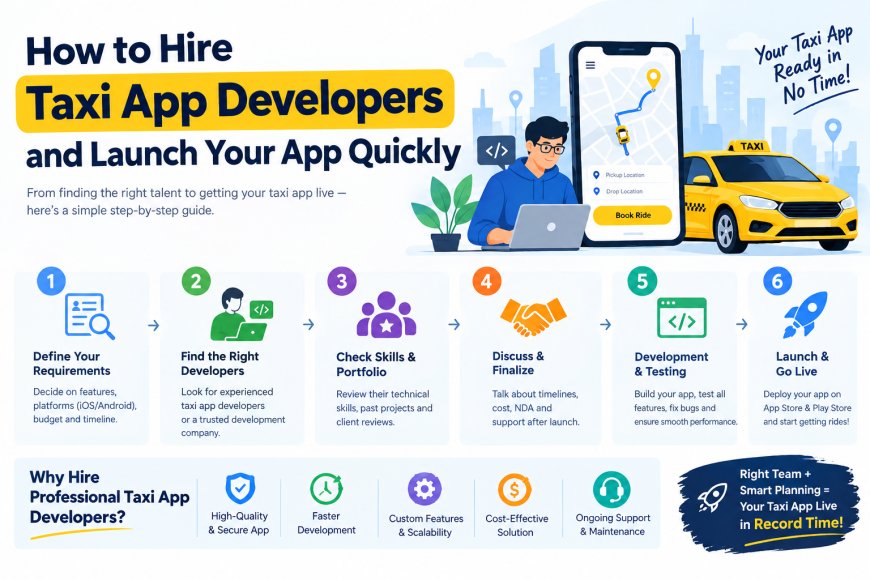
A practical launch strategy looks like this:
Step 1: Define One Core Market
Choose the initial city, customer segment, and service model.
Step 2: Document Essential Features
Separate must-have functionality from future ideas.
Step 3: Select an Experienced Team
Look for demonstrated experience with location-based, booking, payment, and real-time applications.
Step 4: Design the Main User Journeys
Create the passenger, driver, and admin workflows before extensive coding begins.
Step 5: Develop the MVP
Build the smallest complete system capable of accepting, managing, and completing real rides.
Step 6: Test With Real Scenarios
Use actual devices, realistic locations, different network conditions, and controlled driver/passenger testing.
Step 7: Launch in a Controlled Area
Start with a manageable geographic market rather than attempting immediate large-scale expansion.
Step 8: Collect Feedback
Monitor cancellations, booking completion, driver acceptance, payment failures, support requests, and user feedback.
Step 9: Improve Based on Evidence
Use actual usage data to decide which features should be developed next.
Conclusion
Hiring taxi app developers is not simply a matter of finding someone who can build an iOS or Android application. You are hiring a team to create a real-time transportation system involving passengers, drivers, administrators, payments, maps, notifications, and constantly changing locations.
The fastest route to launch is usually a disciplined one.
Define the business model before development begins. Prioritize the MVP. Select developers who understand location-based and on-demand applications. Establish clear milestones. Keep communication consistent. Test real-world scenarios. Prepare your launch infrastructure early, and resist the temptation to turn the first release into a massive all-in-one platform.
Most importantly, remember that launching quickly and launching intelligently are not opposites. A focused taxi app can reach the market faster while still having a technical foundation capable of supporting future growth.
When you hire the right taxi app development team and give them a clearly defined target, development becomes easier to manage, decisions become faster, and your business can move from an initial concept toward a functioning transportation platform without unnecessary delays.
What's Your Reaction?
 Like
0
 Dislike
0
 Love
0
 Funny
0
 Angry
0
 Sad
0
 Wow
0




