









How Hologram Display Technology Is Reshaping Events, Museums, and Retail Spaces
Discover how hologram projector technology works in events, museums, and retail spaces, including key lighting, ceiling height, and setup requirements.
Walk into a modern museum exhibition, flagship retail store, or international trade summit today, and you will likely notice a shift in how visual stories are told. Flat screens and printed banners are steadily sharing floor space with floating, glasses-free 3D visuals. Yet behind every captivating three dimensional display lies a careful balance of optics, ambient lighting, and spatial engineering. Planning an effective hologram projector installation requires far more than selecting high-resolution hardware it demands understanding how light behaves inside a physical room.
For event organizers, curators, and venue managers, the appeal of holographic projection is easy to understand. Unlike virtual reality headsets, which isolate viewers one by one, holographic displays allow an entire room to view a floating object simultaneously without wearable gear. However, the technology relies on optical illusion rather than science-fiction solid light, meaning environmental conditions play a decisive role in visual quality.
How Commercial Hologram Displays Actually Create Depth
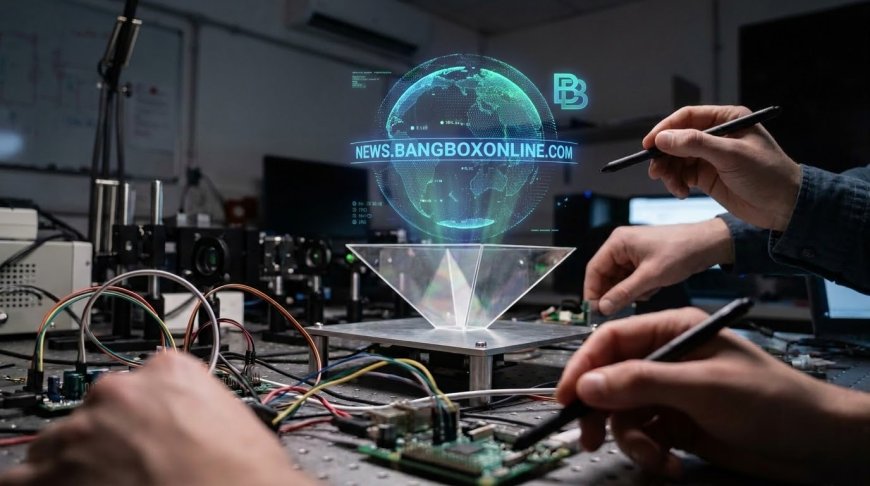
Most commercial holographic installations rely on well-established optical principles rather than true laser interference holography. Understanding the core formats helps venues match the right display method to their architectural constraints and audience size.
Pepper's Ghost Optical Stages
Adapted from a nineteenth century theatrical technique, modern Pepper's Ghost stages use a high-brightness LED display or projection surface paired with an angled transparent foil or glass pane set at 45 degrees. When viewed from the front, high contrast visuals appear suspended in mid-air against a dark stage backdrop. This format delivers sharp, life-size human presenters and detailed product reveals, making it popular for keynotes and permanent museum galleries.
Holographic Gauze and Scrim Projection
Holographic gauze is a lightweight, nearly invisible metallic mesh suspended from overhead rigging. When a high-lumen laser projector casts bright imagery onto the mesh in a darkened room, the background disappears and the visual appears to float in three-dimensional space. Because gauze can span wide stage openings, it works well for concerts, theatrical performances, and large scale auditorium events.
Spinning LED Hologram Fans and Holographic Tables
For smaller footprints, spinning LED fan arrays use persistence of vision to render bright, floating animations that remain visible even in moderately lit retail stores. Meanwhile, holographic tables project 3D models onto a horizontal surface, allowing architects, urban planners, and visitors to walk around a virtual masterplan or artifact and inspect it from every angle.
Why Room Conditions Matter More Than Hardware Specifications
A common mistake in experiential design is purchasing projection hardware before surveying the venue. Because holographic imagery is formed by light projected against a dark field, any stray light hitting the background washes out contrast and breaks the illusion of depth.
Ambient light levels, measured in lux, dictate which format can succeed in a given space. Museum galleries typically maintain low ambient lighting around 50 lux to protect sensitive artifacts, creating an ideal environment for Pepper's Ghost and gauze projections.
By contrast, sun drenched shopping mall atriums and convention center halls often exceed several hundred lux. In brighter spaces, venues must either build light-shielded enclosures or switch to high-brightness LED fan displays designed to compete with indoor lighting.
Ceiling height and throw distance are equally critical. A life-size Pepper's Ghost stage requires roughly 4.5 to 5 meters of clear vertical height to conceal overhead screens, rigging trusses, and masking borders.
Projection based gauze systems also require unobstructed throw distances between the lens and screen so visitors walking through the venue do not cast shadows across the beam path.
Practical Applications Across Industries
As display hardware becomes more reliable and content creation pipelines mature, holographic visuals are moving beyond novelty stunts into practical, everyday applications.
Cultural Heritage and Museum Storytelling
Museums and cultural institutions increasingly use 3D projections to display fragile, oversized, or repatriated artifacts that cannot be physically handled. Visitors can examine intricate sculptures, historical manuscripts, or extinct wildlife at full scale while keeping original items safely preserved in climate-controlled storage.
Trade Shows, Summits, and Product Launches
At international summits and B2B exhibitions, transporting heavy industrial machinery or full-scale architectural models is expensive and logistically complex. Holographic stages let engineering and automotive brands showcase exploded 3D views of engines, smart-city infrastructure, and medical devices in a compact booth footprint.
Retail Windows and Interactive Showrooms
Brick-and-mortar retailers face constant pressure to turn window shoppers into in-store visitors. Compact holographic displays positioned near store entrances capture foot traffic by showcasing floating footwear, watches, or seasonal campaigns without cluttering physical display tables.
Key Planning Checks Before Deploying a Holographic Display
Organizations considering a 3D visual installation can avoid costly last-minute redesigns by running a straightforward site assessment early in the project timeline:
• Measure ambient light at multiple times of day: Track lux readings at the backdrop, screen plane, and viewer eye level during morning, midday, and peak operating hours.
• Map sightlines for all visitors: Verify viewing angles for both standing adults and seated guests or wheelchair users so nobody sees hidden projectors, edges, or overhead trusses.
• Confirm power, cooling, and automation needs: High-output laser projectors and LED walls require dedicated electrical circuits, uninterruptible power supplies, and automated scheduling software for unattended daily operation.
• Design content specifically for depth: Standard flat video rarely translates well to 3D projection. Visuals need pure black backgrounds, strong edge lighting, and deliberate foreground-to-background separation to appear genuinely three-dimensional.
When space, lighting, and content are engineered together from the outset, holographic projection transforms passive venues into memorable shared experiences. As venues continue blending physical architecture with digital storytelling, thoughtful spatial planning remains the true secret behind every convincing floating image.
Related Reading
Explore more visual production and creative technology insights on Bang Box Online: Video Production Services in UAE: Inside a Creative Media Studio
Sign in to report this article
What's Your Reaction?
 Like
0
 Dislike
0
 Love
0
 Funny
0
 Angry
0
 Sad
0
 Wow
0