




















How Multi-Chain Tokens Work: The Technology Behind One Token Across Multiple Chains
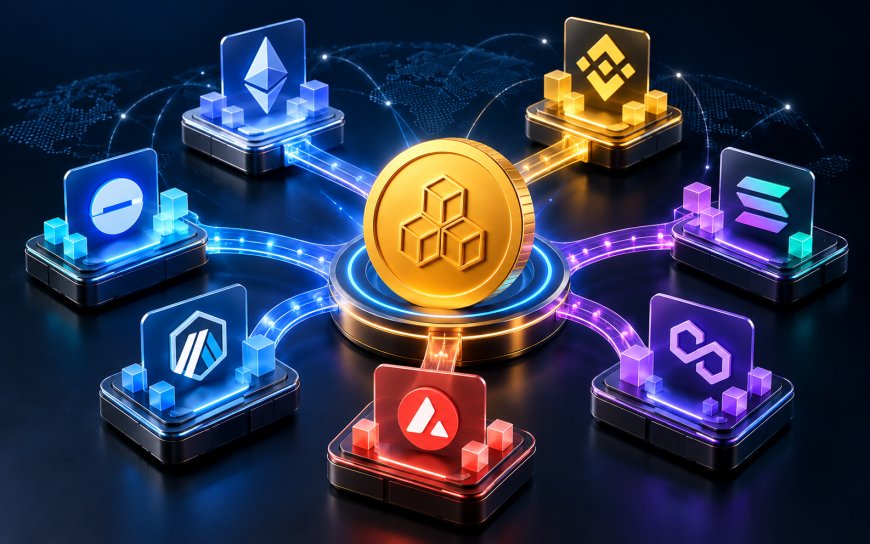
A token deployed on one blockchain has a relatively straightforward architecture. Its smart contract defines supply, ownership, transfers, balances, and other rules within that network. The moment the same token needs to operate across Ethereum, BNB Chain, Solana, Base, Arbitrum, or another network, the architecture becomes considerably more complex.
A multi-chain token is not simply one smart contract copied onto several blockchains. Each network maintains its own ledger, execution environment, transaction finality, token contract, and state. The challenge is therefore to make separate deployments behave as parts of one economic system without accidentally creating multiple independent supplies.
Cross-chain infrastructure has evolved to address this problem. Protocols such as Chainlink CCIP, Circle's Cross-Chain Transfer Protocol (CCTP), and Wormhole's Native Token Transfers use different technical models to move assets or coordinate state between networks. Their designs reveal what actually changes under the hood when a token becomes multi-chain.
A Multi-Chain Token Is a Network of Contracts, Not One Contract
The first concept to understand is that a token does not literally exist as one shared object across different blockchains.
An ERC-20 token on Ethereum is governed by a contract on Ethereum. A corresponding deployment on another EVM network has its own contract address and state. A token deployed on Solana uses a different account and program architecture altogether.
Each network independently records:
- Token balances
- Contract state
- Transaction history
- Minting and burning events
- Ownership or administrative permissions
- Transfer activity
The multi-chain architecture therefore needs a mechanism that coordinates these independent environments.
This usually involves a combination of token contracts, cross-chain messaging infrastructure, verification mechanisms, relayers or validators, and supply-control logic.
The objective is simple even though the engineering is not: one economic token should maintain a consistent supply and identity across multiple networks.
What Actually Happens When a Token Moves Between Chains?
Imagine a user holds 1,000 units of a token on Ethereum and wants to move 300 units to another supported blockchain.
The system cannot simply tell the second blockchain that the user now owns 300 tokens. The destination blockchain has no native knowledge of what happened on Ethereum.
Instead, a cross-chain mechanism must establish that the source transaction actually occurred and that the transfer is valid.
A simplified flow looks like this:
User → Source Token Contract → Cross-Chain Message → Verification Layer → Destination Contract → Recipient
The source chain records the initial action. A messaging or interoperability layer observes it and produces information about the transfer. That information is verified according to the protocol's security model. The destination chain then executes the corresponding action.
Depending on the architecture, the source tokens may be locked, burned, or otherwise accounted for before an equivalent representation becomes available on the destination chain.
Wormhole's documentation, for example, describes both wrapped transfers and Native Token Transfers. Its NTT architecture can use burning on the source chain followed by minting on the destination, while its wrapped-token model can lock the original asset and mint a wrapped representation.
This is the basic mechanism that makes a multi-chain token possible.
Burn-and-Mint vs. Lock-and-Mint
One of the most important architectural decisions is how token supply is represented during a cross-chain transfer.
Burn-and-Mint
In a burn-and-mint model, tokens are destroyed on the source chain and an equivalent amount is created on the destination chain.
For example:
Ethereum: 300 tokens burned
Cross-chain message: Transfer verified
Base: 300 tokens minted
The total circulating supply can remain constant because the source-side tokens cease to exist before the destination-side tokens are created.
Circle's CCTP uses this model for native USDC transfers. Circle describes CCTP as a permissionless infrastructure that enables native USDC to move between supported blockchains through burning and minting rather than relying on a traditional liquidity pool bridge.
This approach can help maintain native asset representation across supported networks.
Lock-and-Mint
A different model locks the original tokens on the source chain and creates a corresponding wrapped token on the destination chain.
For example:
Ethereum: 300 original tokens locked
Destination chain: 300 wrapped tokens minted
When the user returns the asset, the wrapped tokens can be burned and the original tokens released.
Wormhole's Wrapped Token Transfer architecture uses this type of model, with source-chain contracts locking or burning assets and destination contracts handling the corresponding wrapped representation.
The distinction matters because the destination asset may not be the same native token contract. It can instead be a representation backed by assets held elsewhere.
The Cross-Chain Message Is the Critical Layer
Moving tokens across chains is ultimately a messaging problem.
Blockchains are generally isolated execution environments. Ethereum does not automatically know that a transaction occurred on Solana. Solana does not automatically trust a transaction reported by an Ethereum contract.
A cross-chain protocol therefore needs infrastructure capable of communicating information between networks.
Chainlink's Cross-Chain Token standard, for example, provides token-pool architectures supporting both Lock and Release and Burn and Mint approaches. It is designed to connect token contracts across different blockchain environments through CCIP.
Wormhole similarly separates its messaging layer from token-transfer logic. Its documentation describes Guardian-signed messages that are delivered to destination-chain contracts, where the message is validated before the appropriate token operation occurs.
This separation is important.
The token contract manages the asset.
The messaging layer communicates the transfer.
The verification system determines whether the message should be trusted.
The destination contract executes the result.
These components collectively create the cross-chain architecture.
Verification Determines How Much the System Can Be Trusted
The most complicated part of multi-chain infrastructure is not sending a message. It is proving that the message is legitimate.
A cross-chain system needs to answer several questions:
Did the source transaction actually happen?
Was the correct token transferred?
Was the transfer amount altered?
Has the message already been processed?
Is the destination contract authorized to execute it?
Has the system exceeded its permitted transfer limits?
Different interoperability systems answer these questions through different architectures.
Some use validator or guardian networks. Others use oracle networks, light-client verification, cryptographic proofs, or combinations of mechanisms.
Wormhole's token-transfer system, for example, uses Guardian-signed messages and additional accounting controls. Its Global Accountant is designed to check cross-chain transfer integrity and prevent more tokens from being transferred out of a chain than the system's accounting permits.
This demonstrates why a bridge should not be viewed merely as a transaction router.
It is effectively a trust and verification layer connecting independent state machines.
The Token Contract Must Change Too
A conventional token contract is usually designed for activity within one network.
A multi-chain token requires additional functionality.
The contracts may need to recognize authorized cross-chain messages, communicate with a token manager, restrict who can mint or burn, enforce transfer limits, and coordinate administrative actions across networks.
This introduces another architectural challenge: governance consistency.
Suppose a token issuer changes the maximum supply or pauses transfers.
If the token exists on five chains, the change needs to be reflected appropriately across those deployments. Otherwise, one chain could continue operating under outdated rules.
Wormhole's NTT documentation highlights configurable ownership, upgradeability, access control, rate limits, and governance across native token deployments.
For a serious multi-chain project, governance therefore becomes part of the technical architecture rather than an administrative afterthought.
Supply Management Becomes Much More Important
A single-chain token has one primary ledger for its circulating supply.
A multi-chain token has multiple ledgers.
That creates a fundamental accounting problem.
Imagine a token with a maximum supply of 100 million units distributed across four networks:
- Ethereum: 40 million
- BNB Chain: 25 million
- Solana: 20 million
- Base: 15 million
If 5 million tokens move from Ethereum to Base, the system needs to record the new distribution correctly.
The intended result becomes:
Ethereum: 35 million
Base: 20 million
The global supply remains 100 million.
A poorly designed system could accidentally create additional supply if the destination chain mints tokens without properly reducing or locking the corresponding source-side amount.
This is why supply accounting, mint permissions, burn mechanisms, rate limits, and message verification are central to multi-chain token development.
Rate Limits Add Another Security Layer
Cross-chain systems can also impose transfer limits.
This may appear inconvenient to users, but it serves an important security purpose.
If a vulnerability is discovered in a bridge or token-transfer contract, unlimited transfer capacity could allow an attacker to drain enormous amounts of value before the system is stopped.
Rate limits can restrict the amount that can move within a specific period.
Wormhole's current NTT architecture, for example, includes rate-limiting mechanisms on supported implementations. Transfers exceeding configured capacity can be queued or rejected depending on the system configuration.
For high-value tokens, these controls can become part of the project's broader risk-management strategy.
The Same Token Does Not Mean the Same User Experience
From the user's perspective, a multi-chain token should ideally feel like one asset.
But the underlying experience can be quite different.
Users may need to account for:
- Different gas tokens
- Different wallet formats
- Different confirmation times
- Different transaction fees
- Different chain-specific contract addresses
- Different bridge or transfer interfaces
- Different liquidity environments
A multi-chain application therefore needs to hide as much unnecessary complexity as possible.
Circle's CCTP is designed partly around this objective. Circle describes its infrastructure as enabling applications to move native USDC across supported networks while abstracting much of the chain-specific complexity from users.
The goal is not simply technical interoperability.
It is usable interoperability.
Liquidity Is Another Layer of the Architecture
A token being available on multiple networks does not guarantee equal liquidity on each network.
Suppose a token has substantial liquidity on Ethereum but very little on another chain. Technically, users may be able to transfer it there. Economically, however, the asset may be difficult to trade.
This creates a distinction between availability and liquidity.
A multi-chain token strategy therefore needs to consider decentralized exchanges, centralized exchanges, liquidity providers, market makers, treasury allocation, and cross-chain routing.
Circle's explanation of CCTP specifically highlights unified liquidity as one reason for native cross-chain asset movement. By reducing reliance on separate pools of bridged assets, the architecture can help applications move native USDC across supported networks.
For token issuers, this means choosing additional chains is not simply a development decision.
It is also a liquidity-management decision.
Multi-Chain Deployment Creates More Attack Surfaces
Adding chains increases reach, but it also increases complexity.
Every additional blockchain can introduce another smart contract deployment, integration point, messaging path, governance configuration, and operational dependency.
If a token operates across six networks, developers need to maintain six environments and ensure that cross-chain permissions remain synchronized.
Security testing therefore needs to cover both individual contracts and the connections between them.
A smart contract can be secure in isolation but still participate in an insecure cross-chain workflow.
This is why cross-chain audits need to examine message validation, replay protection, token accounting, mint and burn permissions, administrative keys, upgrade mechanisms, rate limits, and failure scenarios.
The question is no longer simply:
"Is the token contract secure?"
It becomes:
"Is the entire system secure when independent blockchain environments interact?"
Real-World Example: Native USDC Across Chains
USDC provides a useful example of how multi-chain architecture can evolve beyond wrapped assets.
Circle's CCTP enables supported native USDC to move between blockchains through a burn-and-mint mechanism. A transfer starts on the source chain, Circle's infrastructure provides an attestation, and the destination-chain process completes the transfer.
The model illustrates an important principle: the objective is not necessarily to maintain a separate liquidity pool of wrapped USDC on every chain.
Instead, the system can destroy native USDC on one supported network and create an equivalent amount on another.
Circle says CCTP is designed to support applications including exchanges, wallets, bridges, payments, and treasury infrastructure.
This demonstrates how cross-chain token infrastructure can become part of broader financial application architecture rather than functioning only as a standalone bridge.
What Changes Under the Hood?
When a token becomes multi-chain, almost every technical layer becomes more sophisticated.
The token contract gains cross-chain permissions and controls. The supply model needs global accounting. A messaging system connects independent networks. Verification infrastructure determines which messages can be trusted. Governance needs to coordinate multiple deployments. Liquidity needs to be distributed across ecosystems. Security monitoring must cover both contracts and cross-chain communication.
The architecture can therefore be summarized as:
Token contracts → Messaging → Verification → Destination execution → Supply accounting → Liquidity → Governance
Each layer solves a different problem.
Removing any one of them can create weaknesses in the overall system.
Multi-Chain Is Becoming an Architecture Choice, Not Just a Marketing Feature
The decision to deploy a token across multiple chains should ultimately be based on the application's users, liquidity requirements, technical environment, and operational model.
A gaming token may prioritize high transaction throughput and low fees. A DeFi asset may prioritize deep liquidity and composability. A stablecoin may require reliable settlement and native issuance. An institutional asset may place greater emphasis on permissioning, compliance, custody, and controlled transfers.
There is no universal cross-chain architecture that fits every token.
The right approach depends on what the token needs to accomplish after deployment.
As interoperability infrastructure matures, the industry is moving toward architectures where users can interact with the same economic asset across different networks while the underlying systems handle chain-specific complexity.
The important change is happening underneath the interface.
A multi-chain token is not one contract magically existing everywhere. It is a coordinated network of contracts, messages, verification systems, accounting rules, liquidity mechanisms, and governance controls.
The token may look like one asset to the user. Under the hood, it is an entire cross-chain system working to make that single identity possible.
What's Your Reaction?
 Like
0
 Dislike
0
 Love
0
 Funny
0
 Angry
0
 Sad
0
 Wow
0

Related Posts
Professional Safe Removalists for Heavy Safe Moving
gary Oct 22, 2026 0 2
Aseptic Packaging Market Size, Share, and Growth Opport...
shrikant pawar Oct 22, 2026 0 2
Preschool in Fremont: A Guide for Parents and Families
Sparkle Montessori Oct 22, 2026 0 3




