














How to Choose a Pressure Reducing Regulator for Compressed Air and Gas Systems
Almost every compressed air or gas system has a pressure mismatch somewhere. A cylinder or header may run at several thousand psi, while the instrument, analyser, or process downstream needs a small fraction of that. A pressure reducing regulator closes the gap. It looks like a simple component, but choosing the wrong one is a common reason for unstable pressure, short seal life, and troubleshooting calls.

Almost every compressed air or gas system has a pressure mismatch somewhere. A cylinder or header may run at several thousand psi, while the instrument, analyser, or process downstream needs a small fraction of that. A pressure reducing regulator closes the gap. It looks like a simple component, but choosing the wrong one is a common reason for unstable pressure, short seal life, and troubleshooting calls.
This article covers how these regulators work, how piston and diaphragm designs differ, and what to check before you specify one.
How a Pressure Reducing Regulator Works
A pressure reducing regulator controls downstream (outlet) pressure, regardless of changes in inlet pressure or flow demand. Three elements work together:
- A loading element, usually an adjustable spring, that sets the desired outlet pressure.
- A sensing element, either a diaphragm or a piston, that “feels” the downstream pressure.
- A valve (poppet and seat) that opens or closes to let fluid through.
When downstream pressure falls below the set point, the spring force wins and the valve opens further. When downstream pressure rises, it pushes back on the sensing element and the valve throttles toward closed. The regulator constantly settles at the point where these forces balance.
This is also why a regulator is not a shutoff valve or a safety device. If downstream pressure can be driven above its limit by thermal expansion or a failure, the system needs its own relief protection.
Diaphragm vs. Piston Sensing
The choice of sensing element is one of the biggest decisions in regulator selection.
Diaphragm-operated regulators use a flexible membrane as the sensing element. A diaphragm has very little friction, so it responds to small pressure changes. That makes it a good fit for low set pressures and for applications that need fine, repeatable control at low flow. The trade-off is a limit on pressure and force. A diaphragm must be thin enough to flex, so very high pressures need careful design.
Piston-operated regulators use a sliding piston with a seal. A piston handles high pressures well and can be built compactly with large effective flow capacity. Because the piston seal creates some friction, it can show slightly more hysteresis than a diaphragm at very low set pressures. For high-pressure and high-flow duty, that is usually an acceptable trade for the added robustness.
As a rule of thumb, diaphragm designs lean toward low set pressure and sensitivity, while piston designs lean toward high pressure and flow capacity. Many product lines offer both so you can match the design to the job.
Performance Terms to Understand
Datasheets use a few terms that directly affect how a regulator behaves in your system.
- Droop (offset): As flow demand increases, outlet pressure falls slightly below the set point. This is normal for spring-loaded regulators. A regulator that is sized well for the flow range keeps droop small.
- Supply (inlet) pressure effect: In many designs, a falling inlet pressure causes a small rise in outlet pressure, and the reverse. This matters for gas cylinders, where inlet pressure drops steadily as the cylinder empties.
- Lockup: The outlet pressure at which the regulator fully closes at zero flow. It is slightly above the set point and shows how well the seat seals.
- Cv (flow coefficient): A measure of flow capacity. Choose a Cv that suits your actual flow range. Oversized regulators tend to be less stable at low flow, and undersized ones show excessive droop.
What to Gather Before Selecting
A few details should be confirmed up front:
- Inlet pressure range, including the maximum and minimum you expect.
- Required outlet (set) pressure and the acceptable tolerance.
- Flow rate, both normal and peak, ideally in the units the datasheet uses.
- Process media. Compressed air, nitrogen, and other gases are common, but material compatibility needs to be checked for anything corrosive or reactive.
- Operating temperature, since it affects seal materials and gas behavior.
- Connection size and type, and any cleanliness or oxygen-service requirements.
Skipping any of these is how installations end up with a regulator that technically fits but does not perform well.
Matching Application to Regulator Type
Different operating conditions call for different designs:
- Very high inlet pressure with very low flow is typical of analytical and laboratory gas supply. Regulators built for this duty keep control stable at tiny flow rates.
- Low set pressure at very low flow needs a sensitive sensing element so that a few psi, or less, can be held steadily.
- High-flow service benefits from piston-operated designs with higher Cv options, so the regulator does not choke the line.
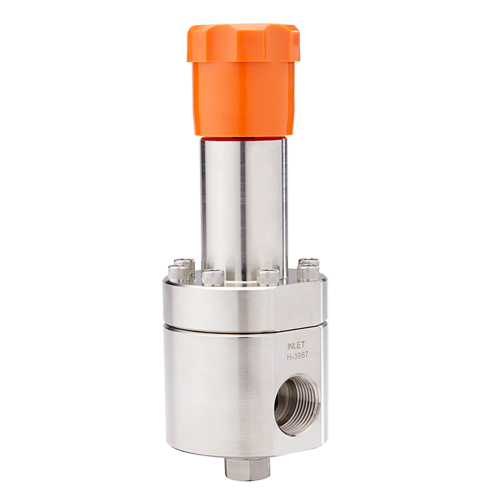
The pressure reducing regulator range from LowFlow Valve is organized along these lines. It includes diaphragm-operated and piston-operated series for high-pressure/low-flow, low-set-pressure/very-low-flow, and high-flow compressed air and gas applications, and some configurations are available through a Quick Ship program for shorter lead times.
Installation and Maintenance Tips
- Filter upstream. Particles on the seat are a leading cause of creep and leakage. A small filter protects the regulator.
- Install a gauge on the outlet so you can see what the regulator is delivering.
- Adjust upward. Approach the set pressure from below, since this gives a more repeatable setting than backing down from an overshoot.
- Add downstream relief wherever over-pressure could damage equipment or injure someone.
- Inspect seals and seats periodically. Wear shows up as pressure creep, drift, or failure to hold lockup.
Final Thoughts
A good regulator choice comes down to understanding your pressure range, flow requirement, and media, then picking the sensing design that fits. Diaphragm and piston designs each have clear strengths, and the right one depends on whether sensitivity or pressure capacity matters more. If your application is unusual, such as very high pressure with very low flow, speak with a manufacturer’s applications team before you finalize the specification. For sanitary air and gas service, a dedicated sanitary regulator line is the better starting point.
What's Your Reaction?
 Like
0
 Dislike
0
 Love
0
 Funny
0
 Angry
0
 Sad
0
 Wow
0