











How to Control Gas at Very Low Pressure and Very Low Flow: A Look at the JRLL Series Regulator
Learn how the JRLL Series low flow pressure regulating valve delivers stable low-pressure control with Cv 0.012-0.20, 316L SS and a PTFE Jorlon diaphragm.

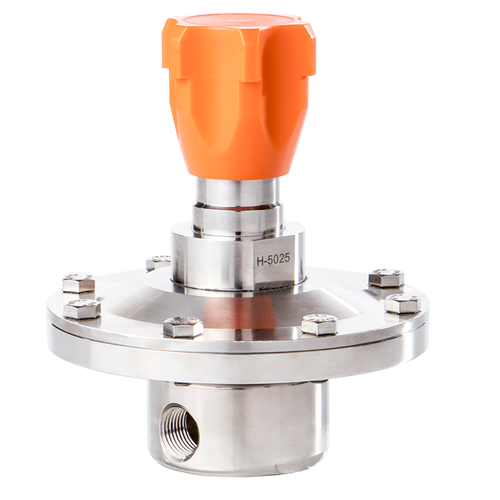
Most pressure regulators are built for general duty: a few hundred psi, decent flow, and a pressure setting that doesn’t need to be exact. Things get harder when the job is to hold a few psi on a small gas line. Common examples are a tank blanketing system, a sparging line, or a lab gas manifold. At low set pressures and tiny flow rates, an ordinary regulator can drift, chatter, or fail to shut off cleanly.
This is the kind of application the JRLL Series was designed for. It is a low set pressure, very low flow pressure regulating valve from LowFlow Valve. Below are why these applications are difficult and what to check when specifying a regulator for them.
Why low-pressure, low-flow regulation is tricky
A pressure regulator works by balancing a spring force against the pressure acting on a diaphragm. At very low set pressures the forces involved are small. A diaphragm that is stiff, sticky, or insensitive will not respond to small changes in outlet pressure, and the setpoint wanders.
Two other problems show up often:
- Droop (offset). When flow demand rises, outlet pressure falls below the setpoint. Droop is easy to notice at low pressure, because even a small absolute change is a large percentage of the setting.
- Poor shutoff. If the seat leaks at zero flow, downstream pressure creeps upward. In a blanketing or gas cabinet application, this means unwanted gas passing through the regulator.
A regulator for this duty needs a sensitive sensing element, a low-droop design, and a seat that seals reliably.
What the JRLL Series offers
Sensitive diaphragm. The JRLL uses a PTFE Jorlon diaphragm for accurate low-pressure sensing. LowFlow Valve describes this material as providing a long service life, and most of its regulators carry a lifetime diaphragm warranty.
Low droop. The design keeps set point offset very low, especially at higher inlet pressures. This matters when the supply pressure is much higher than the outlet setting, as with a cylinder or header feeding a low-pressure process line.
Tight shutoff. Seat options include PTFE, PEEK and KEL-F, with EPDM also available. The valve is rated for ANSI Class VI shutoff. USDA and FDA approved soft goods can be supplied on request.
Barstock construction. The body and metal trim are machined from 316L stainless steel barstock (ASTM A479). Barstock gives consistent material quality and a good surface finish, and 316L suits many process gases.
Top-entry design. The internals can be reached from the top, which makes in-line cleaning and maintenance easier without removing the valve from the piping.
Key specifications
|
Parameter |
JRLL Series |
|
Sizes |
1/4", 3/8", 1/2" (DN8, DN10, DN15) |
|
Cv (Kv) |
0.012, 0.03, 0.08, 0.20 (0.01, 0.026, 0.07, 0.17) |
|
Spring ranges |
1-75 psi (0.7-5.2 bar) and 25-100 psi (1.7-6.9 bar) |
|
Body material |
ASTM A479 316L stainless steel, others available |
|
Seat options |
PTFE, PEEK, KEL-F |
|
End connections |
Threaded, socket weld, flanged, others |
|
Shutoff |
ANSI Class VI |
|
Approvals |
ATEX certified |
The Cv range of 0.012 to 0.20 is far smaller than that of a typical industrial regulator. Matching Cv to your actual flow is important. An oversized regulator usually controls worse at low flow, and an undersized one cannot meet peak demand.
Where it fits
The JRLL suits low-pressure gas applications such as:
- Tank blanketing: keeping a small positive pressure of inert gas, such as nitrogen, over a stored liquid to exclude air and moisture.
- Sparging: feeding gas at a controlled low rate into a liquid.
- Gas cabinets and high-pressure gas systems: stepping down supply pressure for downstream equipment.
- Research and development and pilot plants: where repeatable setpoints on small flows matter.
- Injection moulding: for gas applications that need stable low-pressure control.
Selection checklist
Before choosing a low-flow regulator, confirm the following:
- Inlet pressure range (minimum and maximum).
- Required outlet set pressure, and so which spring range applies.
- Maximum and minimum flow, to select the correct Cv.
- Media and temperature, to confirm body and seat compatibility.
- Shutoff requirements, since seat material affects leakage and chemical compatibility.
- Connection type and size for your piping.
LowFlow Valve publishes a J Series product matrix and a selection tool, along with data sheets, an installation and maintenance manual and STEP files for common configurations. These are worth reviewing before you place an order. A Quick Ship program is also available for some configurations.
Final thoughts
Low-pressure regulation is mainly a problem of sensitivity. The regulator must detect small changes in outlet pressure, respond without lag or sticking, and close fully when demand stops. A regulator built around a sensitive diaphragm, a low-droop design and a tight-sealing seat is the right starting point for such systems.
For full specifications, documentation and quoting, see the JRLL Series Low Set Pressure / Very Low Flow Pressure Regulating Valve page.
What's Your Reaction?
 Like
0
 Dislike
0
 Love
0
 Funny
0
 Angry
0
 Sad
0
 Wow
0