How to Control High-Pressure Gas and Liquid Lines with a Self-Operated Regulating Valve: The Mark 6800HP Series
Mark 6800HP self-operated high pressure regulating valve for gas and non-cavitating liquid service. 4000 psi inlet, barstock stainless body, Stellite trim.

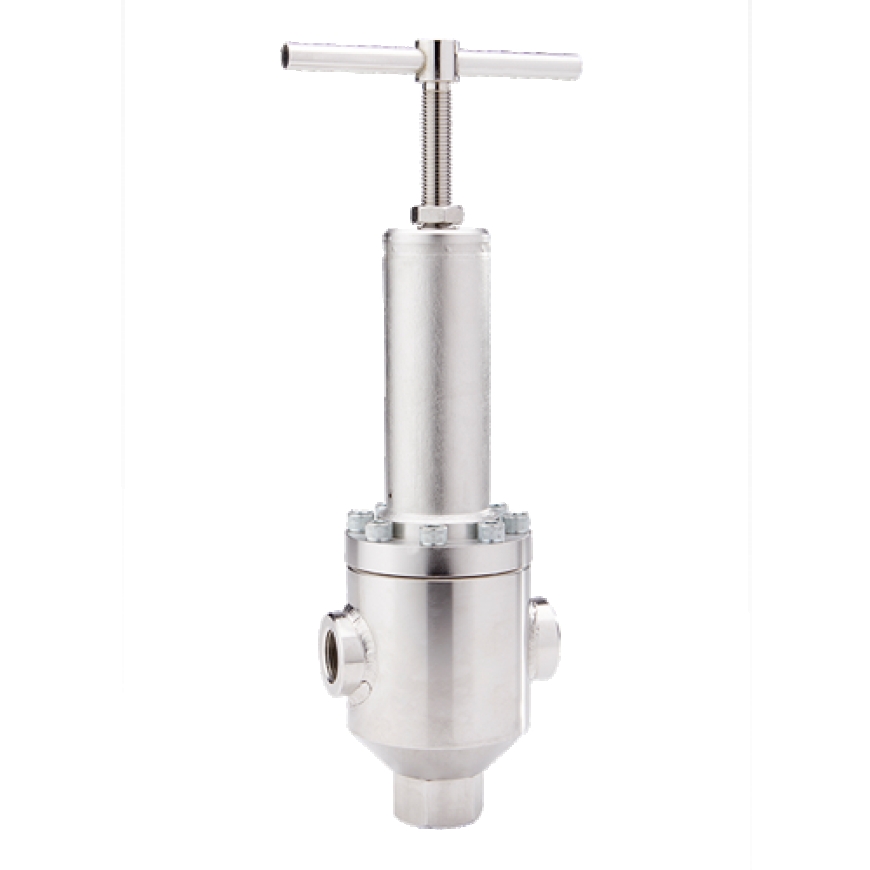
Regulating pressure at several thousand psi is a different job from regulating it at a few hundred. Seat loading, spring selection, body construction, and leak integrity all matter more at high pressure. A self-operated regulating valve is a common solution for these conditions because it needs no external power, controller, or instrument air. This article explains how these valves work and what to check when specifying one, using the Mark 6800HP Series as a reference.
What Is a Self-Operated High Pressure Regulating Valve?
A self-operated regulator controls pressure using only the energy of the process fluid. A sensing element, typically a piston or diaphragm, compares the controlled pressure against a preset spring force. When the controlled pressure moves away from setpoint, the sensing element shifts and repositions the valve plug relative to its seat, restoring balance. No positioner, transmitter, or actuator supply is involved, which makes this design well suited to remote skids, test stands, and gas panels.
The Mark 6800HP is a self-operated regulating valve for high-pressure industrial gas and liquid services up to 4000 psi (276 bar). It is listed by the manufacturer under both high-pressure regulators and pressure reducing regulators.
Design Features That Matter at High Pressure
Barstock body construction. The 1/2" to 1" valves are built from solid barstock with all stainless-steel components. Barstock avoids the porosity concerns associated with some cast bodies, which is a useful property when the body contains pressure in the thousands of psi.
Hard or soft seats, with balanced trim available on either. Hard seats (such as Stellite) tolerate erosive or high-temperature conditions, while soft seats (such as Vespel or Teflon) generally give tighter shutoff. Balanced trim reduces the effect of inlet pressure on the plug. In practice this limits outlet pressure drift when supply pressure changes, which is common when a gas cylinder or storage vessel depletes.
Multiple piston sizes and spring ranges. Matching the piston area and spring to the required setpoint keeps the regulator in the middle of its working range. Accuracy is generally better there than at the extremes of a spring range.
Stellite trim and high-strain bolting. These help protect the pressure-containing parts and wetted trim in demanding service.
In-line maintainability. Seats and internals can be serviced without removing the valve from the pipeline, which reduces downtime.
Choosing the Right Configuration
- Confirm the service. The Mark 6800HP is intended for gas and non-cavitating liquid service. Liquid applications with a large pressure drop that could cause cavitation or flashing need separate evaluation.
- Define inlet and outlet pressure. Keep the inlet within 4000 psi and the setpoint within 3000 psi and choose a spring range that brackets the required outlet pressure.
- Size for flow. Use the required flow, the pressure drops, and fluid properties to choose among the 0.5, 1.0, and 2.5 Cv options. An oversized valve tends to operate near its seat and can regulate poorly at low flow.
- Select the seat for shutoff. Class VI is typically specified where tight shutoff matters, such as in dead-end service or sampling systems.
- Match materials to the media. Options include 316L stainless steel, Hastelloy C, Monel, and Alloy 20. Choose based on corrosion, temperature, and compatibility with soft goods. USDA- and FDA-approved soft goods are available on request.
Typical Applications
- High-pressure gas delivery from cylinders and manifolds
- Test benches and pressure-testing equipment
- Process gas pressure reduction on skids
- Non-cavitating high-pressure liquid lines
- Hazardous-area installations, where the ATEX certification is relevant
Installation and Operating Tips
- Install a properly rated gauge on the downstream side so setpoint can be verified.
- Use a downstream relief device to protect equipment if the regulator fails or pressure rises from a downstream heat source.
- Keep the fluid clean. A filter upstream helps prevent debris from damaging the seat and causing creep.
- Note that self-operated regulators show some outlet pressure droop as flow increases. Size for the expected flow range and set the pressure under typical flow conditions.
Conclusion
The Mark 6800HP Series provides a compact, spring-loaded solution for controlling pressure in high-pressure gas and non-cavitating liquid systems, with a choice of seat materials, shutoff classes, and body alloys. For the data sheet, installation and maintenance manual, or a quote, visit the Mark 6800HP Series product page.
What's Your Reaction?
 Like
0
 Dislike
0
 Love
0
 Funny
0
 Angry
0
 Sad
0
 Wow
0