How to Turn Your PhD Thesis Into a Journal Paper (2026)
Learn how to convert your PhD thesis into a journal article, choose the right Scopus or SCI journal, and avoid rejection. Get free expert guidance today.
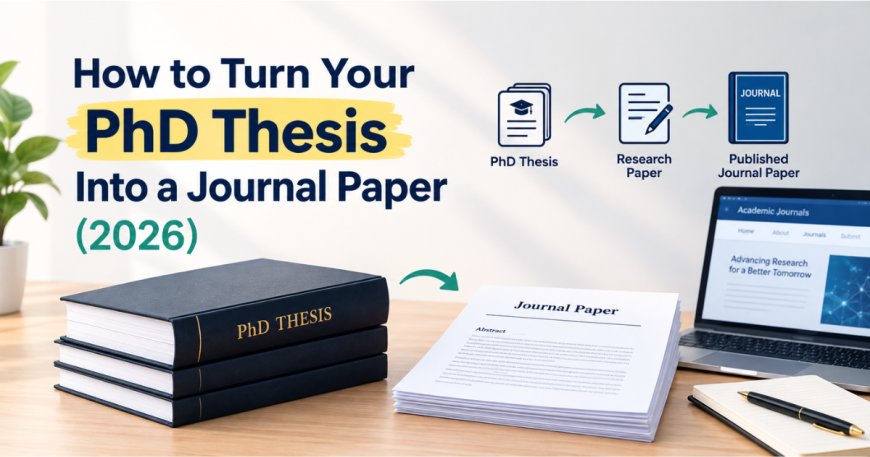
You spent years on your doctoral research. Right now, only your examiners and a university repository have read it. Learning how to turn a thesis into a journal paper is what moves that work into Scopus and Web of Science, where hiring panels, grant committees and other researchers can find and cite it.
Quick Answer: Here is how to convert phd thesis into journal article form:
- Pick one focused research question.
- Cut the text to the journal's word limit, often 4,000–8,000 words.
- Rebuild it in IMRaD format (Introduction, Methods, Results, Discussion).
- Update the literature.
- Submit to an indexed journal whose scope matches your topic.
This guide draws on what Anushram's research mentors see every week while helping Indian scholars prepare manuscripts: what editors accept, what they return, and why.
Can You Publish Your PhD Thesis as a Journal Paper?
Yes, but not in its current form. Journals publish articles, not theses. You publish the findings from your thesis after reshaping them into a paper.
Your thesis will not normally block you from submitting. Most major publishers, including Elsevier, Springer Nature and Wiley, do not treat a thesis as "prior publication." Still check each journal's policy before you submit.
There is one catch for Indian scholars. PhD theses are deposited in Shodhganga, the INFLIBNET repository. Journal similarity checkers will match your paper against that text. Mention the thesis in your cover letter so the editor is not surprised by the similarity report.
The UGC PhD Regulations 2022 removed the rule that you must publish papers before submitting your thesis. Publications still carry heavy weight in faculty recruitment, promotions and research funding. That makes knowing how to publish PhD thesis in a journal one of the most useful career moves after your viva.
Most theses can produce 2 to 4 papers. A common split is one review article from the literature chapter and one or more research papers from the results chapters. Anushram's publication support team can help you map which chapters can stand alone as separate papers.
Thesis vs Journal Paper: Key Differences
| Purpose | Prove you can do independent research | Share one new finding |
| Length | 60,000–100,000+ words (varies by university) | About 3,000–8,000 words |
| Literature review | A full, detailed chapter | One or two pages that frame the research gap |
| Methods | Every step, with justification | Enough detail for others to repeat the study |
| Reader | Examiners | Busy editors and researchers |
The biggest change is in mindset. A thesis shows everything you did. A paper argues one point and removes anything that does not support it.
This is why many attempts to convert thesis into research paper form fail. Authors shorten chapters instead of rebuilding the argument. Understanding how to turn a thesis into a journal paper starts with accepting that most of your thesis will stay out.
How to Convert a Thesis Into a Paper: Step-by-Step
This is the process our mentors use when scholars ask how to convert PhD thesis into journal article drafts:
- Choose one research question. Write your main finding as a single sentence. If you can't, the paper isn't focused enough yet.
- Pick your target journal first. The journal decides your word limit, structure and reference style.
- Rebuild the structure in IMRaD. Merge your background and literature chapters into a short introduction. End it with a clear research gap.
- Update your references. Your literature review may be two or three years old, and reviewers notice when recent studies are missing.
- Cut hard. Remove textbook definitions, repeated explanations and results that do not answer your question. Move extra tables into supplementary files.
- Rewrite in new sentences. Copying large blocks of thesis text raises your similarity score, even though the words are your own. Rewriting is the safest way to convert thesis into research paper form without plagiarism flags.
- Write the title and abstract last. Use the terms researchers actually search for, and stay within the abstract limit (often 150–250 words).
- Get a pre-submission review from your supervisor or an experienced researcher.
If your statistics need to be re-run or presented more clearly, Anushram's analytical services team works with SPSS, R and Python to make results publication-ready. This is where reliable research paper writing services in India add real value: editing, restructuring and data presentation, while the research and ideas stay yours.
Stuck turning 300 pages into a 6,000-word paper?
Book a free consultation with an Anushram publication expert and get a chapter-to-paper plan. Hundreds of PhD scholars have already used our research paper writing services in India to move from thesis to submission.
👉 Book My Free Consultation Now
How to Choose the Right Scopus or SCI Journal
Choosing the wrong journal is the fastest route to desk rejection. When scholars ask how to publish PhD thesis in a journal with the least delay, our first answer is: match the scope before chasing impact factor.
- Verify indexing yourself. Check the Scopus Sources list and the Clarivate Master Journal List for SCIE, SSCI and ESCI. Don't rely on what a journal's website claims.
- Read the aims and scope, and recent issues. If the journal hasn't published work like yours in the last two years, look elsewhere.
- Avoid predatory and cloned journals. Warning signs include guaranteed acceptance, publication "within 7 days," fees charged before peer review, and websites that copy real journals. The Think. Check. Submit. checklist helps you spot them.
- Compare timelines and costs. Peer review can take several months. Open-access journals may charge article processing charges (APCs); many subscription journals do not.
- Check your university's rules. Some institutions accept only certain indexes for promotion or API scores.
Not sure which journals fit your topic? Sign up free on Anushram and get matched with a subject expert who will help you shortlist the right journals.
Common Mistakes That Get Thesis-Based Papers Rejected
These are the problems our mentors see most often in rejected manuscripts:
- Submitting a shortened chapter. Editors spot thesis-style writing immediately: long background, slow start, no clear argument.
- High similarity scores from text copied directly out of the thesis.
- Outdated references, with nothing from the last two or three years.
- Scope mismatch between the paper and the journal.
- Salami slicing, which means splitting one study into several thin papers. COPE treats this as a publication-ethics concern.
- Ignoring author guidelines on word count, formatting and reference style.
- Unclear authorship. Agree on co-authorship with your supervisor before you submit.
Rejection is common and rarely final. Use the reviewer comments, revise, and submit to a better-matched journal. Anyone serious about learning how to turn a thesis into a journal paper should expect at least one round of revisions.
Don't let a desk rejection cost you another six months.
Get your manuscript reviewed by experienced PhD mentors before you submit.
👉 Talk to a Publication Expert Today
Frequently Asked Questions
Q1. How long does it take to turn a PhD thesis into a journal paper?
A. Writing and restructuring usually take 4–8 weeks of focused work. Peer review can add a few months to a year, depending on the journal.
A. Writing and restructuring usually take 4–8 weeks of focused work. Peer review can add a few months to a year, depending on the journal.
Q2. Will my thesis on Shodhganga cause plagiarism issues?
A. Similarity software will detect the match. Rewrite the text in new sentences and mention the thesis in your cover letter. Most journals accept thesis-based papers.
A. Similarity software will detect the match. Rewrite the text in new sentences and mention the thesis in your cover letter. Most journals accept thesis-based papers.
Q3. Is it possible to convert thesis into research paper form without my supervisor?
A. Yes. Still, your supervisor usually contributed to the work and is often a co-author, so discuss authorship with them first.
A. Yes. Still, your supervisor usually contributed to the work and is often a co-author, so discuss authorship with them first.
Q4. Can I learn how to publish PhD thesis in a journal after my PhD is awarded?
A. Yes. Many scholars publish after the degree. Publishing within one or two years keeps your literature review current.
A. Yes. Many scholars publish after the degree. Publishing within one or two years keeps your literature review current.
What's Your Reaction?
 Like
0
 Dislike
0
 Love
0
 Funny
0
 Angry
0
 Sad
0
 Wow
0

anushram
Best Thesis Writing Services In India and We provide high-quality thesis writing services in India, tailored to university guidelines with expert research support. Get expert research paper, thesis, and dissertation writing services in India. Topic selection, writing assistance, and editing support by professionals.