KP AUTOMATIONS Automatic Pasta Making Machine: Configuring a Complete Commercial Production Line
Choosing an automatic pasta making machine is an important decision for any business planning commercial pasta production. However, selecting the main machine is only one part of building a successful manufacturing operation.
A complete pasta production system may also require drying, cooling, product handling, weighing, packaging, utilities, and appropriate automation. If these stages are not considered together, the manufacturer may end up with equipment that does not operate efficiently as a complete line.
KP AUTOMATIONS manufactures pasta machinery for commercial and industrial applications, along with drying and packaging solutions. Its automatic pasta systems are designed around processes such as dough preparation, extrusion, shaping and, depending on configuration, cutting and drying. The company also offers options for integrating continuous dryers and packaging systems.
For a new pasta factory or an existing manufacturer upgrading production, the right approach is therefore to plan the complete process rather than purchase individual machines in isolation.
What Is an Automatic Pasta Making Machine?
An automatic pasta making machine is a food-processing system designed to automate important stages of pasta production.
Depending on the configuration, the process can include:
- Ingredient mixing
- Dough preparation
- Kneading
- Vacuum processing
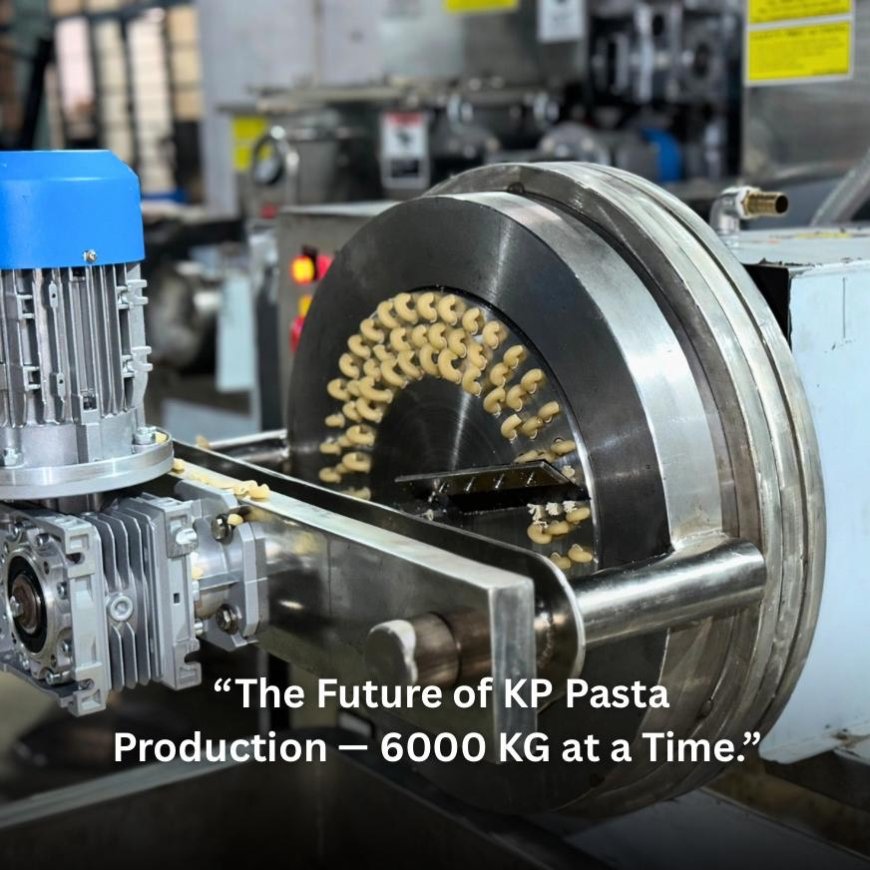
- Extrusion
- Pasta shaping
- Cutting
- Product transfer
- Drying
- Preparation for packaging
The basic process begins with ingredients such as semolina or flour and water. The dough is processed and forced through a selected die to create the desired pasta shape.
Modern automatic systems reduce repetitive manual operations and provide a more structured production process.
For commercial manufacturers, this can support greater consistency, higher throughput, and easier production management.
Why the Complete Line Should Be Planned Together
A pasta machine does not work independently.
Once pasta leaves the extrusion system, it needs to move through additional stages before becoming a finished commercial product.
A typical dry-pasta workflow can be represented as:
Raw Materials → Mixing → Extrusion → Shaping → Pre-Drying → Main Drying → Cooling → Packaging
Every stage influences the next.
For example, an extrusion machine may have a high production capacity, but if the dryer or packaging equipment cannot handle the same production flow, the effective output of the factory may be restricted.
This is why manufacturers should consider the relationship between the pasta machine, dryer, conveyors, cooling system, and packaging equipment before finalizing equipment specifications.
Selecting the Right Production Capacity
The first major decision is the required production capacity.
A small manufacturer may require a compact production system, while a large food-processing company may need a high-capacity industrial line.
KP AUTOMATIONS offers different pasta machine configurations for varying production requirements, including compact 50 kg/hr and 100 kg/hr systems and mid-size 200 kg/hr, 300 kg/hr, and 500 kg/hr machines.
The appropriate capacity depends on:
- Current market demand
- Expected future sales
- Number of production shifts
- Available factory space
- Product range
- Dryer capacity
- Packaging requirements
- Expansion plans
The goal should be to choose a capacity that fits the complete production strategy.
Compact Automatic Pasta Making Machines
Compact systems can be suitable for businesses entering commercial pasta production or operating at smaller volumes.
KP AUTOMATIONS' compact range includes 50 kg/hr and 100 kg/hr configurations for short-cut pasta applications.
These systems can be used for products such as:
- Macaroni
- Vermicelli
- Other short-cut pasta varieties
A compact automatic setup can provide a more controlled production process without requiring the infrastructure associated with a large industrial line.
For growing businesses, the equipment can also form the foundation of a future expansion strategy.
Mid-Size Production for Growing Manufacturers
As demand increases, manufacturers may require higher production capacity.
KP AUTOMATIONS provides 200 kg/hr, 300 kg/hr, and 500 kg/hr mid-size configurations for commercial pasta production.
At this level, the supporting systems become increasingly important.
A manufacturer should evaluate:
- Extruder output
- Dryer throughput
- Product transfer
- Cooling
- Packaging speed
- Electrical requirements
- Operator access
- Maintenance space
Increasing the capacity of the main pasta machine without upgrading the rest of the line may simply move the production bottleneck to another stage.
Choosing Pasta Shapes and Dies
Product variety is another important factor when selecting an automatic pasta making machine.
Different dies can be used to create different pasta formats.
Depending on the equipment configuration, manufacturers may produce:
- Macaroni
- Penne
- Fusilli
- Vermicelli
- Spaghetti
- Other specialty formats
A manufacturer should identify the intended product range before selecting the machine configuration.
Producing multiple shapes can increase market flexibility, but it also means that the factory needs to consider die changes, cleaning, drying requirements, and packaging adjustments.
The production line should therefore be designed around the complete product portfolio rather than only one pasta shape.
The Importance of the Pasta Continuous Dryer
For dried pasta production, the drying section is one of the most important parts of the line.
A pasta continuous dryer allows product to move through controlled drying zones as part of a continuous process.
A typical arrangement can be:
Automatic Pasta Making Machine → Pre-Drying → Continuous Dryer → Cooling → Packaging
This arrangement reduces the need for repeated manual transfer between extrusion and drying.
The continuous dryer should be selected according to the production output, pasta shapes, factory layout, and required process conditions.
Its capacity should be balanced with the upstream extrusion system.
Automatic Pasta Dryer: What to Consider
An automatic pasta dryer is not simply a heating unit.
Effective drying depends on several variables, including:
- Temperature
- Humidity
- Airflow
- Residence time
- Product thickness
- Pasta shape
- Production loading
These parameters interact throughout the drying process.
A properly configured automatic drying system can provide more repeatable conditions and reduce reliance on manual adjustments.
For manufacturers producing different pasta products, controlled drying is particularly important because different shapes may require different processing conditions.
Choosing Between Continuous and Batch Drying
Not every pasta manufacturer requires the same drying configuration.
A continuous dryer can be appropriate for a production line in which pasta moves continuously from extrusion toward cooling and packaging.
A batch or static dryer can be suitable for operations where production is organized around separate drying cycles.
The decision should consider:
- Production capacity
- Product mix
- Available floor space
- Automation level
- Desired production flow
- Drying cycle
- Future expansion
The best drying system is therefore the one that fits the overall production process.
Why the Pasta Dryer Must Match the Extruder
One of the most important planning principles is capacity balance.
Consider the following simplified relationship:
Extrusion → Drying → Cooling → Packaging
If the extrusion system supplies pasta faster than the drying system can process it, product may accumulate between stages.
If the dryer has significantly greater capacity than the extruder, part of its available production capability may remain unused.
The goal is not necessarily to make every machine specification identical. Instead, the equipment should be engineered to operate together under the intended production conditions.
This becomes particularly important when manufacturers plan to operate multiple shifts.
Cooling and Product Handling
After drying, pasta generally needs to move through an appropriate cooling and handling stage before packaging.
This part of the line should be planned carefully because unnecessary manual movement can create delays.
A well-organized system may use conveyors and controlled product transfer between:
Dryer → Cooling → Handling → Weighing → Packaging
The handling system should also provide suitable access for inspection and cleaning.
For higher-output factories, automated product transfer can become an important part of maintaining a steady production flow.
Integrating a Pasta Packing Machine
The final stage of the production line is packaging.
A pasta packing machine can automate weighing, filling, pouch formation, and sealing according to the selected packaging configuration.
KP AUTOMATIONS lists packaging options including VFFS systems, weighing and filling machines, vacuum packaging, pillow and flow-wrap systems, and box or carton packaging. Its official automatic pasta machine page identifies VFFS as suitable for dry products such as penne, macaroni, and spaghetti.
Packaging equipment should be selected according to:
- Product shape
- Pack weight
- Packaging material
- Required production speed
- Retail or bulk requirements
- Desired packaging format
The packaging machine should also be capable of accepting the expected flow from the upstream production system.
Matching Packaging Speed With Production
A common mistake is to select the pasta machine and dryer first and consider packaging later.
Packaging capacity is an important part of the overall production calculation.
For example, if a line produces a large quantity of dried pasta per hour but the packing section processes substantially less product, finished pasta can accumulate before packaging.
This can create:
- Additional storage requirements
- More product handling
- Production interruptions
- Increased operator involvement
Packaging should therefore be included in the original line-planning process.
Automation for Multiple Products
Many commercial pasta manufacturers want to produce more than one product.
A single production line may need to handle several shapes and pack sizes.
Automation can make this easier when the equipment is designed around repeatable settings and organized changeovers.
A multi-product operation should consider:
- Die replacement
- Product changeover
- Cleaning
- Drying parameters
- Conveyor settings
- Weighing adjustments
- Packaging-film changes
- Recipe management
The objective is to make product changes systematic rather than treating every new SKU as a completely different production process.
Food-Grade Machine Construction
Machine construction is another important consideration when purchasing pasta equipment.
Food-processing machinery needs to support hygiene, durability, cleaning, and routine inspection.
KP AUTOMATIONS highlights food-grade stainless-steel construction among the features of its pasta machinery solutions.
Manufacturers should evaluate:
- Product-contact surfaces
- Corrosion resistance
- Cleaning access
- Inspection points
- Maintenance access
- Operator safety
The machine should be suitable for the operating environment in which it will be installed.
Planning Utilities Before Installation
An automatic pasta production line requires more than floor space.
The factory should plan for the required utilities before installation begins.
Depending on the selected equipment, this may include:
- Electrical power
- Three-phase supply
- Water
- Compressed air
- Ventilation
- Air circulation
- Drainage
- Heating requirements
- Control-panel connections
Utility planning should be based on the complete line rather than only the main extruder.
This helps reduce installation complications later.
Maintenance and Spare Parts
A fully automatic production line still requires regular maintenance.
Important components can include:
- Extrusion screws
- Dies
- Bearings
- Seals
- Motors
- Conveyors
- Sensors
- Heating components
- Air circulation systems
- Electrical controls
- Packaging components
Preventive maintenance helps keep the equipment operating according to its intended production parameters.
Manufacturers should also consider spare-parts availability when selecting their machinery supplier.
A reliable spare-parts strategy can be especially important for production facilities operating multiple shifts.
Choosing Pasta Machine Manufacturers India
When comparing pasta machine manufacturers India, buyers should look beyond the machine name and advertised capacity.
Important evaluation points include:
Engineering Experience
Understand how long the manufacturer has been involved in pasta or food-processing machinery.
Product Range
Check whether the manufacturer can supply machinery suitable for the required capacity and pasta formats.
Drying Integration
Determine whether the supplier can provide or integrate the required pasta dryer or continuous dryer.
Packaging
Consider whether packaging equipment can be incorporated into the overall production plan.
Automation
Evaluate PLC controls, process monitoring, and the level of automation appropriate for the facility.
Service and Spare Parts
Ask about installation, commissioning, maintenance support, and replacement components.
Expansion
Consider whether the supplier can support future capacity increases or additional product formats.
This approach gives the manufacturer a broader basis for evaluating a complete production solution.
Why KP AUTOMATIONS?
KP AUTOMATIONS has been involved in food processing, packaging, automation, and pasta machinery since 1998.
Its portfolio includes automatic pasta machines across different production capacities along with pasta drying and packaging solutions.
For manufacturers planning a commercial pasta factory, this allows the production process to be evaluated from extrusion through drying and packaging rather than treating each machine as an isolated purchase.
The company also operates from Noida, Uttar Pradesh, with its manufacturing unit in Greater Noida.
Planning a Complete Pasta Production Line
Before purchasing an automatic pasta making machine, manufacturers should prepare a complete production checklist.
Production
- Target kg/hr
- Operating shifts
- Pasta shapes
- Product mix
Processing
- Mixing
- Extrusion
- Dies
- Cutting
- Product transfer
Drying
- Pasta dryer type
- Continuous or batch operation
- Drying capacity
- Temperature and humidity control
Packaging
- Pack sizes
- Weighing system
- Filling
- Sealing
- Packaging speed
Factory
- Floor space
- Utilities
- Operator access
- Maintenance clearance
- Raw-material storage
- Finished-goods storage
Future Growth
- Additional dies
- Higher capacity
- Larger dryer
- Faster packaging
- Additional production lines
This checklist can help manufacturers compare equipment based on the complete production requirement.
Conclusion
Selecting an automatic pasta making machine is an important step toward commercial pasta manufacturing, but the machine should be evaluated as part of a complete production system.
The extrusion equipment needs to work effectively with the pasta continuous dryer, automatic pasta dryer, product handling system, and pasta packing machine.
Manufacturers should also evaluate the experience and capabilities of pasta machine manufacturers India, particularly when the project involves complete plant planning, installation, automation, drying, and packaging.
KP AUTOMATIONS provides pasta machinery, drying systems, packaging equipment, and automation-focused solutions for businesses developing commercial and industrial pasta production facilities.
By planning extrusion, drying, handling, and packaging together, manufacturers can build a production line that is better aligned with current requirements while remaining adaptable to future growth.
What's Your Reaction?
 Like
0
 Dislike
0
 Love
0
 Funny
0
 Angry
0
 Sad
0
 Wow
0