

























How to Measure Website Visibility in Google AI Mode and AI Overviews
Learn how to measure website visibility in Google AI Mode and AI Overviews using citation tracking, GEO metrics, Search Console data, and AI attribution.

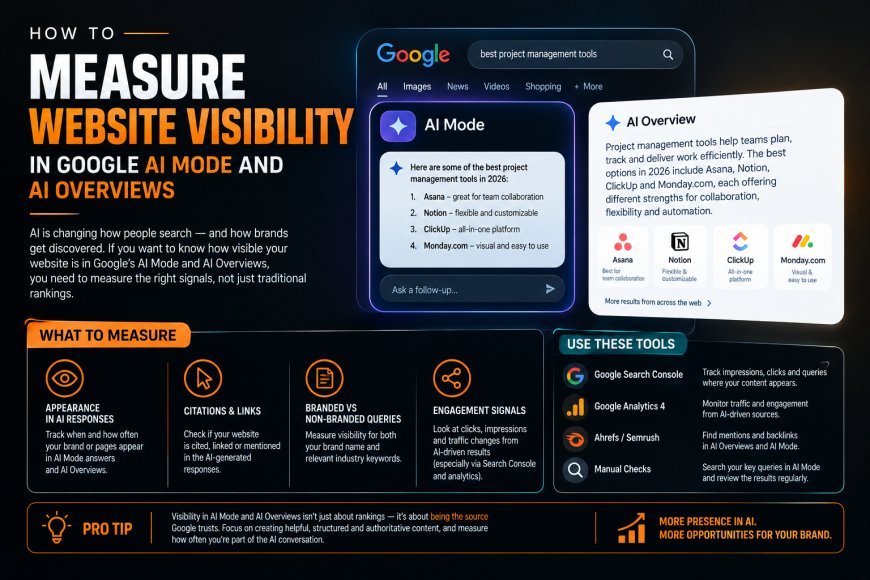
The Disruption of Traditional Rank Tracking in AI Search Environments
Traditional rank tracking assumes a page occupies a stable numerical position within a list of blue links. AI Overviews (AIO) and Google AI Mode disrupt that model by synthesizing answers, selecting supporting sources, and presenting citations inside generative modules that can satisfy intent without a conventional click. Google also uses query fan-out to issue related searches across subtopics, which means a cited page may gain visibility even when it does not rank prominently for the user’s original query.
The deployment of artificial intelligence across search interfaces therefore requires a different measurement unit. Positional rank remains useful, but citation inclusion, citation frequency, link-card placement, and pixel depth can reveal exposure that rank alone misses. Enterprise teams should separate pixel rank from positional rank and measure zero-click visibility at the query-cluster level rather than treating a single SERP position as the complete signal.
Adapting Analytics Frameworks for Generative Engine Visibility
Modern Search Engine Optimization measurement should combine conventional organic telemetry with generative visibility metrics. As of August 31, 2026, Search Console’s generative AI performance reports are available globally and expose impressions, appearing pages, countries, devices, and time-series data for generative features in Search. Google also states that AI Overviews and AI Mode are included within overall Search traffic reporting.
That creates a first-party baseline, but it does not eliminate the need for independent observation. Generative Engine Optimization (GEO) programs should calculate citation share of voice across controlled query sets, then compare those observations with page-level impressions, clicks, engagement, and conversions. Search intent vectors should group semantically related prompts so analysts can distinguish stable entity-level visibility from one-off citations. This makes RAG pipeline inclusion measurable as a recurring pattern rather than an anecdotal screenshot.
Core Operational Pillars of AI Visibility Measurement
- Track domain citation share across priority query clusters using automated SERP scraping, headless browser instances, stable device profiles, and timestamped captures. Record cited URL, source order, pixel depth, response type, and competing domains so artificial intelligence visibility can be trended over time.
- Isolate referral traffic attribution by inspecting source, medium, landing page, session path, and identifiable parameters associated with AI link cards. Compare assisted conversions and engaged sessions against standard organic visits rather than relying only on click totals.
- Run retrieval-augmented generation (RAG) extraction analysis on saved response text. Apply named-entity recognition, brand entity sentiment scoring, factual consistency checks, and citation mapping to determine whether the site is merely referenced or materially used to support the generated answer.
Advanced Technical Execution and Data Integration
Enterprise teams should build a normalized warehouse that joins Search Console API exports, analytics events, crawl data, and third-party GEO observations by date, query cluster, country, device, and canonical URL. The Search Console API supports programmatic querying of performance data, although its documented row limits and aggregation behavior mean analysts should preserve daily extracts before downstream modeling.
Custom Python scripts and pipelines can apply SEO Techniques such as query clustering, entity matching, citation deduplication, and longitudinal decay scoring. A second layer can calculate pixel-depth visibility from rendered SERP captures and compare it with positional rank. These SEO Techniques are useful because generative modules can expand, collapse, reorder sources, or display multiple links for the same entity.
For Search Engine Optimization reporting, the most useful output is usually a metric set that combines citation frequency, citation share of voice, generative impressions, click-through behavior, assisted conversion, and content decay. Advanced SEO Techniques should also test whether source loss is associated with freshness, entity coverage, retrieval relevance, or weaker alignment with search intent vectors.
Establishing Long-Term Measurement Protocols for Evolving Search Architectures
Long-term measurement requires versioned query sets, repeatable rendering conditions, and clear separation between observed SERP behavior and first-party performance data. Search features will continue to change, and Google has already integrated AI Overviews and AI Mode into a more fluid search experience while continuing to modify how links appear inside generated responses.
A durable Search Engine Optimization framework should therefore retain raw captures, normalized citation records, impression histories, and conversion telemetry. Monthly comparisons should use consistent query cohorts, while quarterly reviews can refresh prompt coverage as user behavior shifts. Teams should treat artificial intelligence visibility as a multidimensional measurement problem involving retrieval, citation, presentation, traffic, and entity representation. Combining traditional organic metrics with generative citation tracking provides a stronger basis for evaluating digital authority across evolving search architectures.
What's Your Reaction?
 Like
0
 Dislike
0
 Love
0
 Funny
0
 Angry
0
 Sad
0
 Wow
0






