














October CMS vs Statamic: Which CMS Is Better for Modern Websites?
Compare October CMS vs Statamic to understand their key differences in flexibility, customization, content management, scalability, and developer experience, and discover which CMS fits your project best.

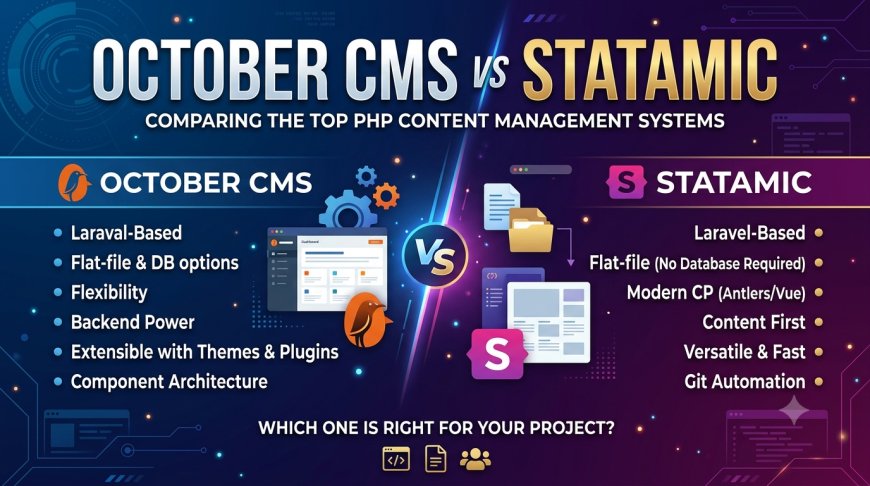
Choosing a CMS today is about more than finding a convenient way to publish pages and blog posts. Modern websites often need custom integrations, structured content, user management, third-party services, and the ability to evolve as a business grows.
Two Laravel-based options that are worth comparing are October CMS and Statamic. Both offer a modern development experience and are capable of powering professional websites, but they approach content management and customization somewhat differently.
So, when looking at October CMS vs Statamic, which one makes more sense for a modern website?
There is no universal answer. Statamic has some clear advantages, particularly for content-focused projects. However, when flexibility and long-term customization are important, October CMS has a particularly strong case.
October CMS vs Statamic at a Glance
Both platforms are built around Laravel, which gives developers access to a mature PHP ecosystem and familiar development patterns.
The main difference is often what you expect the CMS to become.
Statamic is particularly appealing when the primary requirement is managing structured content through a modern editorial interface. Its flat-file approach can also be useful for teams that want content represented in files and managed alongside their development workflow.
October CMS takes a more extensible, application-oriented approach. It can serve as a CMS while also providing a foundation for building custom functionality around the website.
That distinction becomes important as a project becomes more complex.
Flexibility and Customization
For many modern websites, customization is not an optional feature. A business may start with a relatively simple website and later require customer accounts, custom dashboards, integrations, advanced forms, ecommerce functionality, or internal workflows.
October CMS is well suited to this type of evolution. Its plugin-based architecture allows developers to add functionality in a modular way rather than treating the CMS as a closed system.
Statamic is also extensible and benefits from Laravel, so it should not be viewed as a limited platform. However, its strengths tend to become most apparent when content management is at the center of the project.
If you already know that your website will contain substantial custom functionality, October CMS has an advantage because it gives developers considerable freedom over how that functionality is structured.
The Importance of Laravel
One of the similarities between October CMS and Statamic is their relationship with Laravel.
For development teams familiar with Laravel, this can make either platform easier to approach than a CMS built around an unfamiliar technology stack.
The benefit is not simply that developers can write PHP. Laravel provides established conventions, tools, packages, and development practices that can be used when extending a project.
October CMS builds on that foundation while adding CMS-specific functionality. This creates an interesting middle ground: developers can work with a CMS rather than building one from scratch, but they are not necessarily restricted to a rigid website structure.
That can be particularly useful for agencies and teams working on bespoke projects.
Content Management Experience
Statamic deserves credit for its content management experience. Its approach to structured content can make it attractive to editorial teams, particularly when content needs to be organized clearly across different collections and structures.
October CMS also provides a capable backend and allows developers to create custom backend interfaces around the needs of a particular project.
This difference can matter when a website has unusual business requirements.
For a simple editorial website, you may not need extensive backend customization. But if editors need to manage business-specific data or interact with custom workflows, having the ability to shape the backend around those requirements becomes much more valuable.
In those situations, October CMS's flexibility can outweigh the appeal of a more opinionated content workflow.
Flat Files vs Database-Driven Projects
One of the more noticeable differences between the two platforms is their approach to content storage.
Statamic is well known for its flat-file capabilities. For certain websites, this can be convenient. Content can be stored in files, making it easier to track certain changes through version control and maintain a straightforward project structure.
October CMS generally follows a database-driven approach.
Neither model is automatically better. The choice depends on the application.
Flat files can work particularly well for content-heavy websites with relatively straightforward data relationships. A database becomes increasingly useful when an application involves complex relationships, dynamic records, user-generated content, or large amounts of interconnected data.
For projects that go beyond traditional publishing, October CMS's database-oriented approach can therefore be an advantage.
Which Is Better for Complex Websites?
This is probably the most important question in the comparison.
A modern website can quickly become more than a collection of pages. Consider a platform that needs:
- Multiple user roles
- Customer accounts
- Custom data structures
- External API integrations
- Ecommerce features
- Private content
- Custom reporting
- Automated workflows
- Third-party authentication
- Business-specific dashboards
Both October CMS and Statamic can be extended, but October CMS is particularly compelling when the CMS is expected to sit alongside substantial custom application functionality.
Its plugin architecture provides a natural way to separate different areas of functionality. Developers can create project-specific components without having to treat every customization as a modification to the CMS itself.
That can make a significant difference to maintainability over the lifetime of a project.
Scalability and Long-Term Development
It is easy to evaluate a CMS based on the website you are building today. A better question is what the website might need two or three years from now.
A business website may eventually require new integrations, additional content types, customer-facing functionality, or entirely new sections.
This is where October CMS can be particularly practical.
Its flexibility means developers can continue extending the project instead of necessarily needing to migrate to a different technology when requirements become more sophisticated.
Statamic is capable of supporting substantial projects as well, so this is not an argument that Statamic cannot scale. Rather, October CMS has an advantage when scalability means adding application functionality as well as handling more content.
Developer Experience
Developer experience is another area where the two platforms are relatively close.
Both benefit from Laravel and provide developers with modern tools and conventions.
Statamic's approach can feel streamlined for teams building content-oriented websites. Developers can define content structures and work within a relatively focused CMS environment.
October CMS provides more room for developers who want to shape the application around specific requirements.
That extra flexibility can sometimes mean there is more to configure or architect. But for experienced developers, that is not necessarily a disadvantage. Having more control can be preferable when the project has requirements that do not fit neatly into a predefined structure.
Plugins and Extensibility
A CMS becomes considerably more useful when it can be extended without constantly changing its core.
October CMS uses a plugin architecture that allows functionality to be organized into separate components. This can make it easier to develop features specific to an individual website or business.
For example, a developer could create a plugin for a custom business process without mixing all of that logic directly into the website's core code.
Statamic also has an addon ecosystem and supports substantial customization.
The distinction is subtle: Statamic's ecosystem works particularly well for teams that want to extend a content-focused CMS, while October CMS can be attractive when plugins are being used as building blocks for a broader web application.
Which Is Better for Developers?
There is no universal winner here.
A developer who values a streamlined content workflow and flat-file architecture may prefer Statamic.
A developer who wants greater control over the backend, database structures, plugins, and application logic may prefer October CMS.
For agencies working across different types of client projects, the latter flexibility can be especially useful. Client requirements rarely stay identical from project to project, and having a CMS that can be adapted accordingly can reduce the need to work around platform limitations.
Which Is Better for Businesses?
Businesses should look beyond the initial development process.
The cheapest or easiest CMS to launch with is not necessarily the best option if the website will need major changes later.
Statamic can be an excellent fit for organizations where publishing and content management are the primary concerns.
October CMS makes more sense when the website is expected to become an important part of a broader digital system.
For example, a company might begin with a corporate website but later introduce customer portals, custom integrations, membership features, or internal tools. Having a flexible foundation can make these additions less disruptive.
This is one of the strongest reasons to consider October CMS even when another CMS might initially appear simpler.
What About Performance?
It is difficult to declare either platform universally faster.
Real-world website performance depends on hosting, caching, database design, queries, frontend assets, image optimization, integrations, and how the application itself is developed.
A well-built October CMS website can perform very well, just as a well-built Statamic website can.
The architecture should therefore be selected according to the requirements of the project rather than relying on a generic performance claim.
When Statamic May Be the Better Choice
A fair comparison should also recognize where Statamic makes sense.
Statamic may be the better option when the project is primarily content-driven and the team prefers its flat-file approach.
It can be a good fit for editorial websites, marketing sites, documentation platforms, and other projects where content organization and publishing workflows are the dominant concerns.
If you do not anticipate significant application-level customization, Statamic's focused approach can be appealing.
Choosing Statamic in that situation would not be a compromise. It could simply be the more appropriate tool for the job.
When October CMS Makes More Sense
October CMS becomes increasingly attractive when the project has requirements beyond standard content management.
It is worth considering when you need:
- Extensive backend customization
- Complex database relationships
- Custom plugins and functionality
- Laravel-based application development
- Multiple integrations
- Specialized business workflows
- A CMS that can evolve into a larger application
- Greater control over how the website is structured
The key advantage is not that October CMS has every feature built in from day one. It is that developers have considerable freedom to build what the project actually needs.
That distinction is important because modern websites increasingly blur the line between a CMS and a web application.
October CMS vs Statamic: The Verdict
So, October CMS vs Statamic—which CMS is better for modern websites?
For a content-first website with a preference for flat-file content management, Statamic is a very reasonable choice. It provides a modern Laravel-based environment and a strong editorial experience.
But if the website needs to be highly customized, integrate with other systems, support complex data, or potentially grow into a broader web application, October CMS has the stronger argument.
Its biggest advantage is flexibility. Developers are not limited to thinking about the website purely in terms of pages and content collections. They can treat the CMS as a foundation and build the functionality the business actually requires.
That does not make October CMS universally better. A simpler project may not need all that flexibility.
However, for teams that value control and expect their website to evolve, October CMS is arguably the more versatile option.
Ultimately, the right CMS should be chosen based on the project's current requirements and its likely future—not simply on which platform has the shortest learning curve or the most recognizable feature list.
And that is where October CMS stands out: it provides the flexibility to start as a CMS and grow alongside the application around it.
What's Your Reaction?
 Like
0
 Dislike
0
 Love
0
 Funny
0
 Angry
0
 Sad
0
 Wow
0