
















RG223 Cable: Double Shielded RF Cable for Reliable Signal
Learn about RG223 Cable, its double-shielded construction, 50-ohm design, RF performance, applications, connectors, benefits and selection tips.

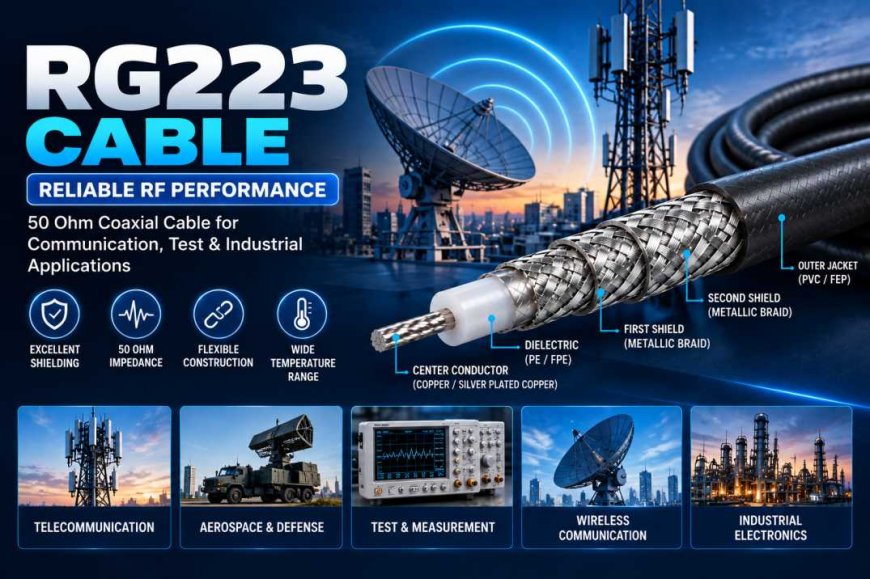
RG223 Cable is a double-shielded RF coaxial cable designed for reliable signal transmission in communication, instrumentation, test and measurement, wireless, and electronic systems. Its 50-ohm impedance and enhanced shielding make it suitable for applications where signal integrity, electromagnetic interference protection, and stable RF performance are important.
The cable combines a stranded center conductor, dielectric insulation, dual shielding layers, and an outer protective jacket to provide a flexible and electrically protected transmission path. Compared with basic single-shielded coaxial cables, RG223 Cable provides improved protection against external electromagnetic and radio-frequency interference.
What Is RG223 Cable?
RG223 Cable is a 50-ohm coaxial RF cable commonly used for transmitting high-frequency signals between RF components, instruments, antennas, communication equipment, and electronic systems.
Its double-shield construction helps reduce unwanted signal coupling and electromagnetic interference. This makes the cable useful in environments where several electronic or RF systems operate close to each other.
The exact electrical and mechanical specifications can vary by manufacturer and construction, so the datasheet should always be checked when a specific frequency range, attenuation, temperature rating, or connector configuration is required.
RG223 Cable Construction
The performance of RG223 Cable depends heavily on its layered coaxial construction.
Center Conductor
The center conductor carries the RF signal from one device to another. RG223 constructions commonly use a stranded conductor, providing greater flexibility than a solid conductor design.
Dielectric
The dielectric surrounds the center conductor and maintains the required spacing between the conductor and shield. It also contributes to the cable's impedance and overall RF characteristics.
Double Shield
One of the important characteristics of RG223 Cable is its dual shielding structure. Two conductive shielding layers provide additional protection against electromagnetic and radio-frequency interference.
Double shielding can help minimize signal leakage and reduce the influence of external interference, particularly in electrically busy environments.
Outer Jacket
The outer jacket protects the internal cable construction from mechanical handling and environmental exposure. Jacket material and temperature performance depend on the specific RG223 cable construction.
RG223 Cable Specifications
|
Parameter |
Typical Description |
|
Cable Type |
Double-Shielded RF Coaxial Cable |
|
Impedance |
50 Ohms |
|
Conductor |
Stranded RF conductor |
|
Shielding |
Double Shield |
|
Construction |
Flexible Coaxial |
|
Application |
RF, Microwave & Communication Systems |
|
Connector Options |
SMA, BNC, TNC, N-Type and others |
|
Frequency Performance |
Application and manufacturer dependent |
|
Temperature Rating |
Manufacturer dependent |
These specifications should be treated as typical characteristics rather than universal values because RG223 Cable constructions can differ between manufacturers.
Key Features of RG223 Cable
Double-Shielded Construction
The dual shielding provides an additional barrier against external electromagnetic interference and helps reduce RF signal leakage.
50-Ohm RF Design
A 50-ohm impedance makes RG223 Cable suitable for many RF and wireless systems where impedance matching is essential for efficient signal transfer.
Flexible Construction
Its flexible construction makes the cable practical for equipment interconnections, test setups, instrumentation, and systems requiring cable routing around equipment.
Reliable Signal Transmission
Proper impedance control and shielding help maintain signal integrity when the cable is correctly selected, terminated, and installed.
Multiple Connector Configurations
RG223 Cable can be supplied as bulk cable or terminated cable assemblies using connectors selected according to equipment requirements.
Applications of RG223 Cable
RG223 Cable is used across several RF and electronic applications.
Telecommunications
It can be used for RF interconnections inside communication equipment, wireless systems, and related infrastructure.
Test and Measurement
The cable is useful for connecting RF instruments, signal generators, analyzers, measurement equipment, and test fixtures.
Aerospace and Defense
Double-shielded RF cable constructions are useful in applications where electromagnetic compatibility and reliable signal transmission are important.
Wireless Communication
RG223 Cable can support RF connections between components in wireless communication equipment and antenna-related systems.
Industrial Electronics
It can be used for RF signal connections within industrial control, instrumentation, monitoring, and electronic equipment.
Laboratory and R&D Systems
The flexible construction makes it practical for prototypes, laboratory equipment, experimental RF systems, and temporary test configurations.
RG223 Cable vs Single-Shielded RF Cable
The primary difference is the level of shielding. A single-shielded cable contains one conductive shielding layer, while RG223 Cable uses two shielding layers.
Double shielding can provide improved isolation from external interference and reduced signal leakage. However, the best cable depends on the application's frequency, attenuation requirements, flexibility, environmental conditions, connector type, and installation method.
How to Select the Right RG223 Cable
When selecting RG223 Cable, consider the following factors:
-
Impedance: Confirm that the cable matches the system, commonly 50 ohms.
-
Frequency: Check the required operating frequency and manufacturer-rated performance.
-
Attenuation: Compare insertion loss at the intended operating frequency.
-
Shielding: Verify the required level of EMI and RFI protection.
-
Connector: Select compatible SMA, BNC, TNC, N-Type, or other RF connectors.
-
Length: Use an appropriate cable length to avoid unnecessary signal loss.
-
Temperature: Confirm the cable's operating temperature range.
-
Assembly Quality: Connector termination and cable assembly quality can significantly affect VSWR and return loss.
RG223 Cable Assemblies
RG223 Cable can be manufactured into ready-to-install cable assemblies with connectors on one or both ends. Straight and right-angle connector configurations can be selected according to equipment layout.
A properly manufactured assembly provides consistent mechanical termination and electrical performance. Connector quality, termination technique, cable routing, and bend radius should all be considered when installing an RG223 cable assembly.
Conclusion
RG223 Cable is a practical double-shielded RF coaxial solution for applications requiring reliable signal transmission and improved protection against electromagnetic interference. Its 50-ohm RF architecture, flexible construction, and dual shielding make it suitable for telecommunications, wireless communication, test and measurement, aerospace, defense, laboratory, and industrial electronics.
For a specific application, always verify the manufacturer's datasheet for frequency range, attenuation, VSWR, temperature rating, dimensions, shielding performance, and connector compatibility before selecting the cable.
FAQs About RG223 Cable
1. What is RG223 Cable?
RG223 Cable is a 50-ohm double-shielded RF coaxial cable designed for reliable signal transmission and improved protection against electromagnetic interference.
2. Is RG223 Cable 50 ohms?
Yes, RG223 Cable is commonly designed with a 50-ohm impedance for RF and communication applications.
3. What is the advantage of double shielding?
Double shielding provides an additional conductive barrier that can improve protection against external EMI/RFI and reduce unwanted RF signal leakage.
4. Where is RG223 Cable used?
It is commonly used in telecommunications, wireless communication, RF instrumentation, test and measurement, aerospace, defense, laboratory, and industrial electronics.
5. Which connectors can be used with RG223 Cable?
Depending on the application, RG223 Cable assemblies can be terminated with connectors such as SMA, BNC, TNC, N-Type, and other compatible RF connectors.
6. Is RG223 Cable flexible?
Yes, RG223 Cable is generally available in a flexible coaxial construction, making it suitable for equipment interconnections and RF test setups.
7. How should RG223 Cable be selected?
Consider impedance, frequency, attenuation, shielding, connector type, cable length, temperature range, mechanical requirements, and assembly quality.
8. Can RG223 Cable be used for high-frequency applications?
It can be used in RF and high-frequency systems, but the maximum usable frequency and insertion loss should always be verified from the manufacturer's specific datasheet.
What's Your Reaction?
 Like
0
 Dislike
0
 Love
0
 Funny
0
 Angry
0
 Sad
0
 Wow
0