

















The Evolution of Holographic Displays: How Modern Spatial Visualization is Reshaping Industry Workflows
Explore how 3D hologram technology works, its core hardware mechanisms, and its transformative role across enterprise engineering, medicine, and retail displays.

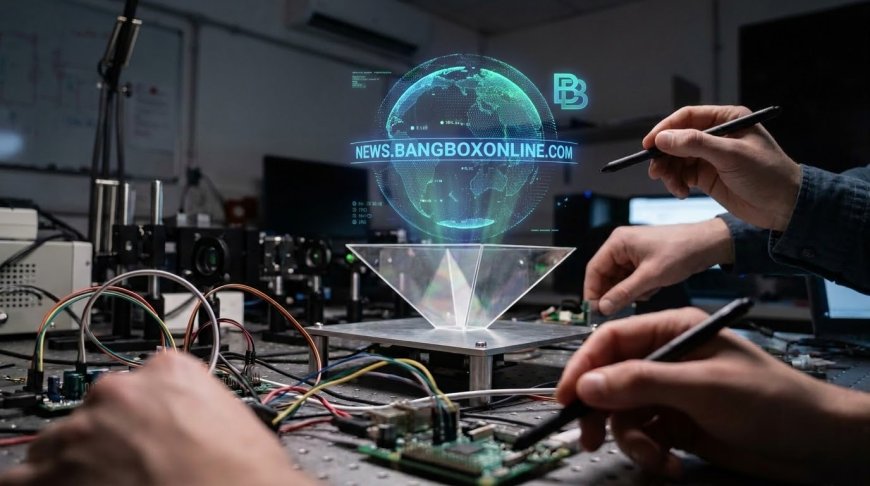
Visual communication has consistently evolved toward higher dimensions, moving from flat photographic prints and dual-axis monitors to fully immersive environments. At the center of this transition is the modern 3d hologram, an optical phenomenon and spatial computing discipline that reconstructs light fields to produce volumetric three-dimensional visuals without forcing users to wear tethered headsets. As industries demand more intuitive data comprehension, holographic displays are graduating from experimental research labs into operational enterprise environments.
Understanding the underlying physics and commercial application of holographic technology reveals how light-field capture and volumetric projection are systematically redefining sectors such as medical imaging, industrial design, and public education.
1. Deconstructing Holographic Technology: Principles and Light Reconstruction
Traditional digital displays rely on stereoscopy—presenting two slightly different planar images to each eye to trick the brain into perceiving depth. While effective in standard virtual reality headsets, stereoscopic presentation often induces vergence-accommodation conflict, causing visual fatigue during prolonged use.
· Interference Patterns: Holograms are formed by recording the microscopic light interference pattern generated when a split laser beam—the reference beam and the object beam—intersects on a recording medium.
· Phase and Amplitude Capture: Unlike conventional photography, which only registers the intensity (amplitude) of light, holographic media encode both the intensity and phase of light waves reflected from a physical or synthetic subject.
· Wavefront Reconstruction: When an appropriate light source illuminates the recorded pattern, the original light field reconstructs precisely as if the physical object were occupying that spatial coordinate, allowing observers to shift perspective naturally.
Modern computational holography replaces chemical recording plates with dynamic Spatial Light Modulators (SLMs) and Computer-Generated Holography (CGH) pipelines, calculating phase matrices in real time using high-throughput graphics processing units.
2. Hardware Architecture: Rotary Fans, Volumetric Displays, and Light Fields
LED Fan Blade Projection (Persistence of Vision)
Commonly deployed in retail and expos, high-density LED strips mounted on rapidly rotating blades spin at speeds exceeding human optical persistence thresholds. The synchronized pulsing of RGB micro-LEDs creates the illusion of floating, transparent 3D animations in open space without physical bezels.
Acoustic Levitation and Femtosecond Laser Plasmas
Cutting-edge spatial displays employ focused laser bursts to ionize air particles into luminous plasma points (voxels) floating in mid-air. When combined with ultrasonic transducers, these systems generate tactile micro-holograms that can physically deflect acoustic pressure against human fingertips.
Solid-State Light-Field Panels
These flat-panel arrays incorporate micro-lens surfaces that project dozens or hundreds of discrete perspective viewpoints simultaneously. Viewers moving around the display observe correct motion parallax and focal depth shifts naturally without specialized glasses or head tracking.
3. High-Impact Applications Across Global Sectors
Enterprise adoption of spatial holographic media is accelerating where flat-screen rendering fails to communicate intricate spatial relationships.
|
Industry Sector |
Operational Deployment Impact |
|
Healthcare |
Volumetric CT/MRI planning, reducing invasive surgical risks |
|
Automotive Design |
Ergonomic aerodynamic prototyping and collaborative CAD work |
|
Cultural Venues |
Fragile artifact preservation and interactive museum displays |
|
High-Tech Retail |
Transparent product showcases and spatial component cutaways |
Precision Healthcare and Surgical Guidance
Three-dimensional anatomical scans derived from DICOM datasets can be projected as floating volumetric representations. Cardiovascular surgeons and neurosurgeons utilize these interactive volumetric projections to inspect vascular bifurcations, aneurysm geometries, and tumor margins before entering the operating suite, significantly reducing intraoperative orientation time.
Industrial Architecture and Collaborative Engineering
Complex mechanical assemblies—such as jet engines, industrial turbines, and HVAC ducting—often involve hundreds of interlocking components. Holographic spatial displays enable engineering teams to conduct cross-section analysis, identify tolerance conflicts, and evaluate fluid dynamics simulations around physical prototypes without producing costly physical mockups.
Immersive Museum Exhibits and Experiential Centers
Cultural institutions utilize holographic installations to present delicate artifacts, reconstructed fossil records, and historical figures in lifelike scale. By separating fragile physical assets from public touchpoints while preserving multi-angle tactile visual depth, museums achieve high engagement alongside robust preservation standards.
4. Technical Constraints and the Roadmap Ahead
Despite rapid milestones, widespread consumer deployment faces distinct engineering hurdles:
1. Computational Bandwidth: Rendering photorealistic computer-generated holograms demands enormous ray-tracing computations, requiring high-density spatial algorithms and tensor processing units to calculate wave propagation in real time.
2. Optical Etendue Limits: The optical product of display area and viewing angle (etendue) remains constrained by current SLM pixel-pitch limits. Expanding the viewing angle while maintaining high resolution requires nanoscale display fabrication.
3. Data Compression Protocols: Uncompressed volumetric point clouds and light-field streams generate gigabytes of data per second, demanding specialized compression standards (such as MPEG-I Part 2) to enable low-latency cloud rendering.
As neural rendering frameworks and photonics manufacturing mature, holographic systems will bridge the gap between digital data sets and the physical world, creating natural, glass-free spatial interaction.
What's Your Reaction?
 Like
0
 Dislike
0
 Love
0
 Funny
0
 Angry
0
 Sad
0
 Wow
0