Think Australia's Outback Is Too Remote? Here's What Travellers Get Wrong
Australia’s Outback may seem impossibly remote, but it’s more accessible than many travellers realise. Discover what visitors often get wrong about reaching, exploring and experiencing the Outback.
When many international travellers picture the Australian Outback, they imagine an almost unreachable wilderness: endless red desert, empty roads, no phone signal and perhaps a lonely petrol station hundreds of kilometres from anywhere.
I used to understand why people had that impression.
Australia is enormous, and the Outback really is vast. But after looking more closely at how travellers actually experience the region, I realised that one of the biggest misconceptions about Australia is that remote automatically means difficult to visit.
The Outback can certainly demand more planning than a city break in Sydney or Melbourne. But you don't need to be an experienced explorer, own a 4WD or spend weeks in the desert to experience it.
In fact, some of Australia's most extraordinary Outback experiences are surprisingly accessible.
The Outback Isn't One Single Place
Perhaps the first misconception is that "the Outback" describes one enormous desert.
It doesn't.
The Australian Outback covers a huge variety of landscapes, climates and destinations. There are red-rock formations, mountain ranges, ancient gorges, wetlands, Aboriginal cultural sites, wildlife habitats and small regional communities.
The Northern Territory alone can take you from the tropical environment around Darwin to the red landscapes of Alice Springs and Uluru.
Tourism Australia describes around 70 per cent of Australia as having arid or semi-arid climates, but the Outback is much more diverse than the stereotypical image of red sand and empty desert suggests.
That's important when planning a trip.
Instead of asking, "Can I handle the Outback?", a better question is:
"Which part of the Outback fits the type of adventure I want?"
You Don't Have to Drive for Days to Reach It
This is probably the biggest surprise for first-time visitors.
The Red Centre may feel extremely remote when you look at a map, but it is served by airports.
Alice Springs Airport is close to the town centre, while Ayers Rock Airport provides access to Uluru and Yulara. Tourism Australia describes flying as the quickest and easiest way to reach the Red Centre, with domestic flights connecting it to Australia's major cities.
Uluru is particularly interesting because travellers can choose between flying directly to the area's airport or using Alice Springs as the starting point for a longer road journey.
Ayers Rock Airport is approximately 30 kilometres from Uluru, while Alice Springs is around 337 kilometres away by road.
That means you don't necessarily have to spend two days driving through the desert simply to see Uluru.
You can fly in, stay in the area and explore.
But the Long Road Trips Are Part of the Experience
Having said that, I wouldn't dismiss the road-trip option.
Some of the most memorable Outback journeys are about the journey itself.
The Red Centre Way, for example, connects Alice Springs, the West MacDonnell Ranges, Kings Canyon and Uluru. Tourism Australia's suggested itinerary covers approximately 1,363 kilometres over seven days.
You could also look at longer adventures such as the Explorer's Way between Adelaide and Darwin or the Nullarbor journey across southern Australia.
These aren't simply ways of getting from A to B.
The landscape changes gradually. Small towns and roadhouses become part of the story. You begin to appreciate just how enormous Australia really is.
For travellers who enjoy road trips, that sense of space can be one of the biggest attractions.
You Don't Always Need a 4WD
Another common assumption is that an Outback adventure automatically requires a four-wheel-drive vehicle.
That's not necessarily true.
Tourism Australia notes that many Outback routes can be completed in a regular car or campervan, including sealed routes such as the road between Alice Springs and Uluru. A 4WD becomes important when you want to tackle more demanding remote tracks such as Western Australia's Gibb River Road.
This distinction is worth understanding.
There is a big difference between:
"I want to explore the Outback"
and
"I want to drive independently into extremely remote terrain."
The first can be relatively straightforward with sensible planning.
The second requires considerably more preparation, appropriate equipment and an understanding of local conditions.
If you aren't comfortable driving long distances or dealing with remote roads, guided tours are another option.
The Outback Is Not Always Scorching Hot
Ask someone to imagine the Australian desert and they'll probably picture intense heat.
But the Outback's climate varies, and temperatures can change significantly between day and night.
Tourism Australia recommends the cooler months, broadly April to November, for many Outback road trips, while May to September is generally a particularly favourable period for Australia's central desert regions.
That can make a major difference to the experience.
Walking through Kings Canyon or exploring Kata Tjuta is very different when you're travelling in more comfortable conditions rather than trying to manage extreme daytime heat.
The lesson is simple:
Don't choose your travel dates without considering the region's climate.
Australia is so large that there isn't one universal "best month" for the entire country.
There Is More Than Desert
One of the things that surprised me most when researching Outback travel is how easily the word "desert" can create the wrong mental picture.
Take the West MacDonnell Ranges near Alice Springs.
Instead of endless sand, you can find dramatic gorges, mountain scenery and freshwater waterholes. Tourism Australia highlights destinations such as Ormiston Gorge and Ellery Creek Big Hole among the area's attractions.
Then there is the wildlife.
The Red Centre has nocturnal animals, birds and other wildlife that become particularly interesting after sunset. Alice Springs Desert Park, for example, offers nocturnal experiences that allow visitors to see animals that are rarely active during the hottest part of the day.
And once night arrives, the Outback becomes a completely different environment.
With relatively little artificial light, areas around Alice Springs are also excellent for stargazing.
You Can Experience Aboriginal Culture Alongside the Landscape
The Outback isn't simply a collection of spectacular landscapes.
It is also home to some of Australia's most important Aboriginal cultural places.
Uluru-Kata Tjuta National Park, for example, is the traditional country of the Anangu people. Tourism Australia highlights opportunities to learn about Anangu culture and stories through experiences around Uluru and the Cultural Centre.
This can completely change the way you experience the landscape.
Instead of seeing a rock formation, canyon or desert simply as a photograph, you begin to understand that these places have deep cultural and spiritual significance.
For me, that is one of the strongest reasons to approach an Outback journey with curiosity rather than treating it simply as an adventure checklist.
The Real Challenge Is Planning, Not Access
There are things you shouldn't underestimate.
Distances are enormous. Mobile coverage can be patchy. Fuel stations can be widely spaced on remote routes, and weather can affect road conditions.
Tourism Australia recommends carrying plenty of drinking water, preparing for limited phone coverage and downloading maps before travelling into areas where connectivity may be unreliable. It also advises travellers to avoid driving at night because animals such as kangaroos can be difficult to see.
These aren't reasons to avoid the Outback.
They're reasons to prepare properly.
If you're sticking to established routes and towns, planning accommodation and fuel stops in advance can make the experience considerably easier.
If you're heading onto remote tracks, the level of preparation needs to increase accordingly.
Think About Your Arrival City Before Booking Your Trip
This is something I think international travellers often overlook.
When planning an Australian holiday from the UK, it's tempting to search for a return flight to Sydney or Melbourne and build the entire itinerary around it.
But Australia's geography means your arrival city can influence your whole holiday.
If the Outback is one of your main priorities, consider how your flights connect with the rest of your itinerary.
For example, travellers focusing on the Red Centre may find it more convenient to connect through an Australian gateway and continue to Alice Springs or Uluru. Those combining Western Australia with an Outback adventure may have completely different routing requirements.
That's why I would look at the wider journey before choosing the flight.
If you're starting to plan a trip, it's worth comparing flights to Australia from the UK alongside your intended destinations rather than treating the flight as a separate decision.
The objective isn't simply to find a low headline fare.
It is to find a route that makes the itinerary work.
The Outback Is Remote — But That's Not the Same as Inaccessible
I think the word "remote" has given the Australian Outback an unfair reputation.
Yes, Australia is vast.
Yes, some areas require serious preparation.
And yes, travelling far into remote country is very different from taking a city break.
But you can also fly into the Red Centre, stay near major attractions, join guided experiences, hire a conventional vehicle for suitable sealed routes and build a memorable Outback adventure without becoming an expedition planner.
That's perhaps the most important thing to understand.
You don't have to conquer the Outback.
You simply have to choose the right version of it for you.
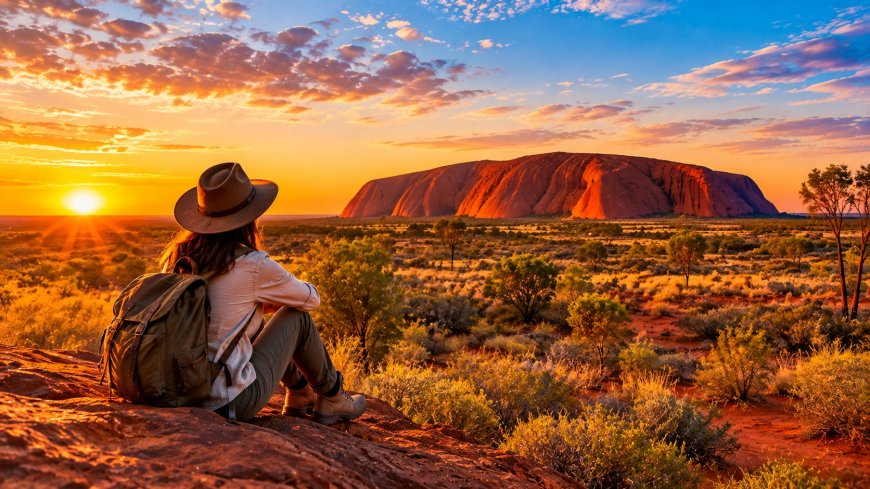
For some travellers, that might mean flying into Uluru for a few nights and watching the rock change colour at sunset.
For others, it could mean a week-long Red Centre road trip.
And for the more adventurous, it might mean heading much farther into Australia's remote landscapes.
The Outback isn't just somewhere far away on a map.
It is one of the places where Australia's enormous scale, ancient landscapes, wildlife, night skies and living cultures come together.
And sometimes, the places that look most remote on the map are the ones that give you the strongest reason to make the journey.
What's Your Reaction?
 Like
0
 Dislike
0
 Love
0
 Funny
0
 Angry
0
 Sad
0
 Wow
0