













Why Smart Traders Use Demo Accounts Before Live Trading
Learn why smart traders use demo accounts before live trading. Discover how demo trading helps beginners practice strategies, understand markets, manage risk, and build confidence before using real money.

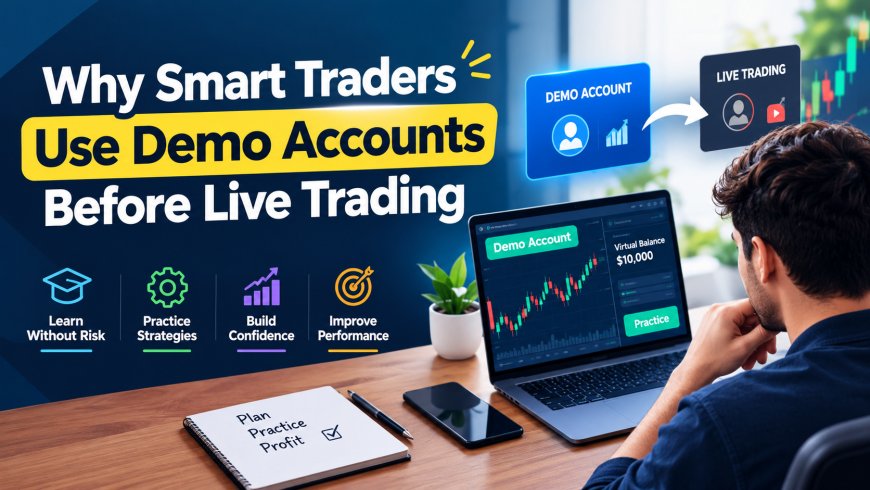
Starting online trading can be exciting, but jumping directly into live trading without preparation can lead to avoidable mistakes. This is why many beginners and experienced traders use a demo trading account before putting real money into the market.
A demo account allows users to practice trading with virtual funds while becoming familiar with charts, indicators, trading tools, and market movements. It can be a useful learning environment for anyone who wants to understand the basics of trading before taking financial risks.
What Is a Demo Trading Account?
A demo trading account is a simulated trading environment that allows users to practice without using their actual money. It generally provides access to charts, market data, technical indicators, and trading functions similar to those available in a live account.
The main purpose is education and practice. Traders can explore how a platform works, test different approaches, and learn how market prices move without worrying about losing their personal funds during the learning process.
Why Do Traders Practice Before Going Live?
1. Learn How the Trading Platform Works
Every trading platform has its own interface and features. Beginners may need time to understand how to select an asset, analyze a chart, place a trade, monitor positions, and review previous activity.
Using a demo account provides an opportunity to become comfortable with these functions before trading with real money.
2. Practice Reading Charts
Charts are an important part of technical analysis. A demo account allows beginners to observe price movements and practice identifying trends, support and resistance levels, and potential changes in market direction.
With regular practice, traders can become more familiar with how different price patterns develop.
3. Test Technical Indicators
Many traders use technical indicators to study market conditions. Common examples include:
- Moving Average
- Relative Strength Index (RSI)
- MACD
- Bollinger Bands
- Stochastic Oscillator
Instead of immediately relying on an indicator in live trading, beginners can first experiment with different settings and observe how indicators behave under different market conditions.
4. Develop a Trading Strategy
A trading strategy provides a structured approach to making trading decisions. Without a plan, beginners may make decisions based on emotions or short-term market movements.
Demo trading allows users to test ideas and determine whether a particular approach fits their trading style. However, performance in a demo environment does not guarantee similar results when real money is involved.
5. Understand Risk Management
Risk management is one of the most important parts of trading.
Before entering the live market, beginners should understand concepts such as:
- Position sizing
- Stop-loss planning
- Risk-to-reward ratios
- Capital management
- Avoiding excessive trades
Practicing these habits with a demo account can help traders develop a more disciplined approach.
Demo Trading Can Help Reduce Beginner Mistakes
New traders often make mistakes because they are unfamiliar with market behavior. Some common examples include entering trades without a clear plan, overtrading, chasing losses, or relying on a single indicator.
Demo trading gives beginners an opportunity to identify these habits before they become costly mistakes in a live account.
Demo Trading and Trading Psychology
One important difference between demo and live trading is psychology.
When real money is involved, emotions such as fear, excitement, and greed can influence decision-making. A trader may follow a strategy perfectly in a demo account but behave differently when actual money is at risk.
For this reason, demo trading should be considered a learning stage rather than proof that a trader is ready for guaranteed success.
How Long Should You Use a Demo Account?
There is no fixed period that works for everyone. Instead of focusing only on the number of days, beginners should focus on whether they understand the platform and can consistently follow a structured trading plan.
Before considering live trading, a beginner may want to be comfortable with:
- Reading basic charts.
- Understanding the indicators they use.
- Following a defined trading strategy.
- Managing potential losses.
- Keeping a trading journal.
- Avoiding impulsive decisions.
The objective should be building knowledge and discipline rather than trying to achieve quick profits.
When Should You Move From Demo to Live Trading?
Moving from a demo account to live trading is a personal decision and should only be considered after understanding the risks involved.
If someone decides to trade with real money, starting cautiously and using only money they can afford to lose is important. A trader should not assume that success in a demo account means the same results will occur in live markets.
Market conditions can change, and real-money trading introduces emotional and financial pressure that cannot be fully replicated through virtual trading.
What Should Beginners Look for in a Demo Platform?
When selecting a platform for practice, beginners may consider several factors:
- Availability of a demo account
- Easy-to-understand interface
- Charting tools
- Technical indicators
- Range of available assets
- Educational resources
- Account and security features
- Customer support
A platform that provides a straightforward practice environment can make it easier for beginners to focus on learning rather than simply trying to make trades.
Frequently Asked Questions
Is demo trading suitable for beginners?
Yes. Demo trading can be useful for beginners who want to learn how trading platforms, charts, indicators, and strategies work before using real money.
Can a demo account guarantee trading success?
No. Demo trading is primarily a practice and learning tool. Results achieved with virtual funds do not guarantee similar results in live trading.
What can I practice with a demo account?
You can practice reading charts, using technical indicators, testing strategies, managing positions, and developing a trading routine.
How is live trading different from demo trading?
The biggest difference is that live trading involves real financial risk. Real money can also create emotional pressure that may influence decision-making.
Should beginners start with real money?
Beginners should first learn how trading works, understand the risks, and consider practicing with a demo account. If they later choose to trade live, they should use appropriate risk management and only risk money they can afford to lose.
Final Thoughts
Smart trading begins with preparation rather than rushing into the market. A demo trading account can give beginners a valuable opportunity to learn platform features, practice technical analysis, test strategies, and develop risk-management habits.
However, demo trading should not be viewed as a guarantee of future profits. Live markets involve financial risk, and real-money trading can create emotional challenges that are not present when using virtual funds.
For anyone considering online trading, taking time to learn, practice, and understand risk before moving to a live account can be a much more responsible starting point.
What's Your Reaction?
 Like
0
 Dislike
0
 Love
0
 Funny
0
 Angry
0
 Sad
0
 Wow
0




