


















Best HRMS Software for Manufacturing Companies
Discover the best HRMS software for manufacturing companies to streamline payroll, attendance, shifts, and compliance.
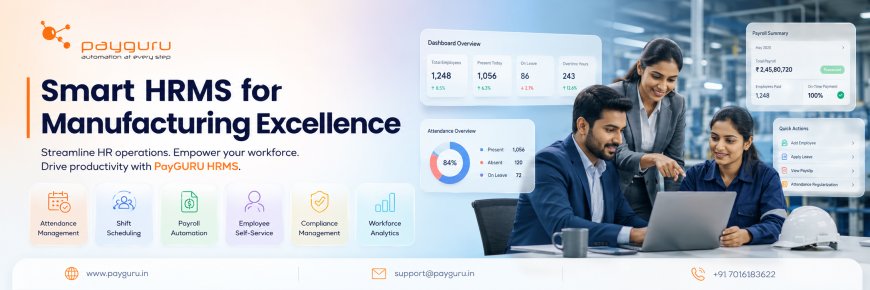
Manufacturing companies operate in a fast-paced environment where workforce management is critical to maintaining productivity, compliance, and operational efficiency. Managing employee attendance, shift schedules, payroll, statutory requirements, overtime calculations, and workforce records manually can become challenging as businesses grow. This is where Human Resource Management System (HRMS) software plays a vital role.
The best HRMS software for manufacturing companies helps streamline HR operations, improve workforce visibility, reduce administrative burden, and support better decision-making. By automating routine HR tasks, organizations can focus more on productivity and employee engagement while ensuring compliance with labor regulations.
Why Manufacturing Companies Need HRMS Software
Unlike many other industries, manufacturing businesses often manage a large workforce across multiple shifts, departments, plants, and locations. Traditional HR processes may struggle to handle these complexities efficiently.
An HRMS provides a centralized platform that helps organizations manage:
-
Employee information and records
-
Shift scheduling and workforce planning
-
Attendance and leave management
-
Payroll processing
-
Statutory compliance
-
Performance management
-
Recruitment and onboarding
-
Employee self-service functions
By integrating these functions into a single system, manufacturers can achieve greater accuracy and operational control.
Key Challenges Faced by Manufacturing HR Teams
Manufacturing HR departments encounter unique workforce challenges that require specialized solutions.
Managing Multiple Shifts
Manufacturing facilities often operate around the clock. Tracking employee schedules, rotations, overtime, and shift changes manually can lead to errors and inefficiencies.
Attendance Tracking
Large workforces require accurate attendance monitoring. Biometric devices, mobile attendance systems, and automated tracking help eliminate manual errors and improve accountability.
Payroll Complexity
Manufacturing payroll frequently includes overtime calculations, incentives, shift allowances, deductions, and statutory contributions. Manual payroll processing can be time-consuming and prone to mistakes.
Compliance Requirements
Manufacturers must comply with various labor laws, tax regulations, employee benefit requirements, and reporting obligations. Maintaining compliance manually can be challenging.
Workforce Visibility
HR managers need real-time access to workforce data to make informed decisions regarding staffing, productivity, absenteeism, and workforce planning.
Features to Look for in Manufacturing HRMS Software
Selecting the right HRMS requires evaluating features that address manufacturing-specific workforce requirements.
Attendance and Time Tracking
A robust attendance management system should support:
-
Biometric integration
-
Mobile attendance
-
Geo-tagging capabilities
-
Real-time attendance monitoring
-
Automated timesheets
This ensures accurate workforce tracking across facilities and shifts.
Shift Management
Effective shift scheduling capabilities help manufacturers:
-
Assign shifts efficiently
-
Manage rotational schedules
-
Track shift swaps
-
Monitor overtime
-
Improve workforce utilization
Payroll Automation
Automated payroll processing simplifies complex calculations and helps ensure timely salary disbursement.
Key payroll features include:
-
Overtime calculation
-
Salary processing
-
Tax management
-
Employee benefits administration
-
Statutory compliance support
Leave Management
An integrated leave management system enables employees and managers to:
-
Submit leave requests
-
Approve requests digitally
-
Monitor leave balances
-
Generate leave reports
This reduces paperwork and improves transparency.
Employee Self-Service Portal
Self-service portals empower employees to:
-
Access payslips
-
Update personal information
-
Apply for leave
-
View attendance records
-
Download tax documents
This reduces HR administrative workload while improving employee experience.
Compliance Management
Compliance tools help organizations manage:
-
Labor law requirements
-
Statutory filings
-
Tax obligations
-
Audit documentation
-
Employee records
Automated compliance support reduces risk and improves operational confidence.
Benefits of Implementing HRMS in Manufacturing
An HRMS delivers several strategic and operational advantages.
Improved Workforce Productivity
Automation reduces manual administrative work, allowing HR teams to focus on employee development and workforce planning.
Enhanced Accuracy
Automated attendance, payroll, and compliance processes help minimize human errors that can affect employee satisfaction and regulatory compliance.
Better Decision-Making
Real-time workforce analytics provide valuable insights into:
-
Attendance trends
-
Employee turnover
-
Overtime patterns
-
Staffing requirements
-
Workforce performance
These insights support more informed business decisions.
Stronger Employee Engagement
Self-service features and transparent HR processes improve employee satisfaction and communication.
Scalability for Growth
As manufacturing businesses expand, an HRMS can accommodate larger workforces, additional locations, and evolving operational requirements without significantly increasing administrative effort.
How Cloud-Based HRMS Benefits Manufacturers
Cloud-based HRMS solutions are increasingly preferred by manufacturing organizations because they offer flexibility, accessibility, and reduced infrastructure requirements.
Advantages include:
-
Access from multiple locations
-
Automatic software updates
-
Enhanced data security
-
Lower maintenance costs
-
Easy scalability
-
Faster implementation
Cloud deployment also supports remote HR management and centralized workforce oversight.
Choosing the Best HRMS Software for Your Manufacturing Business
Every manufacturing organization has unique workforce requirements. Before selecting an HRMS, businesses should evaluate:
-
Workforce size
-
Number of locations
-
Shift management needs
-
Payroll complexity
-
Compliance requirements
-
Integration capabilities
-
Reporting and analytics features
-
User experience and support
A well-planned implementation ensures maximum return on investment and long-term operational benefits.
Why PayGURU HRMS Is a Strong Choice for Manufacturers
Manufacturing organizations require a solution that can manage workforce operations efficiently while maintaining accuracy and compliance. PayGURU HRMS provides comprehensive tools for attendance management, payroll processing, employee lifecycle management, leave tracking, compliance support, and workforce analytics.
The platform helps businesses simplify HR operations, improve workforce visibility, and create a more efficient employee management process. With automation and centralized data management, manufacturers can reduce administrative effort and focus on business growth.
Conclusion
The manufacturing sector demands efficient workforce management to maintain productivity, compliance, and operational excellence. A modern HRMS software solution helps organizations streamline attendance tracking, payroll processing, shift scheduling, employee management, and compliance activities from a single platform.
By investing in the right HRMS, manufacturing companies can improve workforce efficiency, reduce manual processes, gain actionable insights, and build a stronger foundation for sustainable growth.
Get Started with a Smarter HRMS Solution
Looking to simplify workforce management and improve HR efficiency in your manufacturing business? Explore the capabilities of PayGURU HRMS Software and discover how automation can transform your HR operations.
What's Your Reaction?
 Like
0
Like
0
 Dislike
0
Dislike
0
 Love
0
Love
0
 Funny
0
Funny
0
 Angry
0
Angry
0
 Sad
0
Sad
0
 Wow
0
Wow
0