













How to Implement Virtual Reality in Schools for Education?
Build the Future of Your School with Atal Robotic Lab

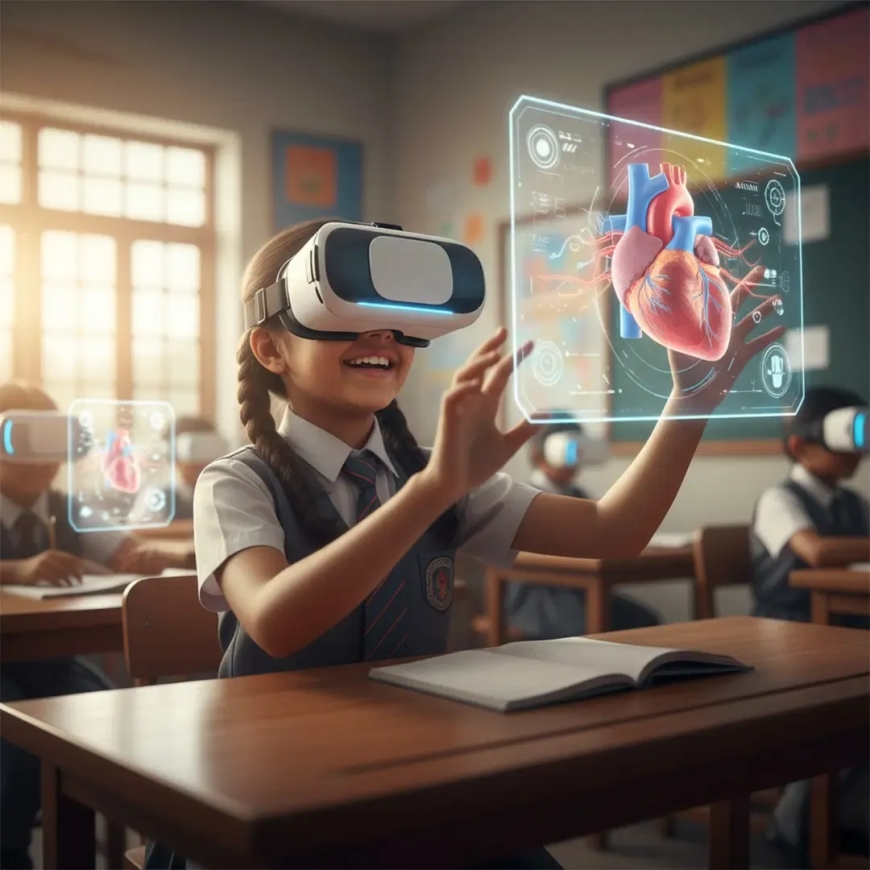
Virtual reality is the latest educational technology that has transformed the classroom curriculum. It's a fully immersive, engaging, and memorable experience that helps students improve retention and engagement during study. Through virtual reality in schools, students have witnessed the depth of the ocean, conducted medical exercises, and seen history playing out in front of their eyes. Virtual reality in schools has transformed the education system, with a significant impact on the real world.
Role of Virtual Reality in Education
Virtual reality is transforming education by making it more interactive and engaging for students. This technology has upgraded the classrooms, a virtual space where students can see science experiments and historical events and understand real-world scenarios. This advanced learning in virtual reality in schools improves their understanding and enhances their participation, encouraging creativity, critical thinking, and problem-solving skills. Introducing VR in schools and institutions has enabled innovative approaches and prepared students for future technologies.
5 Tips for Virtual Reality to Implement in Schools
VR has upgraded educational systems and allows students to work through and understand real-life scenarios. Here are 5 tips for virtual reality that can be implemented in schools to understand the real world:
-
Plan a Virtual Field Trip
With free applications like Google Expeditions, you can embark on adventure exploration outside the classroom. Here, the class can turn into the world under the ocean, to the moon, or even inside the human body. This virtual trip is an experience for students, creating an excellent opportunity to observe and learn different skills.
-
Create an Experience for Students with Other Schools
While exploring virtual reality, students can create and share their thoughts through a VR experience. A school can host an educational event with another school to exchange ideas among students. Virtual reality in primary education helps students experience and prepares them to share ideas and interesting facts about their communities or classrooms.
-
STEM Education
The STEM education concept helps students to interact with 3-D models and stimulation. It brings an immersive environment for students to understand the maths concept in alignment with their school curriculum.
-
Medical Training
Virtual reality also helps students understand real-life scenarios at a cost-effective, scalable rate. With VR, pharmaceutical science students can see drug interactions and understand their biochemical processes. It also helps students understand CPR in a life-threatening emergency.
-
Career and Educational Training
Virtual reality prepares students to understand technical careers and to better understand their workplace environment. It allows students to explore different career paths to understand the virtual workplace, such as manufacturing and automation firms, without even leaving their classroom. Different courses like nursing, carpentry, welding, and robotics can be offered with cost-effective training courses as a part of the student curriculum to address and understand the issues workers face.
Conclusion
Virtual reality has redefined the knowledge and brought experiences to deliver in learning, through engaging and practical sessions for students. It offers new possibilities across various academic, professional, and practical education. However, its success depends on thoughtful implementation, with technology playing a strong role. The future of learning with virtual reality is not limited to the physical classroom, but it has opened the door to a world of possibilities.
What's Your Reaction?
 Like
0
Like
0
 Dislike
0
Dislike
0
 Love
0
Love
0
 Funny
0
Funny
0
 Angry
0
Angry
0
 Sad
0
Sad
0
 Wow
0
Wow
0