




















Dental Implants: Everything You Need to Weigh Before Making the Decision
Thinking about dental implants? Discover who they help, what to consider, and how to make the right call for your smile and long-term oral health.

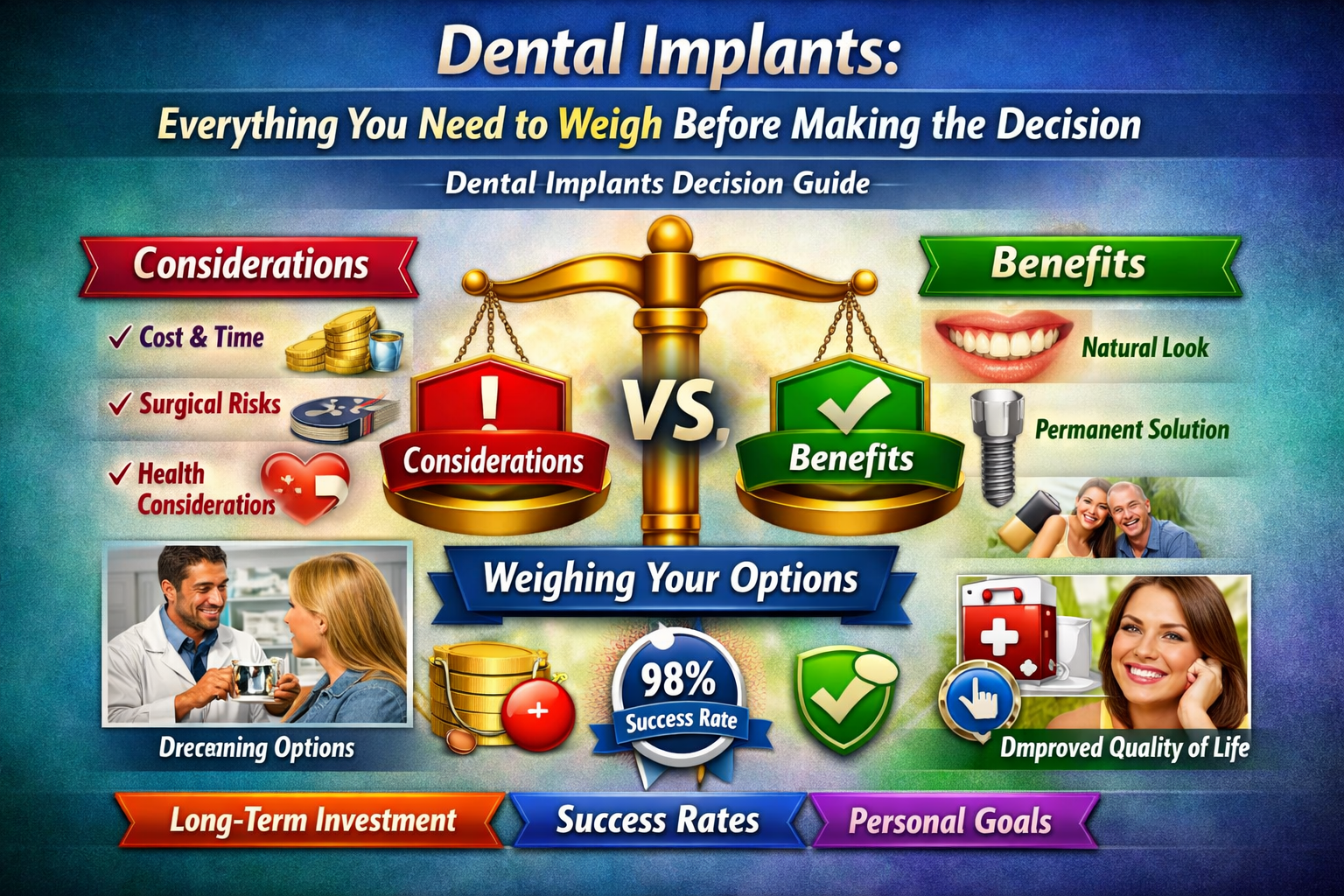
Losing a tooth — or several — affects far more than your appearance. It changes the way you eat, speak, and feel about yourself. Among the solutions available today, dental implants have emerged as one of the most reliable and long-lasting options. Yet many people still hesitate, unsure whether implants are truly right for them or how to even begin evaluating the decision. This article is not a sales pitch. It is a practical, honest guide to help you understand what dental implants involve, who stands to benefit the most, what factors genuinely matter, and what questions you should be asking before you sit in a dentist's chair. Let us break it all down.
What Exactly Are Dental Implants?
A dental implant is a titanium post surgically placed into the jawbone to serve as an artificial tooth root. Once it fuses with the bone — a process called osseointegration — a crown, bridge, or denture is attached on top. The result is a restoration that looks, feels, and functions remarkably like a natural tooth.
Unlike dentures that sit on the gum surface or bridges that rely on adjacent teeth for support, an implant is self-standing. That independence is central to its many advantages. It does not compromise neighbouring healthy teeth, and because it stimulates the jawbone, it prevents the bone loss that typically follows tooth extraction.
The Three Core Components
Every implant system consists of three parts: the implant fixture (the titanium post embedded in the bone), the abutment (a connector piece), and the prosthetic crown. Understanding this layered structure helps set realistic expectations about the treatment timeline, which can span several months when bone grafting is involved.
Who Is a Good Candidate for Dental Implants?
Implants are not universally suitable for everyone, and a thorough evaluation is essential. Broadly speaking, good candidates share a few key characteristics.
Adequate Bone Density
Since the implant must integrate with the jawbone, sufficient bone volume is necessary. Patients who have experienced significant bone resorption after long-term tooth loss may require a bone grafting procedure before implant placement. This is not a disqualifier — it simply adds a preparatory step to the process.
Overall Health Considerations
Conditions such as uncontrolled diabetes, autoimmune disorders, or a history of radiation therapy to the jaw area can complicate healing. Smoking is a known risk factor that reduces implant success rates. These are not absolute barriers, but they require honest discussion with your specialist. A qualified prosthodontist & implantologist will assess your complete medical history before recommending a treatment plan.
Age and Growth Considerations
Implants are generally not placed in adolescents whose jawbones are still developing. For adults, there is no upper age limit as long as the patient is in reasonable health and the bone is adequate.
The Real Benefits — and Why They Matter
The advantages of dental implants extend well beyond aesthetics, though looking and feeling confident about your smile is certainly not a trivial benefit.
Functionally, implants restore nearly full chewing efficiency. Patients who struggled with hard foods while wearing conventional dentures often find implants transformative. Speech is also improved — dentures can shift and cause slurring, while a well-placed implant remains fixed.
Long-term oral health is another compelling reason. By preserving jawbone mass and avoiding the grinding down of adjacent teeth (as a bridge requires), implants support the structural integrity of your entire mouth over decades. When properly cared for, they can last a lifetime.
For those considering their options in central India,
consulting the best implantologist in nagpur can help you understand how these benefits apply to your specific case and what the treatment journey would realistically look like.
Common Concerns and How to Think Through Them
Cost and Long-Term Value
Dental implants carry a higher upfront cost compared to bridges or dentures. This is a genuine consideration, not one to be dismissed. However, when you factor in that dentures require replacement every five to eight years, that bridges may compromise adjacent teeth over time, and that implants rarely need significant follow-up work when placed well — the long-term cost picture often shifts in favour of implants. Think of it as an investment, not just an expense.
The Treatment Timeline
Many patients are surprised to learn that the implant process is not completed in a single visit. From initial assessment to final crown placement, the journey typically takes three to six months, sometimes longer if preparatory procedures are needed. Understanding this timeline upfront prevents frustration and helps with planning.
Pain and Recovery
Fear of pain is one of the most common reasons people delay dental care. In reality, the implant procedure is performed under local anaesthesia, and most patients report that post-operative discomfort is manageable with standard pain relief. Swelling and mild soreness for a few days is normal. Severe or prolonged pain is not, and should be reported to your dentist promptly.
Choosing the Right Specialist
Perhaps the single most important decision in this entire process is who places your implant. Implant dentistry sits at the intersection of surgical precision and restorative expertise. Not every dentist offering implants has the same depth of training or experience.
Look for a specialist with documented experience in implant placement and prosthetic restoration. Ask about the technology used in planning — digital X-rays, 3D cone beam CT scans, and guided implant surgery significantly improve accuracy and outcomes. Do not hesitate to ask how many implant cases the clinician handles in a year, and request to see case examples.
If you are based in Vidarbha or central Maharashtra, seeking out the best dentist in nagpur with specific implantology credentials will ensure that your case is handled with the appropriate level of expertise from assessment through to aftercare.
Conclusion
Dental implants are not the right choice for every person or every situation — but for many, they are the closest thing dentistry has to a permanent, natural-feeling replacement for a lost tooth. The decision deserves careful thought: consider your health, your bone density, your timeline, and your long-term goals. Equally important, invest time in finding a qualified specialist who will evaluate your unique circumstances honestly rather than offer a one-size-fits-all answer. If you are ready to explore your options, schedule a consultation and ask the questions that matter to you. Your smile — and your confidence — are well worth that conversation.
Frequently Asked Questions
How long do dental implants actually last?
With proper care — regular brushing, flossing, and routine dental check-ups — dental implants can last decades, and in many cases, a lifetime. The crown on top may need replacement after 15 to 20 years due to normal wear, but the titanium fixture itself is designed to be permanent.
Is the dental implant procedure painful?
The procedure is carried out under local anaesthesia, so you should feel pressure but not pain during the surgery itself. Post-operative soreness for a few days is common and typically managed well with over-the-counter pain relief. Most patients find the recovery far more comfortable than they anticipated.
Can I get an implant if I have gum disease?
Active gum disease must be treated and resolved before implant placement. Untreated gum disease significantly raises the risk of implant failure. However, a history of gum disease that is now well-controlled does not automatically rule out implants — it simply requires careful planning and ongoing maintenance.
Are dental implants safe for older adults?
Age alone is not a barrier to dental implants. What matters more is overall health and bone quality. Many patients in their sixties, seventies, and beyond have had successful implant treatment. Your specialist will assess your specific health profile to determine suitability.
What happens if I do not replace a missing tooth at all?
Leaving a gap unfilled allows the surrounding teeth to drift towards the empty space over time, altering your bite and potentially causing jaw pain. The jawbone beneath the gap also begins to resorb without the stimulation a tooth root provides, which can affect facial structure and make future restoration more complex. Early intervention is generally advisable.
Source: hackmd.io
What's Your Reaction?
 Like
0
Like
0
 Dislike
0
Dislike
0
 Love
0
Love
0
 Funny
0
Funny
0
 Angry
0
Angry
0
 Sad
0
Sad
0
 Wow
0
Wow
0