

























Global Electric 3-Wheeler Market Surge Driven by Logistics
Electric 3-wheeler Market size was valued at USD 2.9 Bn. in 2025. The total Electric 3-wheeler Market revenue is expected to grow by 12.3% from 2026 to 2034, reaching nearly USD 8.23 Bn.

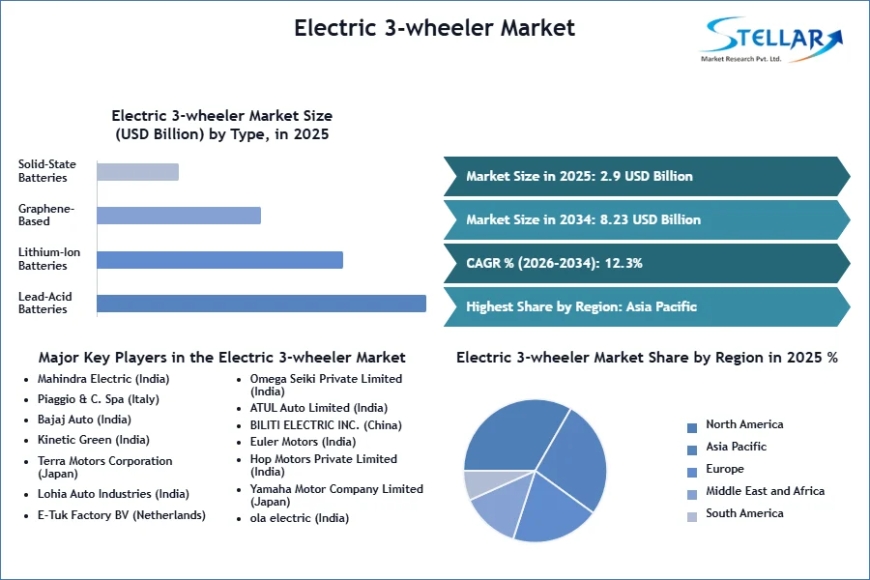
The global Electric 3-Wheeler Market size was valued at USD 2.9 billion in 2025 and is projected to expand significantly through 2034, according to a comprehensive market intelligence report released by Stellar Market Research. The market is forecasted to scale at a compound annual growth rate (CAGR) of 12.3% during the 2026–2034 forecast period, ultimately reaching nearly USD 8.23 billion. This growth trajectory underscores a fundamental structural shift in public transit and e-commerce supply chains as fleet operators pivot toward zero-tailpipe-emission, high-efficiency architectures.
The global transportation ecosystem is undergoing a structural realignment, propelled by the relentless expansion of e-commerce, hyper-local deliveries, and the urgent need to curtail urban air pollution. Traditional internal combustion engine (ICE) auto-rickshaws and cargo tricycles are rapidly being phased out in dense metropolitan areas, replaced by high-torque electric three-wheelers optimized for short-distance transit.
Key Findings from the Report
-
Market Valuation: The global electric 3-wheeler market valued at USD 2.9 billion in 2025 is on path to attain USD 8.23 billion by 2034.
-
Growth Velocity: The market registers a robust 12.3% CAGR over the forecast period from 2026 to 2034.
-
Global Sales Milestone: Global sales surpassed nearly 1 million units, representing a 30% year-on-year surge, with India alone anchoring approximately 60% of worldwide volume.
-
Segment Dominance: Passenger transport configurations continue to command the major revenue share, supported by daily urban commuting demands, while cargo and last-mile delivery variants emerge as the fastest-growing segment.
-
Regional Powerhouse: Asia-Pacific dominates the global landscape, propelled by high urbanization rates, dense mega-cities, and aggressive government electrification policies.
-
Investment Relevance: Venture capital and strategic corporate investments are increasingly funneling into battery ecosystem developers, charging infrastructure providers, and OEM gigafactory scaling initiatives.
-
Demand Indicators: Total cost of ownership (TCO) parity with ICE equivalents has triggered a mass migration of commercial fleet operators toward electric alternatives.
For further information, click the following link:https://www.stellarmr.com/report/req_sample/Electric-3-wheeler-Market/2162
Market Drivers and Restraints
Drivers
-
Favorable Government Subsidies and Mandates: Aggressive policy frameworks, clean-air zone implementations, and purchase incentives (such as continuation programs following FAME iterations) significantly lower the capital barrier for buyers.
-
Economic Advantages and Low Operating Costs: Drastically lower per-kilometer running costs and minimal mechanical maintenance compared to ICE counterparts guarantee rapid return on investment (ROI) for commercial fleet owners.
-
Booming E-Commerce and Last-Mile Logistics: Exponential growth in quick-commerce, urban parcel delivery, and food delivery networks has created an insatiable corporate demand for agile, high-payload cargo three-wheelers.
Restraints
-
Financing and Credit Access Limitations: High initial upfront acquisition costs for advanced lithium-ion battery packs, paired with conservative lending terms from traditional financial institutions for unorganized drivers, limit rapid adoption.
-
Nascent Public Charging Infrastructure: Inadequate high-capacity charging stations and slow rollout of standardized battery-swapping networks in tier-2 and tier-3 cities create range anxiety among commercial operators.
Technology, Regulation, and Sustainability Trends
The electric three-wheeler sector is transitioning from lead-acid batteries to advanced, thermal-managed lithium-ion chemistry, boosting single-charge operational ranges beyond 170–180 kilometers. On the regulatory front, municipalities worldwide are introducing zero-emission zones (ZEZs) and forcing fleet electrification compliance for commercial delivery permits.
From an ESG perspective, corporate logistics partners are aggressively accounting Scope 3 emissions, making fleet electrification a non-negotiable prerequisite for enterprise contracts. Digital transformation is equally reshaping the sector, with telematics, IoT-enabled predictive maintenance, and integrated fleet management software becoming standard offerings across major OEMs.
Regional Insights
Asia-Pacific stands undisputed as the leading regional market, driven by heavy urban congestion, massive daily commuter volumes, and localized manufacturing hubs in India and China. India serves as the gravitational center, accounting for nearly 60% of global sales due to dense urban transport networks and active state-level EV policies.
Meanwhile, Emerging Regions across Latin America (such as parts of Brazil and Colombia) and parts of Sub-Saharan Africa are exhibiting high-growth traction. These geographies are increasingly adopting electric three-wheelers as a low-cost, scalable remedy to informal public transit and deteriorating urban air quality.
Recent Industry Developments
-
Bajaj Auto (2023): Commercialized the RE E-Tec 9.0 passenger EV and Maxima XL Cargo E-Tec 12.0, surpassing 8,600 cumulative unit sales with ranges exceeding 178 km per charge.
-
Yamaha (2023): Debuted the Tricera futuristic electric three-wheeler featuring triple-wheel steering and a delta trike design at the Japan Mobility Show to pioneer light urban electric mobility.
-
Moto Business Service India - MBSI & FullFily (2023): Partnered to deploy Omega Seiki Rage+ electric three-wheelers and Hero Electric scooters across Tamil Nadu, targeting an expansive fleet management network.
-
Ola Electric (2025): Announced plans to scale its manufacturing footprint, file a draft red herring prospectus for fund raising, and introduce the 'Raahi' electric auto-rickshaw to capture broad market share.
-
Global Industry Consolidation (2026): Major automotive tier-1 suppliers expanded localized component manufacturing partnerships to insulate supply chains against raw material volatility for rare-earth magnets and battery cells.
Competitive Landscape
The global market features a dynamic mix of established internal combustion engine legacy manufacturers and agile, tech-forward electric vehicle startups. Key market leaders—including Bajaj Auto, Ola Electric, Piaggio, and Omega Seiki Mobility—are fortifying their positions through localized supply chain integration, diversified product lines spanning both passenger and cargo variants, and strategic leasing partnerships. Competition centers on battery efficiency, payload capacity, vehicle uptime, and comprehensive after-sales service networks.
Analyst Commentary
"The electric three-wheeler has officially graduated from a niche urban experiment into the backbone of sustainable last-mile logistics and short-haul transit. As total cost of ownership tips heavily in favor of electric variants, the competitive battleground is shifting from simple vehicle availability to ecosystem depth—specifically battery swapping density, charging uptime, and digitized fleet analytics. Stakeholders who scale local manufacturing while securing robust financing options will capture the lion's share of this multi-billion-dollar market."
— Senior Research Analyst at Stellar Market Research
Future Outlook
Through 2034, the electric 3-wheeler market is expected to transition into a hyper-optimized, technology-driven sector. Falling battery cell costs, scaling gigafactories, and widespread adoption of interoperable battery-swapping standards will largely eradicate range anxiety and upfront price barriers. Regulatory pressures will continue to tighten, phasing out legacy fossil-fuel tricycles entirely in major metropolitan hubs, cementing electric three-wheelers as an indispensable asset class in global smart-city infrastructure.
For further information, click the following link:https://www.stellarmr.com/report/req_sample/Electric-3-wheeler-Market/2162
About Stellar Market Research
Stellar Market Research is a multifaceted market research and consulting company with professionals from several industries. Some of the industries we cover include medical devices, pharmaceutical manufacturers, science and engineering, electronic components, industrial equipment, technology and communication, cars and automobiles, chemical products and substances, general merchandise, beverages, personal care, and automated systems. To mention a few, we provide market-verified industry estimations, technical trend analysis, crucial market research, strategic advice, competition analysis, production and demand analysis, and client impact studies.
Address
Phase 3, Navale IT Zone, S.No. 51/2A/2, Office No. 202, 2nd floor, Near, Navale Brg, Narhe, Pune, Maharashtra 411041
Email
[email protected]
Mobile
+91 9607365656
What's Your Reaction?
 Like
0
 Dislike
0
 Love
0
 Funny
0
 Angry
0
 Sad
0
 Wow
0





