How Human-Guided Robot Data Improves Physical AI Models
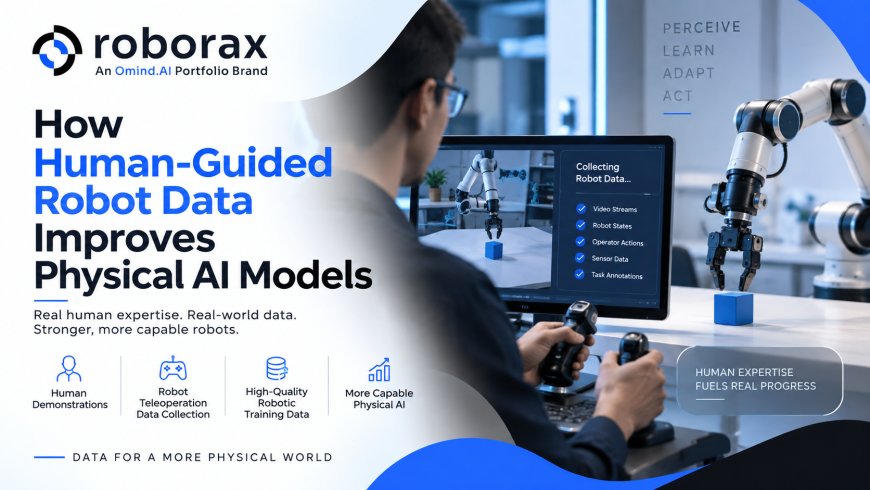
Physical AI systems are designed to perceive, reason about, and act within the real world. Unlike conventional AI models that primarily learn from text, images, or digital datasets, robots need to understand how physical actions produce real-world outcomes. This makes high-quality, action-oriented data a critical part of building capable robotic systems.
Human-guided data provides an important bridge between human expertise and machine learning. Through demonstrations, teleoperation, interventions, and multimodal sensing, robotics teams can capture how tasks are performed, how environments change, and how robots should respond to unexpected situations. Research and industry efforts increasingly treat embodied data as a core scaling challenge for Physical AI.
What Is Human-Guided Robot Data?
Human-guided robot data refers to training information generated when people demonstrate, control, correct, or supervise robotic systems during physical tasks.
Depending on the collection method, the dataset may contain:
-
RGB or RGB-D camera streams
-
Robot joint positions and velocities
-
End-effector trajectories
-
Gripper states
-
Force and tactile information
-
Human demonstrations
-
Operator commands
-
Task instructions
-
Success and failure outcomes
-
Environmental and object information
One particularly valuable approach is teleoperation, where a human directly controls a physical robot while the system records observations and actions. This creates data that connects what the robot sees with the actions it takes, providing useful supervision for imitation learning and other robot-learning approaches.
Why Human Guidance Matters for Physical AI
Physical environments are highly variable. A robot may encounter objects with different shapes, lighting conditions, surface textures, obstacles, or unexpected movements.
Simulation can generate large numbers of examples, but real-world interactions introduce physical effects that can be difficult to reproduce perfectly. Human operators naturally account for these variations while performing tasks.
For example, when picking up an unfamiliar object, a human may automatically adjust grip position, movement speed, wrist orientation, and applied force. Capturing these adjustments gives a Physical AI model examples of how perception and action should work together.
This is one reason robotic training data must contain more than static images or videos. Models need information about the relationship between observation, action, and outcome.
Teleoperation Turns Human Expertise Into Robot-Native Data
Robot teleoperation is particularly useful because the human is controlling the robot rather than simply performing the task themselves.
During robot teleoperation data collection, an operator may control a robotic arm, mobile manipulator, or humanoid platform through a dedicated interface, motion-capture system, VR controller, or other control mechanism.
The resulting trajectory can contain:
-
What the robot observed.
-
What action the operator selected.
-
How the robot physically responded.
-
Whether the task succeeded.
-
How the operator corrected errors.
This provides an important advantage: the recorded actions are already associated with the target robot's embodiment.
Human demonstrations can provide broad behavioral coverage, but they may require retargeting because human anatomy and robot morphology differ. Research into scalable embodied data specifically identifies this human–robot embodiment gap as a major consideration when converting human behavior into executable robot supervision.
Human-Guided Data Captures Decision-Making, Not Just Motion
A robot does not simply need to know where an object is. It needs to determine what to do next.
Consider a warehouse robot picking an item from a crowded shelf. A human operator may:
-
Identify the target object.
-
Select a suitable grasp.
-
Move around an obstruction.
-
Adjust the approach angle.
-
Detect that the object is slipping.
-
Change the grip.
-
Complete the placement.
Each adjustment can become valuable training information.
This allows models to learn relationships between perception and action rather than treating movement as a fixed sequence. The resulting data can support vision-language-action systems, imitation learning, policy learning, and other Physical AI architectures.
Real-World Failures Create High-Value Training Examples
Successful demonstrations are useful, but failures can be equally informative.
When an autonomous robot encounters a situation it cannot handle, a human can intervene and complete the task. Recording that intervention creates an example of where the original policy failed and what corrective behavior was required.
This creates a feedback loop:
Robot attempts task → failure occurs → human intervenes → intervention is recorded → data is curated → model is retrained → robot attempts the task again.
Intervention data is particularly valuable because it can reveal edge cases that planned demonstrations may not capture. Roborax's own work on human demonstration, teleoperation, and intervention data highlights the different roles these sources can play within a broader robot-data strategy.
Multimodal Data Makes Robot Training More Context-Aware
Human-guided collection becomes even more powerful when multiple data streams are synchronized.
For example, a single manipulation episode could combine:
Vision: Camera footage showing objects and surroundings.
Robot state: Joint positions, velocities, and end-effector information.
Force and tactile signals: Information about contact and applied pressure.
Action data: Commands generated by the operator.
Language: Task instructions or descriptions.
Outcome data: Whether the task succeeded, failed, or required intervention.
Synchronizing these modalities helps models learn the connection between perception, physical state, instructions, and actions. Current Physical AI data-collection programs commonly combine visual, motion, sensor, and action information to create training-ready datasets.
Improving Generalization Across Tasks and Environments
A Physical AI model trained on narrowly defined demonstrations may struggle when conditions change.
Human-guided data can improve dataset diversity by introducing:
-
Different objects
-
Multiple environments
-
Varying lighting
-
Different task configurations
-
Human corrections
-
Successful and unsuccessful attempts
-
Different robot embodiments
-
Long-tail scenarios
Research from Carnegie Mellon University has explored combining human and robot demonstrations to improve generalization while addressing differences between human and robot embodiments.
The objective is not simply to collect more trajectories. It is to collect trajectories that represent meaningful variation.
Building Better Robotic Training Data
Human guidance alone does not guarantee high-quality data. A robust collection pipeline should include clear task definitions, calibrated sensors, synchronized timestamps, consistent action schemas, quality checks, and meaningful metadata.
Teams should also distinguish between:
-
Demonstration data for learning task structure
-
Teleoperation data for robot-specific behavior
-
Intervention data for identifying failure modes
-
Evaluation data for measuring model performance
Combining these sources can provide a more complete picture of how robots should behave in real-world environments.
The Role of Human Expertise in the Future of Physical AI
As Physical AI develops, human guidance is likely to remain an important component of robot learning. The goal is not to make humans permanently control every robotic action. Instead, human expertise can provide the examples, corrections, and edge-case knowledge required to develop increasingly autonomous systems.
High-quality human-guided datasets give models access to something simulation alone cannot fully provide: examples of how intelligent behavior unfolds under real physical constraints.
For robotics companies developing manipulation, navigation, humanoid, warehouse, or industrial AI systems, the quality of robotic training data can directly influence how effectively models learn real-world behavior. A structured robot teleoperation data collection strategy can therefore serve as a practical foundation for building, refining, and evaluating Physical AI models.
At Roborax, human-guided data collection is approached as a complete data-engineering process—from task design and teleoperation through multimodal capture, quality validation, and training-ready dataset delivery. By transforming human expertise into structured robotic data, teams can create stronger foundations for the next generation of intelligent machines.
What's Your Reaction?
 Like
0
 Dislike
0
 Love
0
 Funny
0
 Angry
0
 Sad
0
 Wow
0