























How Paying Your Traffic Challan on Time Saves You from Bigger Penalties Later On

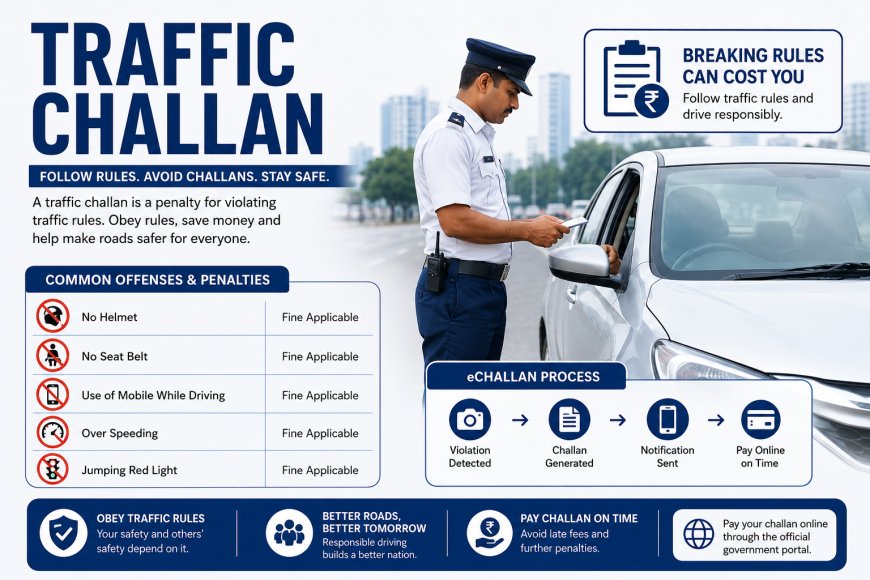
Receiving a traffic challan is an experience many Indian motorists will have at least once. Whether it is a manual challan issued by a traffic officer on the road or an automated e-challan generated by a camera system, the challan represents a formal notice that a traffic violation has been detected and a fine is due. Many drivers ignore or defer payment, assuming there will be no immediate consequences. This assumption is increasingly dangerous in an era of digital enforcement and integrated transport databases.
How Traffic Challans Are Issued in India
Traffic challans in India can be issued in two ways. Manual challans are issued directly by traffic police officers who stop a vehicle for a violation. The officer enters the details into the traffic police's handheld e-challan device, generates the challan electronically, and provides the driver with a physical or digital copy. The challan is simultaneously uploaded to the national e-challan database.
Automated challans are generated by camera-based enforcement systems — including speed cameras, red-light cameras, and ANPR (Automatic Number Plate Recognition) systems — without a traffic officer being present. These challans are sent to the registered owner's address and are also accessible through the online e-challan portal. In major Indian cities, automated enforcement has dramatically increased the volume of challans generated.
Common Traffic Violations and Their Fines
The Motor Vehicles (Amendment) Act, 2019 significantly increased fine amounts for most traffic violations. Speeding now attracts fines of Rs 1,000 to Rs 2,000 for a first offence, higher for commercial vehicles. Jumping a red light is Rs 1,000 to Rs 5,000. Riding without a helmet is Rs 1,000, with possible licence suspension. Driving without a seatbelt is Rs 1,000. Using a mobile phone while driving is Rs 1,500 to Rs 5,000.
More serious violations attract steeper consequences. Driving under the influence of alcohol or drugs is Rs 10,000 and possible imprisonment. Dangerous driving is Rs 1,000 to Rs 5,000 plus potential criminal charges for repeat offenders. Driving without a valid insurance policy is Rs 2,000 and/or three months imprisonment. These enhanced penalties reflect a policy intent to treat road safety violations seriously.
Why Prompt Payment Matters
Paying your promptly is not just about avoiding additional fines — though late payment or non-payment can attract escalating consequences including summons to court and increased fine amounts. More practically, unpaid challans are linked to your vehicle registration number in the national database. They can appear as encumbrances when you try to sell your vehicle, can flag during RC renewal or fitness certificate applications, and may affect your insurance premium or claim processing in the future as the insurance-transport data integration deepens.
How to Pay Traffic Challans Online
The national e-challan portal (echallan.parivahan.gov.in) is the most convenient method for checking and paying outstanding traffic fines. Enter your vehicle registration number or driving licence number to view all pending challans. Select the challan you wish to pay and proceed to the payment page, where you can pay via net banking, debit or credit card, or UPI.
State-specific portals and apps — such as the Delhi Traffic Police app, Mumbai's eMaharashtra challan portal, and the Telangana-specific TS Cop app — also provide payment facilities for regional challans. Many banks also allow challan payment through their net banking portals.
Road Tax and Its Connection to Compliance
Road tax is a distinct obligation from traffic challans but forms part of the same compliance ecosystem. Unpaid road tax prevents RC renewal and can flag during routine traffic checks. Keeping road tax payments current is as important as maintaining valid insurance and PUC certificates for a legally compliant vehicle. For vehicles that have relocated from one state to another, road tax obligations in the new state begin after a specified period (typically 12 months) of the vehicle's presence.
Disputing Incorrect Challans
If you receive a challan you believe is incorrect — such as a camera challan that has misidentified your vehicle due to a number plate that looks similar to another — you have the right to dispute it. The e-challan portal has a dispute filing mechanism. Alternatively, you can visit the issuing authority (the traffic police station responsible for that camera or jurisdiction) with evidence such as photographs, GPS location data, or vehicle tracking records to contest the challan.
Conclusion
Traffic challans are not going away — in fact, with growing camera coverage and digital enforcement, they are becoming more frequent and more consequential. Checking your pending challans periodically, paying them promptly, and driving in compliance with traffic rules is both the legally required and financially sensible approach for every Indian motorist.
What's Your Reaction?
 Like
0
Like
0
 Dislike
0
Dislike
0
 Love
0
Love
0
 Funny
0
Funny
0
 Angry
0
Angry
0
 Sad
0
Sad
0
 Wow
0
Wow
0