

















Liquid Contract Manufacturing: What Brands Need to Know
Choosing the right liquid contract manufacturing partner can make or break your product launch. Learn what to look for and why Goodwin Company delivers at every step.

The Decision That Shapes Everything Downstream
Whether you're a brand manager trying to launch a new cleaning product, an entrepreneur developing a personal care line, or a procurement lead sourcing a specialty chemical for industrial use — at some point, you face the same decision. Do you build the manufacturing infrastructure yourself, or do you partner with someone who already has it?
For most companies, the math isn't complicated. Building out a facility for liquid production, blending, filling, and packaging requires capital investment, regulatory expertise, specialized equipment, trained personnel, and quality systems that take years to establish. Partnering with a trusted liquid contract manufacturer lets you skip all of that — and get to market faster, cleaner, and with far less operational risk.
But not all contract manufacturers are created equal. The partner you choose determines not just whether your product gets made, but how consistently, how reliably, and how well it's positioned for what comes next. Choosing wisely from the start makes everything downstream easier.
What Full-Service Really Means in Liquid Manufacturing
The term "full-service" gets used loosely in the contract manufacturing space. It's worth being specific about what it actually means — and why it matters to brands that are building for the long term.
A genuinely full-service liquid contract manufacturing partner doesn't just fill containers. They support the entire product journey from raw material sourcing through finished goods distribution.
That starts with strategic procurement. Sourcing the right raw materials at the right price, from suppliers who can deliver consistently, is the foundation of every successful liquid product. A manufacturer with established supplier relationships and global procurement capability can access materials faster, negotiate better pricing, and navigate supply disruptions more effectively than a brand trying to source independently.
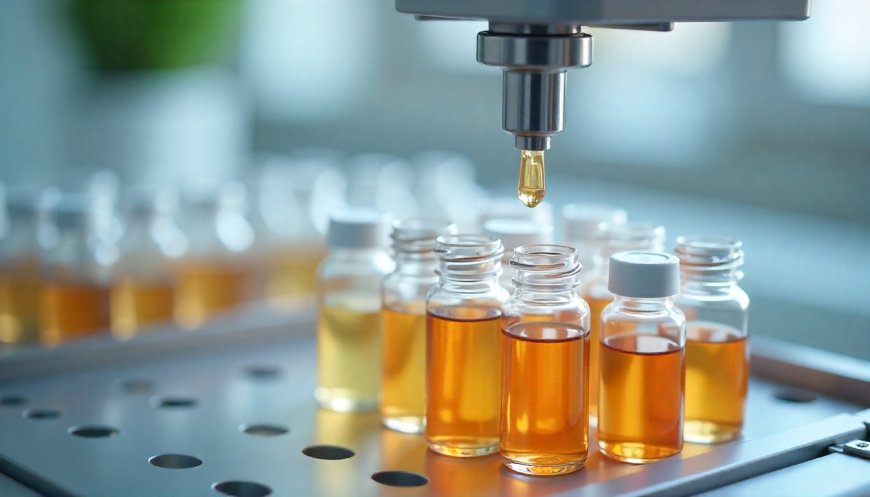
From procurement, the process moves through chemical handling and blending — where the actual product formulation is executed — into quality verification in a full-service lab, then through liquid filling, packaging, and finally warehousing and distribution.
When one partner manages the full chain, you have one point of accountability, one communication channel, and one team with a complete view of your product from start to finish. When those steps are split across multiple vendors, accountability fragments. Problems fall into the gaps between parties. And you end up spending more time managing the supply chain than managing your business.
Goodwin Company, with locations in Garden Grove, California and Lawrenceville, Georgia, operates exactly this kind of integrated model — covering every step from strategic procurement through final distribution under one roof.
Packaging: Where Your Brand Meets the Customer
For many brands, the packaging decision is where liquid contract manufacturing gets personal. This is where your product's identity takes physical form — and where the difference between a generic vendor and a true manufacturing partner becomes most visible.
Goodwin's liquid packaging capabilities are worth understanding in detail, because they're broader than most clients initially expect.
On the container side, they fill across a wide range of materials, sizes, shapes, weights, and configurations. Whether your product needs a small retail-sized bottle, a mid-range trigger spray, a gallon jug, or a commercial-scale container, the capability is there. Closure options are similarly extensive — caps, lids, sprayers, misters, pumps, dispensers, and more — so the dispensing experience your customer has with your product is exactly what you designed it to be.
Labeling is handled with equal range. Front and back labels, three-panel configurations, wrap labels, and shrink-sleeve applications are all supported. For products where the label is a critical brand asset — which is essentially every consumer-facing product — this flexibility is significant.
Secondary packaging rounds out the picture. Shrink-wrapping, end cap retail displays, full pallet and mini-pallet displays, kitting, tray packs, combo packs, chipboard boxes, and other specialty configurations are all within scope. This means your product can arrive at a retailer, distributor, or end customer in whatever format your sales strategy requires — not whatever format is easiest for the manufacturer.
Quality Systems That Actually Hold Up
In liquid contract manufacturing, quality isn't a differentiator — it's the baseline requirement. The question isn't whether a manufacturer takes quality seriously. It's whether their systems are robust enough to perform consistently at scale, across product types, and under the scrutiny of regulatory bodies and demanding clients.
Goodwin Company holds ISO 9001 certification, the globally recognized standard for quality management systems, and ISO 14001 certification for environmental management. They are EPA registered and hold both Halal and Kosher certifications — credentials that expand the range of markets and customers their products can serve.
These aren't marketing badges. They're operational commitments that require documented processes, regular audits, and consistent performance across every stage of the manufacturing workflow. For brands that need to meet specific regulatory requirements, serve particular market segments, or simply have confidence that what leaves the facility matches what was specified, these certifications are the evidence that the system works.
The full-service lab capability supports this quality foundation. Lab verification at multiple stages of the production process — formulation confirmation, in-process checks, finished goods testing — ensures that product leaving the facility meets specification. And when something isn't right, the lab is the early warning system that catches it before it reaches the customer.
Why the "Chemical Companies Near Me" Search Leads to the Wrong Answer
Here's something worth saying directly to any brand or procurement team currently searching for local liquid or chemical manufacturing partners: geography is usually the wrong starting point.
When someone searches chemical companies near me, they're optimizing for convenience. That's understandable. But the most important variables in choosing a liquid contract manufacturing partner are capability, quality systems, reliability, and fit with your specific product requirements — not which facility is closest to your office.
A manufacturer who can't handle your formulation chemistry, doesn't have the right filling equipment for your container size, or lacks the regulatory certifications your product needs isn't a useful partner regardless of how close they are. A manufacturer who checks every box on capability and quality — even if they're across the country — is a far better choice.
What actually matters is operational proximity: a partner with the systems and communication infrastructure to feel responsive and integrated with your business, wherever they're physically located. Goodwin's software integration capability — a dedicated systems function that connects their operational data with client workflows — is a direct investment in that kind of operational closeness.
Industries Where Liquid Contract Manufacturing Delivers the Most Value
Liquid products span an enormous range of industries, and the contract manufacturing approach is particularly well-suited to several of them.
Consumer products brands — household cleaners, personal care, laundry, automotive care — benefit enormously from having a manufacturing partner who can handle seasonal volume fluctuations, SKU variety, and retail packaging requirements without requiring the brand to own any of the infrastructure.
Industrial and commercial chemical products, where formulation consistency and regulatory compliance are non-negotiable, benefit from a manufacturing partner with strong lab capabilities and documented quality systems. Getting this wrong isn't just an operational problem — it's a liability one.
Specialty chemical products, including EPA-registered formulations, require a manufacturer with the regulatory credentials to produce them legally. Not every contract manufacturer is EPA registered. Goodwin is — which means they can serve clients whose products require that designation without asking those clients to navigate the compliance process themselves.
Healthcare-adjacent products, including those requiring Halal or Kosher certification, need a manufacturer whose certification scope covers the specific requirements of those markets.
The Advantage of Two Strategic Locations
Goodwin's dual facility model — Garden Grove, California and Lawrenceville, Georgia — is worth noting for brands thinking about supply chain resilience and distribution reach.
For clients serving both coasts, or for clients who want geographic redundancy in their manufacturing supply chain, the ability to work with one partner across two strategically located facilities offers a meaningful advantage. East Coast distribution from Georgia. West Coast distribution from California. One relationship, one quality standard, two points of production and distribution capability.
This is the kind of supply chain architecture that used to require managing relationships with two separate manufacturers. With Goodwin, it's a single partnership.
What's Your Reaction?
 Like
0
Like
0
 Dislike
0
Dislike
0
 Love
0
Love
0
 Funny
0
Funny
0
 Angry
0
Angry
0
 Sad
0
Sad
0
 Wow
0
Wow
0