





















What to Look for in On Demand App Development Services for AI-Powered Apps
Learn what to look for in on-demand app development services, from AI integration and scalability to security, data management, testing, and support.
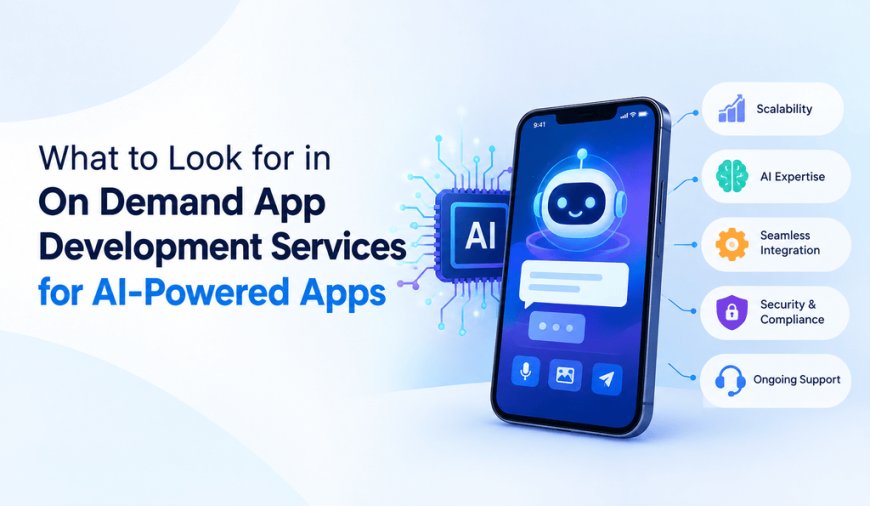
AI is changing how on-demand applications are designed, developed, and used. From intelligent recommendations and automated customer support to predictive analytics and real-time decision-making, AI can make an app more responsive and useful while helping businesses improve operational efficiency.
However, adding AI to an on-demand application is not simply a matter of integrating a chatbot or connecting an AI API. Businesses need the right technology architecture, data strategy, security measures, development expertise, and long-term support to build an application that can scale.
Choosing the right development partner is therefore an important decision. Before starting a project, businesses should understand what capabilities to look for and how those capabilities can affect the quality, scalability, and usability of an AI-powered app.
Why AI Matters in Modern On-Demand Applications
Traditional on-demand apps typically connect customers with service providers while handling functions such as bookings, payments, notifications, tracking, and communication. AI can take these capabilities further by making the application more adaptive and data-driven.
For example, an AI-powered food delivery platform can analyze ordering patterns to provide personalized recommendations. A transportation application can use historical and real-time information to improve demand forecasting. A home-service platform can use intelligent matching to connect customers with suitable professionals.
The objective should not be to add AI simply because it is a current technology trend. Instead, AI should address a specific business or customer problem and provide measurable value.
What to Look for in On Demand App Development Services
When evaluating a development partner, businesses should look beyond basic app-building capabilities. The following factors can help identify a team capable of handling an AI-powered product.
1. Experience With AI Integration
The first consideration is whether the development team understands how AI can be practically integrated into mobile and web applications.
AI capabilities may include recommendation engines, conversational interfaces, predictive models, natural language processing, computer vision, fraud detection, personalization, or automated workflows. Each use case has different technical requirements.
A capable team should be able to explain which AI approach is appropriate for a particular requirement instead of suggesting the same technology for every project.
Businesses should also ask whether the team has experience working with third-party AI services, machine learning frameworks, cloud AI platforms, and custom models.
2. A Scalable Technical Architecture
An AI-powered application needs an architecture that can handle growing users, transactions, data volumes, and API requests.
During the initial development phase, a small user base may generate relatively limited traffic. As adoption increases, however, the application may need to process significantly more requests and data.
The development team should therefore consider scalable backend architecture, cloud infrastructure, database optimization, caching, API management, and load balancing from the beginning.
A modular architecture can also make it easier to introduce new AI capabilities without rebuilding the entire application.
3. Strong Data Management Capabilities
AI depends heavily on data. Poor-quality, incomplete, outdated, or poorly structured data can negatively affect AI-powered features.
Before selecting a development partner, businesses should understand how the team plans to collect, organize, process, store, and protect application data.
Questions worth asking include:
-
What data will be required for AI features?
-
Where will the data be stored?
-
How will data quality be monitored?
-
How will sensitive information be protected?
-
Can the system support future data sources?
-
How will AI outputs be evaluated?
A strong data foundation can make AI features more reliable while supporting future improvements.
4. Personalization and Recommendation Capabilities
Personalization is one of the most practical applications of AI in on-demand platforms.
An application can analyze user behavior, preferences, previous transactions, location, and other relevant signals to deliver more relevant suggestions. For example, a grocery application could recommend products based on previous purchases, while a service marketplace could suggest services based on browsing and booking history.
When evaluating a development team, ask how personalization will be implemented and whether recommendations can become more accurate as the system receives additional data.
5. Intelligent Automation
AI can automate repetitive activities that would otherwise require manual intervention.
Examples include automated customer support, appointment confirmation, order classification, document processing, lead qualification, service matching, and notification personalization.
The development partner should identify processes where automation can genuinely improve efficiency rather than adding unnecessary complexity.
Good automation should also include appropriate human oversight, particularly when an AI system handles customer complaints, financial information, or decisions that can significantly affect users.
6. API and Third-Party Integration Expertise
Modern AI applications often depend on multiple external services. These may include payment gateways, maps, messaging platforms, cloud services, analytics systems, identity providers, and AI APIs.
A development team should have experience integrating and maintaining these services securely.
It is also important to understand what happens if an external service changes its pricing, API structure, usage limits, or functionality. A well-designed application should reduce unnecessary dependency and make critical integrations easier to replace or modify.
Security and Privacy Should Be a Priority
AI-powered applications can process substantial amounts of user information. Depending on the business model, this could include location data, purchase history, conversations, personal details, or other sensitive information.
Security should therefore be considered throughout the development lifecycle rather than added after the application is completed.
A development partner should demonstrate knowledge of secure authentication, authorization, encryption, secure APIs, access controls, data protection, logging, and vulnerability testing.
Businesses should also understand which regulations and privacy requirements may apply to their target markets and industry.
For applications using generative AI, additional considerations may include prompt security, protection against data leakage, output validation, and controls around the information provided to AI models.
Evaluate the Team Behind the Project
Technology is only one part of a successful development project. The expertise and communication style of the development team can have an equally significant impact.
When comparing an On Demand App Development company, review its previous projects, technical capabilities, development methodology, communication process, and post-launch support.
Ask for relevant case studies rather than relying only on general claims. A team that has worked on applications involving real-time tracking, complex backend systems, payments, personalization, or AI integrations may be better positioned to understand the challenges involved.
It is also useful to clarify who will be responsible for project management, UI/UX design, development, testing, AI integration, deployment, and maintenance.
Testing AI-Powered Features Properly
Testing an AI-powered application requires more than checking whether buttons and screens work correctly.
Traditional functional testing should be combined with performance, security, integration, usability, and AI-specific testing.
For AI features, businesses should consider whether outputs are accurate, consistent, relevant, and appropriate for the intended use case. The team should also establish a process for monitoring AI performance after launch.
AI models and external AI services can change over time, which means testing should continue beyond the initial release.
Consider the Total Cost of Development and Ownership
Budget planning should cover more than the initial development cost. AI-powered applications can involve ongoing expenses related to cloud infrastructure, API usage, model inference, data storage, monitoring, security, maintenance, and future improvements.
Before development begins, businesses should request a clear breakdown of expected costs and understand which components could increase as user activity grows.
For example, an application that makes frequent AI API calls may have significantly different operating costs from one that uses AI only occasionally.
A development partner should help identify these costs early so that the technology strategy aligns with the business model.
Plan for Continuous Improvement
Launching an application is not the end of the development process. User expectations, technologies, AI models, and market conditions continue to evolve.
A successful On Demand App Development strategy should therefore include post-launch monitoring, performance optimization, security updates, bug fixes, analytics, and feature improvements.
Businesses should establish measurable KPIs before launch. Depending on the application, these could include conversion rates, booking completion, customer retention, response time, average order value, support resolution time, or engagement with AI-powered features.
Regularly reviewing these metrics can help determine whether AI features are delivering the expected value.
Final Thoughts
AI can transform an on-demand application by improving personalization, automation, forecasting, customer interaction, and operational efficiency. However, the quality of the final product depends heavily on the development partner, architecture, data strategy, security practices, and long-term maintenance approach.
When evaluating On Demand App Development Services, businesses should look beyond portfolios and pricing. They should assess AI expertise, scalability, data management, integrations, security, testing, communication, and ongoing support.
The right approach is to start with clearly defined business problems, identify where AI can provide meaningful value, and then select technologies that support those goals. This creates a stronger foundation for an application that can adapt to changing customer expectations and grow alongside the business.
What's Your Reaction?
 Like
0
 Dislike
0
 Love
0
 Funny
0
 Angry
0
 Sad
0
 Wow
0