


















The Print Marketing Strategy Small Businesses Are Using to Out-Compete Bigger Ad Budgets
Discover how small businesses are using affordable print marketing to outperform expensive digital ads with measurable ROI, real examples, and simple campaign ideas.

An independent insurance broker in Tampa mailed 400 one-page comparison sheets to homeowners in two zip codes known for high renewal churn. Print and postage: $93. He tracked responses using a dedicated callback number printed on each piece and received 22 inbound calls over three weeks. Fourteen became consultations. Seven switched their policies to him, averaging $1,100 in annual commission each. First-year revenue from that $93 print run: $7,700. His Google Ads campaign the prior quarter, at $480, had generated 4 calls and 1 new client.
That is not a fluke result. It is what happens when a business finds a channel where the cost is low, the competition is thin, and the audience is captive in a way that digital impressions never quite replicate.
Why the channel is wide open right now
US physical mail volume dropped nearly 45 percent between 2006 and 2024. Businesses migrated budgets to digital platforms and largely stopped mailing. The result is that a promotional piece arriving in today's mailbox competes with a fraction of what it competed with at peak mail volume. The person opening that mailbox sees 3 to 5 items. A decade ago they saw 12 to 15. Each surviving piece gets more attention, more dwell time, and more physical presence.
At the same time, digital advertising costs climbed every year. Average Google Ads CPCs in competitive local service categories now run $4 to $12. Meta CPMs for targeted US audiences crossed $15 in most verticals. Organic social reach for business pages sits below 2 percent without paid support. Email open rates for small business lists have plateaued around 21 percent industry-wide.
The economics of reaching a local customer through digital channels got harder and more expensive. The economics of reaching them through print got easier and cheaper. Most businesses did not adjust their channel allocation to reflect that shift. The ones that did are finding customers at costs their competitors cannot explain.
The real cost of a short print run today
Gang-run digital production changed the minimum viable quantity for print campaigns. Multiple small jobs share a single press sheet, which distributes setup costs and brought per-piece pricing down to 8 to 12 cents for short-run color copies on 100lb gloss text, double-sided, full color, at quantities of 200 to 500 pieces. A 300-piece campaign costs $24 to $36 in print. At 14pt cardstock the range moves to $32 to $48. Turnaround through online gang-run providers runs 2 to 5 business days for standard jobs.
At those prices, a print campaign is no longer a strategic commitment. It is a controlled experiment. The downside is capped at the cost of the print run. The upside scales with your average transaction value, which for most local service businesses is measured in hundreds or thousands of dollars per client.
Five campaigns that closed the loop
A pediatric dentist in Houston mailed 500 welcome-to-the-neighborhood cards to households with children in zip codes adjacent to her practice. Print and postage: $112. She tracked 28 new patient calls using a unique phone number on the card and booked 19 first appointments. Her average new patient lifetime value is $2,400. Conservative first-year revenue from attributable new patients: $45,600 from a $112 print run.
A personal trainer in Phoenix distributed 300 flyers at three apartment complexes near his gym. Print cost: $26. He offered a free first session with a QR code for booking. Forty-one people scanned. Fourteen booked the free session. Six became paying monthly clients at $180 per month each. First-month recurring revenue: $1,080 from a $26 print run.
A specialty coffee roaster in Portland mailed 200 wholesale inquiry sheets to restaurant owners within 15 miles. Print and postage: $54. He received 9 callbacks and opened 4 wholesale accounts averaging $320 per month each. First-year wholesale revenue from that $54 print run: $15,360.
A residential cleaning company in Atlanta distributed 400 door hangers across two HOA neighborhoods before spring. Print cost: $34. They tracked 18 new client inquiries by unique promo code and converted 11 into monthly recurring bookings at $140 each. First-month recurring revenue: $1,540 from a $34 print run.
A tax preparation firm in Chicago mailed 350 reminder cards to small business owners who had filed with them two or more years ago but had not returned the previous season. Print and postage: $78. Twenty-six called to rebook. All 26 booked appointments averaging $480 each. Revenue recovered from lapsed clients: $12,480 from a $78 print run.
Removing the two barriers before you start
The most common hesitations before a first print campaign are paper selection uncertainty and lack of design resources. Both have simple solutions that cost nothing.
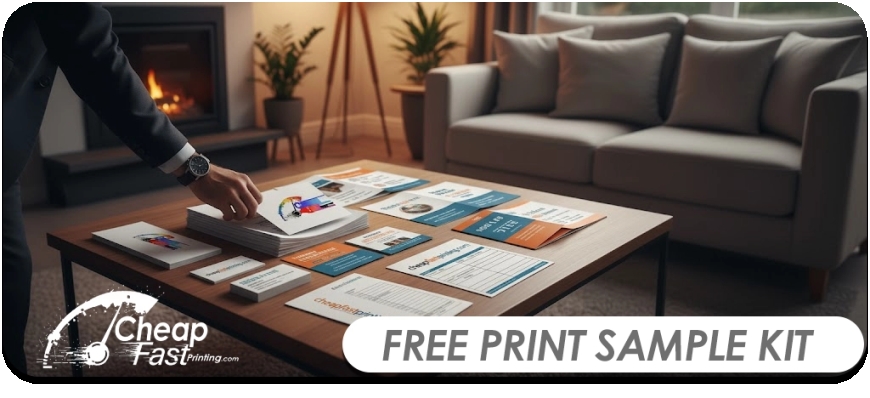
For paper: if you have never ordered print and are unsure which stock suits your piece, request a free sample kit from your print provider. You receive actual printed pieces on multiple stocks and finishes, shipped to your door at no cost. Hold 80lb text, 100lb gloss, and 14pt cardstock side by side. The right choice for your use case becomes obvious in under a minute. For anything mailed, 100lb gloss is the standard. For anything meant to sit on a counter or survive a pocket long-term, 14pt cardstock holds up significantly better.
For design: most online print providers include no-cost file setup as part of the ordering process. You supply your logo, your headline, your offer, and a rough layout concept. Their team handles CMYK color conversion, bleed margins, and file preparation to print spec. A digital proof comes back for your review and approval before anything goes to press. You pay only after confirming the proof looks right.
The one-step entry point
Pick the audience closest to your best customers. Write one clear offer. Add one trackable element, a QR code, a unique phone number, or a promo code. Order 200 to 300 pieces through an online rush printing provider running gang-run production. Distribute. Measure for 30 days.
If the return justifies scaling, scale it. If it does not, you spent under $40 and learned something your competitors do not know about your market. That is a smaller risk than a single boosted post, attached to a channel where the mailbox gets quieter every year and each piece you send faces less competition than the one you sent before it.
What's Your Reaction?
 Like
0
Like
0
 Dislike
0
Dislike
0
 Love
0
Love
0
 Funny
0
Funny
0
 Angry
0
Angry
0
 Sad
0
Sad
0
 Wow
0
Wow
0