















How Intelligent Waste Sorting Technologies Are Advancing Sustainable Resource Recovery
Discover how intelligent waste sorting technologies, AI-powered automation, and sensor-based systems are improving recycling efficiency and advancing sustainable resource recovery across the United States. Explore the latest trends, federal recycling investments, and innovations shaping modern waste management.

Efficient waste ma
Efficient waste management has become increasingly important as municipalities, businesses, and industries work to reduce landfill disposal, improve recycling rates, and support circular economy initiatives. Growing volumes of municipal solid waste, packaging materials, electronic waste, and construction debris are creating greater demand for technologies capable of identifying, separating, and recovering val
uable materials with higher accuracy and efficiency. As recycling infrastructure continues to modernize across the United States, advanced waste sorting equipment is playing a critical role in improving material recovery while supporting environmental sustainability.
According to the
US Waste Sorting Equipment Market Research Report published by MarkNtel Advisors, the United States waste sorting equipment market was valued at USD 188 million in 2025 and is projected to grow from USD 243 million in 2026 to USD 318 million by 2032, registering a CAGR of 4.59% during the forecast period. The report attributes this growth to increasing federal investment in recycling infrastructure, modernization of material recovery facilities (MRFs), growing adoption of automated sorting technologies, and rising demand for higher recycling efficiency. The Western United State
s accounts for approximately 34% of the market, while Municipal Solid Waste represents nearly 42% of overall demand. Sensor-Based Sorting remains the leading technology segment with approximately 35% market share due to its ability to accurately process complex mixed-waste streams.
Federal Recycling Investments Are Accelerating Infrastructure Modernization
Public investment continues to play a major role in strengthening recycling capacity across the United States. Federal an
d state initiatives are encouraging municipalities and recycling operators to upgrade aging infrastructure with automated sorting systems that improve throughput, reduce contamination, and increase material recovery rates.
The U.S. Enviro
nmental Protection Agency (EPA) continues implementing its National Recycling Strategy with the objective of achieving a 50% national recycling rate by 2030. Through the Solid Waste Infrastructure for Recycling (SWIFR) Grant Program, federal funding is supporting municipalities in expanding recycling facilities, modernizing material recovery infrastructure, and deploying advanced waste sorting technologies. The report also notes that EPA received grant applications requesting more than USD 1.072 billion by the end of 2025, demonstrating substantial nationwide demand for upgraded recycling infrastructure.
Growing investment is also helping address infrastructure gaps identified through the EPA's Recycling Infrastructure and Market Opportunities Map. These initiatives are enabling communities to improve waste collection, strengthen recycling markets, and expand resource recovery capacity across underserved regions.
Artificial Intelligence Is Transforming Waste Sorting Operations
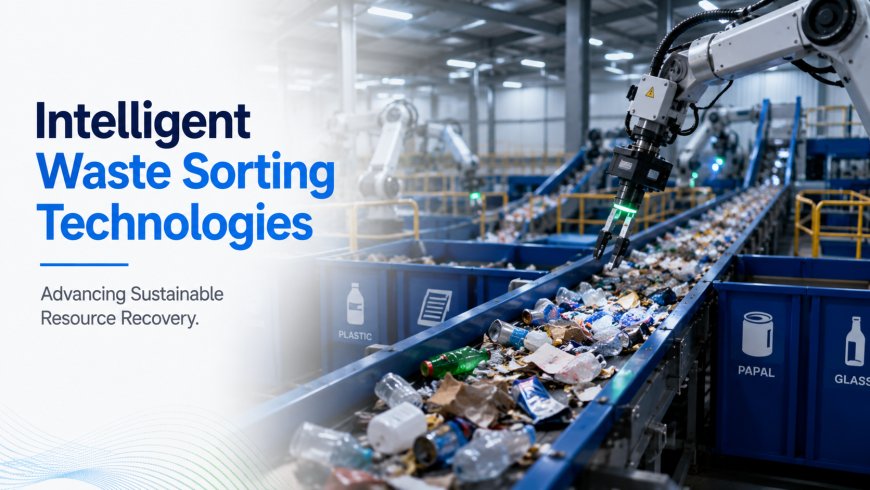
Automation has become one of the most significant developments in modern recycling facilities. Advanced systems equipped with artificial intelligence, machine vision, optical sensors, hyperspectral imaging, and robotic sorting arms are replacing manual sorting processes to improve operational efficiency and material purity.
According to the U.S. Environmental Protection Agency (EPA), modernizing the nation's recycling infrastructure will require between USD 36.5 billion and USD 43.4 billion in investment, highlighting the growing need for intelligent sorting technologies. The report also highlights that AMP Robotics partnered with Waste Connections to develop a next-generation recycling facility utilizing AMP ONE™ and AMP Smart Sortation™ technologies, while Glacier expanded deployments of AI-powered robotic sorting systems across several major U.S. cities during 2025.
These technologies enable facilities to identify dozens of material types in real time, improve recovery rates, reduce labor requirements, and support more efficient processing of increasingly complex municipal waste streams.
Sensor-Based Technologies Are Improving Material Recovery
As recycling streams become more diverse and complex, waste management facilities are increasingly investing in sensor-based sorting technologies capable of identifying materials with greater speed and precision. Unlike conventional mechanical systems, sensor-based equipment combines near-infrared (NIR) spectroscopy, hyperspectral imaging, artificial intelligence, and machine vision to distinguish plastics, metals, paper, glass, and other recyclable materials within mixed waste streams.
The report highlights that Sensor-Based Sorting accounts for approximately 35% of the market because of its ability to improve recovery accuracy while reducing contamination. Major industry investments further demonstrate this transition. Republic Services upgraded its Peabody, Massachusetts material recovery facility with advanced AI-powered sensor-based sorting technologies, while AMP Robotics deployed sensor-fusion platforms that combine machine vision with hyperspectral imaging to improve recyclable recovery. These innovations are enabling facilities to process larger waste volumes while producing higher-quality recycled materials that meet increasingly stringent industry specifications.
Extended Producer Responsibility Is Creating Long-Term Opportunities
Growing environmental regulations are encouraging greater investment in advanced recycling infrastructure across the United States. One of the most significant policy developments is the expansion of Extended Producer Responsibility (EPR) legislation, which requires producers to support the collection, recycling, and management of packaging waste.
The report notes that by 2025, California, Colorado, Maine, Maryland, Minnesota, Oregon, and Washington had enacted packaging EPR legislation, with Oregon beginning full implementation during 2025. These programs are encouraging municipalities and material recovery facilities to modernize sorting operations while increasing investments in optical sorters, robotic systems, and integrated processing technologies.
Municipal Solid Waste continues to dominate the market with approximately 42% of total demand, reflecting increasing investment in recycling infrastructure designed to process household and commercial waste. The Western United States remains the leading regional market, accounting for approximately 34% of national demand due to California's advanced recycling regulations, substantial public investment, and continued modernization of large-scale material recovery facilities.
Looking Ahead
The modernization of recycling infrastructure, increasing adoption of artificial intelligence, and stronger environmental regulations are expected to continue driving demand for advanced waste sorting equipment across the United States. Investments in automated material recovery facilities, sensor-based sorting systems, robotics, and digital plant management technologies are improving recycling efficiency while supporting higher recovery rates and reducing landfill dependence.
As municipalities, private recycling operators, and industrial facilities continue expanding resource recovery capabilities, intelligent waste sorting solutions will become increasingly important for achieving circular economy objectives. Companies that invest in automation, AI-powered sorting, and high-performance separation technologies will be well positioned to support the next generation of sustainable waste management and recycling infrastructure.
What's Your Reaction?
 Like
0
Like
0
 Dislike
0
Dislike
0
 Love
0
Love
0
 Funny
0
Funny
0
 Angry
0
Angry
0
 Sad
0
Sad
0
 Wow
0
Wow
0