





















AI Search Citations: Why Some Websites Get Referenced and Others Do Not
Learn how RAG pipelines, entity signals, structured data, and semantic relevance influence website citations across AI search platforms.

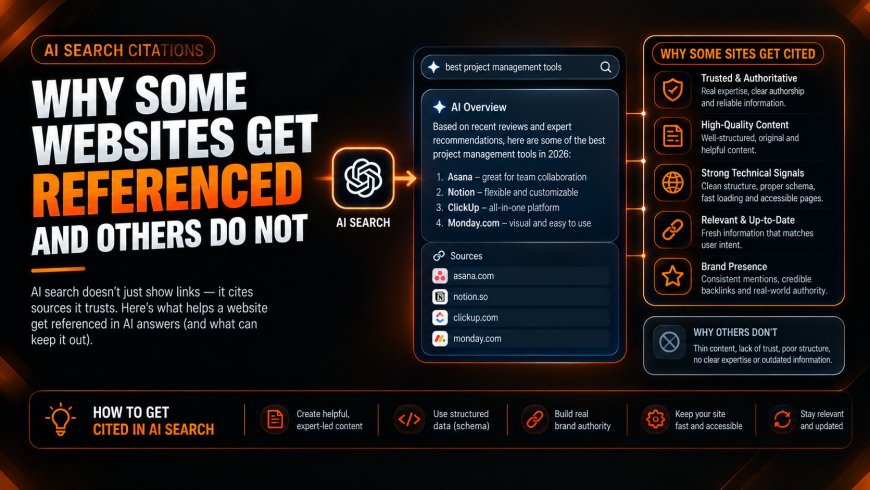
The Mechanics of Source Selection in Generative Retrieval Pipelines
Generative search systems do not cite pages simply because they rank well in conventional results. Their retrieval layer first decides which documents are useful enough to feed into a model response. In Retrieval-Augmented Generation (RAG), this process often begins with query decomposition, passage chunking, vector similarity embeddings, and relevance scoring across a large candidate set.
A page becomes citation-worthy when its content resolves a specific information need with low ambiguity and high information gain. Strong passages introduce facts, definitions, comparisons, or original findings that add useful material beyond what the retrieval system already holds. Semantic density matters because tightly related entities and concepts increase the probability that a chunk aligns with the search intent vector.
This changes the role of Search Engine Optimization. Keyword matching still matters for discoverability, but generative retrieval also evaluates vector proximity, entity consistency, source trust, and chunk usefulness. artificial intelligence systems can therefore bypass a highly ranked page if another source provides a cleaner, more explicit answer.
Structural Engineering for LLM Parseability and Entity Trust
Machine readability directly affects whether a retrieval engine can interpret a page with confidence. Clean HTML hierarchies, descriptive H2 headings, explicit definitions, short factual passages, and logically grouped entities reduce extraction friction. When a system can isolate a self-contained answer block, it has less need to reconstruct meaning from surrounding copy.
Modern Search Engine Optimization strategies should also connect entities explicitly. Organization, product, person, topic, and service references should be consistent across visible content and structured data. JSON-LD schema linking can reinforce these relationships, especially when sameAs properties connect an entity to recognized external profiles or authoritative databases.
Entity disambiguation is equally important. A page that uses vague names, inconsistent terminology, or overlapping topic labels forces artificial intelligence systems to infer identity. That increases uncertainty and can weaken citation confidence. Clear entity naming, contextual qualifiers, canonical references, and coherent internal linking help retrieval models distinguish one concept from another while reducing hallucination risk.
Core Operational Pillars for Securing RAG Citations
- Publish original statistics, benchmark data, expert definitions, and proprietary observations that increase the information gain score of retrieved passages. Distinct evidence gives vector databases a stronger reason to select a source instead of a near-duplicate page.
- Implement JSON-LD schema linking with explicit sameAs nodes, stable identifiers, and accurate entity relationships. Structured references support trust provenance by showing how a publisher, author, topic, and supporting source are connected.
- Format important content in clean machine-readable blocks with descriptive headings, compact summaries, and direct answer sentences. This improves chunk extraction and helps LLM user-agent crawlers isolate passages without processing unnecessary interface elements.
- Use advanced SEO Techniques to align terminology, entities, and supporting context with the semantic intent behind priority queries. The objective is not repetition, but stronger vector similarity and clearer topic ownership.
Technical Execution and Content Optimization Paradigms
Enterprise teams need to treat synthetic search crawlers as a distinct access layer. LLM user-agent crawlers may render, parse, cache, or summarize content differently from traditional search bots. Pages that depend heavily on client-side execution, hidden interface states, or fragmented content can become harder to interpret consistently.
Technical teams should therefore validate server-rendered HTML, crawl accessibility, canonical consistency, metadata stability, and structured data completeness. They should also test whether critical evidence appears in the raw document source instead of only after interaction.
Advanced SEO Techniques now extend into retrieval engineering. Content should map unstructured text to clear semantic search intent vectors while preserving natural language. Entity relationships, definitions, evidence, and supporting context need to appear close enough within a chunk to survive segmentation. Search Engine Optimization teams should also audit whether important pages contain useful answer units rather than long narrative passages with low extractable value.
Trust provenance provides another layer. Citations are easier to justify when claims are linked to identifiable authorship, source methodology, publication dates, references, and consistent organizational entities. artificial intelligence systems can use these signals to evaluate whether a passage is suitable for attribution rather than merely useful for background retrieval.
Establishing Sustainable Brand Authority Across Generative Search Engines
Long-term citation visibility depends on repeatable evidence quality, structural clarity, and entity consistency. A single optimized page may earn temporary inclusion, but durable presence across Google AI Overviews, Perplexity, ChatGPT, and other generative systems requires a broader corpus that reinforces the same domain expertise.
This is where SEO Techniques and retrieval strategy converge. Content should be updated when facts change, structured data should remain synchronized with visible copy, and entity relationships should be maintained across related pages. Search Engine Optimization programs should also monitor which passages are retrieved, which claims attract citations, and which topic clusters lack distinctive evidence.
The strongest citation candidates combine high semantic density, clear provenance, machine-readable structure, and measurable information gain. artificial intelligence retrieval systems are designed to reduce uncertainty before generation. Websites that consistently provide explicit entities, extractable evidence, and technically accessible content give those systems stronger reasons to reference them as primary sources.
Want your content to earn stronger visibility across AI search and generative platforms?
Build a citation-ready SEO strategy focused on entity authority, structured content, and retrieval performance.
What's Your Reaction?
 Like
0
 Dislike
0
 Love
0
 Funny
0
 Angry
0
 Sad
0
 Wow
0





