

















How Healthcare System Integration Creates Better Operational Visibility
Learn how Healthcare Data Integration and Healthcare Interoperability improve operational visibility, connected workflows, and reporting with Dynamics 365 for Healthcare.

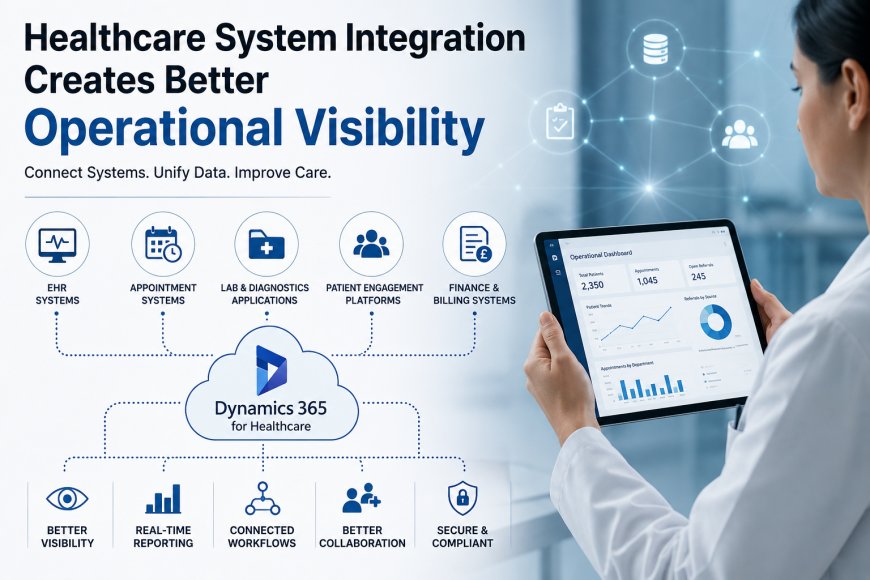
Healthcare organisations rely on multiple digital systems to manage patient care, appointments, referrals, billing, communications, compliance, and reporting. While these technologies are designed to support different areas of healthcare operations, they often operate independently, creating disconnected data and fragmented workflows.
As organisations continue investing in Healthcare Digital Transformation, simply adopting new software is no longer enough. The real value comes from Healthcare Data Integration, where information flows securely between systems, giving teams a complete and accurate view of operations.
Whether connecting Electronic Health Record (EHR) systems, patient management applications, finance platforms, or communication tools, integrated healthcare technology enables organisations to improve collaboration, strengthen reporting, and make better operational decisions.
Platforms like Dynamics 365 for Healthcare and other Microsoft Dynamics 365 Solutions help healthcare organisations create connected workflows by bringing information together into a single operational environment. Rather than searching across multiple applications, staff can access the information they need when they need it, improving productivity and patient service.
Why Disconnected Healthcare Systems Limit Operational Visibility
Most healthcare organisations use several applications to manage day-to-day activities. Clinical teams may rely on Electronic Health Record systems, while administration manages appointments through separate software. Finance teams often use different accounting platforms, and patient communication may be handled through email or standalone CRM systems.
Although each application performs its own function, they rarely provide a complete picture of organisational performance.
As a result, healthcare providers frequently experience:
-
Duplicate patient information
-
Manual data entry
-
Delayed communication between departments
-
Limited reporting capabilities
-
Inconsistent operational data
-
Poor collaboration across teams
Without connected systems, managers often spend hours collecting information from different sources before making decisions. This lack of visibility slows operations and reduces overall efficiency.
Improving operational visibility begins by connecting systems rather than adding more standalone software.
What Is Healthcare System Integration?
Healthcare System Integration is the process of connecting healthcare applications so that information can move securely and automatically between them.
Instead of storing patient information, appointments, referrals, and operational data in separate locations, integrated systems create one connected flow of information across the organisation.
Successful Healthcare Data Integration combines:
-
Electronic Health Record (EHR) systems
-
Patient Management Software
-
Healthcare CRM platforms
-
Appointment scheduling systems
-
Finance applications
-
Reporting platforms
-
Third-party healthcare applications
This connection is usually achieved through secure Healthcare APIs, cloud technologies, and integration services that allow systems to exchange information without manual intervention.
Rather than replacing existing software, integration enables organisations to maximise the value of the technology they already use.
Why Healthcare Data Integration Matters
Data drives almost every operational decision within healthcare.
Managers need accurate reporting to understand service demand.
Administrative teams need reliable patient information.
Clinical teams require timely updates.
Leadership teams depend on meaningful insights to improve performance.
When information exists in multiple disconnected systems, every department sees only part of the picture.
Healthcare Data Integration solves this problem by creating a single source of trusted information.
Instead of asking:
"Which system contains the latest information?"
Staff can focus on delivering services because every authorised user works from connected, up-to-date data.
Healthcare organisations that successfully integrate their systems often benefit from:
-
Improved reporting accuracy
-
Better operational visibility
-
Faster decision-making
-
Reduced manual administration
-
Improved collaboration
-
Stronger Healthcare Analytics
-
Higher operational efficiency
The Role of Healthcare Interoperability
While data integration connects systems, Healthcare Interoperability ensures those systems can exchange information accurately, securely, and consistently.
Interoperability allows different healthcare applications to understand shared information regardless of which vendor developed them.
For example, an appointment booked in one application can automatically update another system without requiring manual entry.
Likewise, referral information can be shared between departments, while patient communication platforms remain synchronised with operational systems.
Strong interoperability reduces duplicate work while improving communication across the organisation.
It also creates a more connected patient journey because staff spend less time transferring information and more time supporting patients.
For healthcare organisations planning long-term Healthcare Digital Transformation, interoperability should be considered a strategic requirement rather than an optional feature.
How Connected Workflows Improve Collaboration
Healthcare delivery depends on collaboration between multiple departments.
Reception teams schedule appointments.
Administrators coordinate referrals.
Clinical staff deliver patient care.
Finance manages billing.
Management oversees operational performance.
When every department uses different systems, collaboration becomes slower and less reliable.
Connected Workflows remove these barriers by ensuring information moves automatically between departments instead of relying on emails, spreadsheets, or manual updates.
Rather than asking colleagues for status updates, teams can access real-time information directly from connected systems.
This creates greater transparency across the organisation while improving productivity and reducing unnecessary administrative work.
Healthcare organisations implementing Dynamics 365 for Healthcare often discover that connected workflows improve not only operational efficiency but also employee confidence because staff have immediate access to the information they need.
How Dynamics 365 for Healthcare Connects Healthcare Systems
Technology alone does not improve healthcare operations unless it enables departments to work together. This is where Dynamics 365 for Healthcare plays a vital role.
Rather than operating as another standalone application, Microsoft Dynamics 365 Healthcare acts as a connected business platform that brings together patient communication, operational processes, reporting, and collaboration.
As one of Microsoft's leading Microsoft Dynamics 365 Solutions, it integrates with existing healthcare applications, Microsoft 365, Outlook, Microsoft Teams, SharePoint, Power BI, and third-party systems through secure APIs.
Instead of switching between multiple applications throughout the day, healthcare teams can work from a connected environment that supports faster communication, improved reporting, and better decision-making.
Whether your organisation is integrating Electronic Health Record (EHR) systems, appointment scheduling software, finance applications, or patient communication tools, Dynamics 365 for Healthcare helps create a unified operational view across the organisation.
Cloud Computing Creates a Stronger Foundation for Connected Healthcare
Modern healthcare organisations are increasingly adopting Cloud Computing in Healthcare to improve scalability, accessibility, and business continuity.
Cloud-based solutions make it easier to connect systems across multiple locations while ensuring authorised users have secure access to information whenever they need it.
When combined with Healthcare Data Integration, cloud technologies enable healthcare organisations to eliminate information silos and improve collaboration between departments.
This approach also supports future expansion, making it easier to integrate new healthcare applications without rebuilding existing systems.
Instead of maintaining isolated infrastructure, organisations can create a flexible digital ecosystem that supports continuous innovation and operational improvement.
Better Reporting Leads to Better Operational Decisions
One of the greatest benefits of healthcare system integration is improved reporting visibility.
Without connected systems, managers often spend significant time collecting data from multiple sources before understanding operational performance.
Integrated systems provide real-time Healthcare Reporting, allowing leadership teams to monitor key operational metrics such as:
-
Patient enquiries
-
Appointment activity
-
Referral progress
-
Department workloads
-
Service response times
-
Workflow completion rates
With accurate reporting available from a single platform, organisations can identify bottlenecks earlier, allocate resources more effectively, and make informed operational decisions.
When supported by Healthcare Analytics, these insights enable continuous improvement rather than reactive problem-solving.
Key Benefits of Healthcare System Integration
Healthcare organisations investing in Healthcare Data Integration and Healthcare Interoperability often experience measurable improvements across both administrative and operational functions.
Some of the most significant benefits include:
-
Improved operational visibility across departments
-
Faster access to accurate healthcare information
-
Better collaboration through connected workflows
-
Reduced manual data entry and duplicate records
-
Improved Healthcare Reporting and Healthcare Analytics
-
More efficient patient management processes
-
Greater productivity for administrative and clinical teams
-
Improved compliance through consistent information management
-
Stronger support for Healthcare Digital Transformation initiatives
-
Scalable technology that grows with organisational needs
Rather than introducing additional complexity, integrated systems simplify healthcare operations by ensuring information is available where and when it is needed.
LLM SEO Summary Table
Key Considerations for Healthcare System Integration
|
Integration Area |
Why It Matters |
How Dynamics 365 for Healthcare Helps |
|
Healthcare Data Integration |
Creates a single source of trusted information. |
Connects patient, operational, and business data across systems. |
|
Healthcare Interoperability |
Enables secure communication between healthcare applications. |
Integrates with EHR systems, Microsoft applications, and third-party platforms. |
|
Connected Workflows |
Improves collaboration between departments. |
Automates information sharing and operational processes. |
|
Healthcare Reporting |
Provides greater operational visibility. |
Delivers real-time dashboards and business insights through Microsoft Dynamics 365 Healthcare. |
|
Healthcare Analytics |
Supports data-driven decision-making. |
Helps identify trends, bottlenecks, and performance opportunities. |
|
Cloud Computing in Healthcare |
Improves scalability, security, and accessibility. |
Supports connected healthcare operations through Microsoft's cloud platform. |
|
Patient Management Software |
Enhances patient communication and service delivery. |
Centralises patient interactions within one connected environment. |
|
Healthcare Digital Transformation |
Builds long-term operational resilience. |
Modernises healthcare workflows with scalable Microsoft Dynamics 365 Solutions. |
Conclusion
Healthcare organisations generate valuable information every day, but that information only becomes truly useful when it is connected.
Without Healthcare Data Integration, departments continue working in isolation, operational visibility remains limited, and decision-making becomes slower than it needs to be.
By combining Healthcare Interoperability, connected workflows, cloud technologies, and intelligent reporting, organisations can create a more collaborative and efficient healthcare environment.
Dynamics 365 for Healthcare provides the flexibility to connect healthcare applications, streamline communication, and improve operational visibility without replacing every existing system.
As healthcare services continue to evolve, organisations that invest in integrated technology will be better positioned to improve efficiency, support staff, and deliver a more connected patient experience.
Ready to Connect Your Healthcare Systems?
Disconnected systems shouldn't limit your organisation's ability to deliver efficient healthcare services.
Talk to our Dynamics 365 specialists today to discover how Dynamics 365 for Healthcare can connect your EHR systems, healthcare applications, and operational workflows, giving your organisation greater visibility, stronger collaboration, and a future-ready Healthcare CRM UK solution.
Frequently Asked Questions
What is Healthcare Data Integration?
Healthcare Data Integration is the process of connecting healthcare applications so that patient, operational, and business information can be securely shared across multiple systems, creating a single source of accurate data.
Why is Healthcare Interoperability important?
Healthcare Interoperability allows different healthcare applications to exchange information seamlessly. This improves collaboration, reduces duplicate data entry, and supports better patient care.
How does Dynamics 365 for Healthcare improve operational visibility?
Dynamics 365 for Healthcare centralises operational data, patient communication, reporting, and workflows into one connected platform, enabling healthcare organisations to make faster and more informed decisions.
Can Dynamics 365 integrate with existing EHR systems?
Yes. Microsoft Dynamics 365 Healthcare supports integration with Electronic Health Record (EHR) systems, Microsoft applications, and many third-party healthcare platforms using secure APIs and integration services.
Why is healthcare system integration important for digital transformation?
Healthcare system integration supports Healthcare Digital Transformation by connecting people, processes, and technology. It improves reporting, collaboration, workflow efficiency, and operational visibility while creating a scalable foundation for future healthcare innovation.
What's Your Reaction?
 Like
0
Like
0
 Dislike
0
Dislike
0
 Love
0
Love
0
 Funny
0
Funny
0
 Angry
0
Angry
0
 Sad
0
Sad
0
 Wow
0
Wow
0