How to Build an AI Strategy With AI Development Services
Learn how to build a practical AI strategy with AI development services, from identifying use cases and preparing data to deployment, security, and scaling.
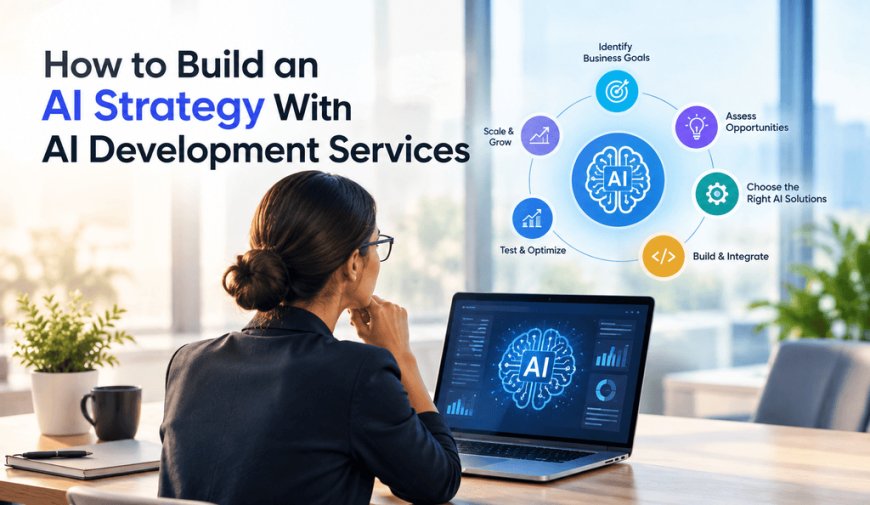
Artificial intelligence is no longer limited to experimental projects or research labs. Businesses across industries are exploring AI to automate repetitive work, improve customer experiences, analyze large amounts of data, and support better decision-making.
However, adopting AI without a clear strategy can create more problems than opportunities. Businesses may invest in tools that do not solve meaningful problems, struggle with data quality, or build applications that are difficult to maintain.
A practical AI strategy helps organizations decide where AI can create value, what technology is required, and how to move from an idea to a reliable solution. This is where AI development services can provide technical expertise throughout the process.
What is an AI Strategy?
An AI strategy is a structured plan for using artificial intelligence to achieve specific business objectives. It connects business goals with data, technology, people, processes, and measurable outcomes.
Instead of asking, “How can we use AI?” businesses should begin with questions such as:
-
Which business problems can AI realistically solve?
-
Where are employees spending too much time on repetitive tasks?
-
What customer experiences could be improved?
-
What data is available for AI applications?
-
How will the success of an AI initiative be measured?
These questions help organizations avoid implementing AI simply because it is a growing technology trend.
1. Identify Business Problems Before Choosing AI Technology
The first step in developing an AI strategy is identifying problems worth solving.
For example, an ecommerce business may want to improve product recommendations, while a financial organization may focus on fraud detection or document processing. A healthcare company could explore AI-assisted administrative workflows, whereas a logistics business may investigate demand forecasting.
The technology should come after the problem has been clearly defined.
A useful way to prioritize AI opportunities is to consider factors such as business impact, implementation complexity, available data, expected cost, and potential risks.
This creates a practical roadmap instead of an unstructured list of AI ideas.
2. Evaluate Your Data Readiness
AI systems depend heavily on data. Even sophisticated models can produce unreliable results when the underlying data is incomplete, outdated, inconsistent, or poorly organized.
Before developing an AI application, businesses should examine:
-
What data is currently available?
-
Where is the data stored?
-
Is it accurate and properly structured?
-
How frequently is it updated?
-
Are there privacy or compliance requirements?
-
Who can access and manage it?
Data preparation may involve cleaning databases, integrating different data sources, establishing governance processes, and creating appropriate access controls.
An AI strategy should therefore include a clear data foundation rather than treating data preparation as an afterthought.
3. Choose the Right AI Approach
Not every business problem requires the same type of AI.
Depending on the objective, organizations may consider machine learning, natural language processing, computer vision, predictive analytics, generative AI, recommendation systems, or AI agents.
For instance, a company processing thousands of customer documents may benefit from natural language processing and document intelligence. A business handling customer inquiries could explore conversational AI or generative AI.
The right approach depends on the use case, available data, required accuracy, budget, security requirements, and expected scale.
An experienced AI development company can help evaluate these factors and determine whether an existing AI model, a customized model, or a combination of technologies is appropriate.
4. Start With a Focused AI Pilot
One common mistake is trying to introduce AI across an entire organization at once.
A better approach is to start with a focused pilot that addresses a clearly defined problem. The pilot provides an opportunity to test assumptions, understand technical limitations, collect user feedback, and measure business results.
For example, instead of immediately building an AI-powered customer service platform for every department, a company could initially test an AI assistant for handling a specific category of frequently asked questions.
The pilot should have measurable objectives, such as reducing response time, improving classification accuracy, increasing automation, or lowering manual processing effort.
Successful pilots can then become the foundation for larger AI initiatives.
5. Plan AI Integration With Existing Systems
AI rarely operates in isolation. Most organizations already use CRMs, ERPs, websites, mobile applications, databases, cloud platforms, and internal software.
An AI strategy should explain how the new AI capability will interact with these systems.
For example, an AI customer support assistant may need access to CRM information, product databases, knowledge bases, and communication platforms. Without proper integration, even a capable AI model may provide limited business value.
AI development services can include API development, system integration, cloud deployment, model implementation, data pipelines, and application development to connect AI capabilities with existing business infrastructure.
6. Address Security, Privacy, and Responsible AI
AI strategy should not focus only on functionality. Security and responsible use are equally important.
Businesses need to consider how sensitive information is collected, processed, stored, and accessed by AI systems. Depending on the industry and location, organizations may also have specific regulatory and compliance obligations.
Important considerations include:
-
Data privacy and access controls
-
Secure API and system integration
-
Model monitoring
-
Human oversight
-
Bias and fairness
-
Protection against unauthorized use
-
Clear policies for AI-generated content
Building these safeguards into the strategy from the beginning is generally more effective than adding them after deployment.
7. Define How AI Success Will Be Measured
An AI project should have clear performance indicators before development begins.
The right metrics depend on the business objective. They could include processing time, operational cost, customer satisfaction, conversion rate, prediction accuracy, employee productivity, or automation rate.
Technical performance matters, but business outcomes should remain central.
For example, an AI model with excellent technical accuracy may still have limited value if employees cannot easily use it or if integration with existing workflows creates additional work.
8. Build a Long-Term AI Roadmap
AI implementation does not end when an application goes live. Models, data, user requirements, and business processes change over time.
A long-term AI roadmap should cover:
-
Initial use cases and priorities
-
Pilot development
-
Testing and validation
-
Production deployment
-
Performance monitoring
-
User feedback
-
Model and system improvements
-
Expansion into additional use cases
Working with an AI development company can also provide access to specialized technical expertise when internal teams need support with architecture, development, integration, testing, or ongoing optimization.
Final Thoughts
Building an AI strategy is less about adopting every new AI technology and more about identifying where artificial intelligence can solve meaningful business problems.
A strong strategy begins with business objectives, evaluates data readiness, selects appropriate AI technologies, starts with manageable pilots, and considers integration, security, measurement, and long-term scalability.
With the right approach to AI development services, businesses can move from isolated AI experiments toward practical solutions that fit their existing operations and evolving goals. The most effective AI strategies are not simply technology-driven. They are built around real problems, measurable outcomes, and the people who ultimately use the technology.
What's Your Reaction?
 Like
0
 Dislike
0
 Love
0
 Funny
0
 Angry
0
 Sad
0
 Wow
0