
















RS-485 to Ethernet Converter – India's Most Affordable, High-Performance Device
A high-performance RS-485 to Ethernet Converter is designed to seamlessly connect legacy serial devices with modern Ethernet networks, enabling reliable communication for industrial automation and Industrial IoT (IIoT) applications. Built to deliver exceptional performance in demanding environments, these converters ensure stable data transmission, simplified network integration, and long-term operational reliability.

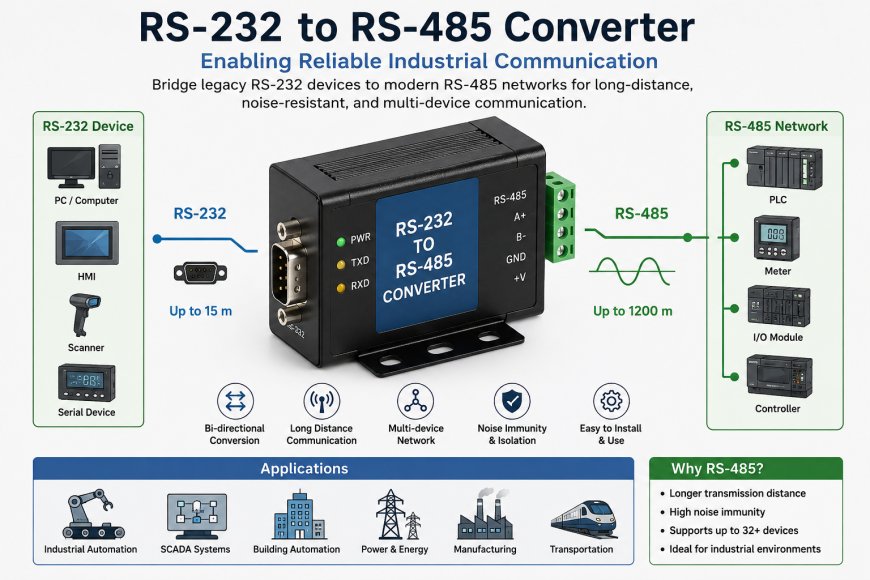
In today's industrial automation environment, reliable communication between devices is essential for maintaining productivity, efficiency, and system performance. Many industrial machines still use the RS-232 communication standard, while modern industrial networks are built around RS-485 due to its superior performance over long distances and in electrically noisy environments.
An RS-232 to RS-485 converter acts as a bridge between these two communication standards, enabling legacy equipment to communicate seamlessly with modern industrial control systems. Whether you're integrating PLCs, SCADA systems, sensors, or industrial controllers, these converters play a crucial role in ensuring stable and efficient data transmission.
What is an RS-232 to RS-485 Converter?
An RS-232 to RS-485 converter is a communication device that converts RS-232 serial signals into RS-485 signals and vice versa. It allows devices with RS-232 ports to connect with RS-485 networks without replacing existing hardware.
This conversion enables industries to extend communication distances, connect multiple devices on a single network, and improve signal reliability in harsh industrial environments.
https://iotstudioz.com/product/rs-232-to-rs-485-converter-for-industrial-communication/
Understanding RS-232 and RS-485
RS-232
RS-232 is one of the oldest serial communication standards and is widely used in computers, laboratory equipment, barcode scanners, and legacy industrial devices.
Key Features:
- Point-to-point communication
- Maximum distance of approximately 15 meters (50 feet)
- Lower resistance to electrical noise
- Supports one transmitter and one receiver
RS-485
RS-485 is specifically designed for industrial environments where long-distance communication and multiple device connections are required.
Key Features:
- Supports communication up to 1,200 meters
- Multi-drop network supporting up to 32 devices (or more with modern transceivers)
- Excellent noise immunity
- Differential signaling for reliable data transmission
- Ideal for industrial automation systems
Why Use an RS-232 to RS-485 Converter?
Many industries continue to operate equipment with RS-232 interfaces. Replacing these devices can be costly and unnecessary.
An RS-232 to RS-485 converter offers several advantages:
- Connects legacy devices to modern industrial networks
- Extends communication distance significantly
- Improves resistance to electromagnetic interference
- Enables communication with multiple devices
- Reduces installation and equipment replacement costs
- Enhances overall network reliability
Applications in Industrial Communication
RS-232 to RS-485 converters are widely used across various industries, including:
Industrial Automation
Connect PLCs, HMIs, industrial PCs, and controllers over long distances while maintaining reliable communication.
SCADA Systems
Enable seamless communication between remote monitoring equipment and central control stations.
Manufacturing Plants
Integrate legacy CNC machines, production equipment, and testing devices into modern automation systems.
Building Automation
Connect HVAC controllers, lighting systems, energy meters, and security equipment using RS-485 networks.
Power and Energy
Used in substations, smart meters, solar monitoring systems, and power distribution equipment.
Transportation
Support communication in railway signaling, traffic management systems, and industrial vehicle monitoring.
Key Features to Look For
When selecting an RS-232 to RS-485 converter, consider the following features:
- Automatic data direction control
- Optical isolation for equipment protection
- Surge and ESD protection
- Wide operating temperature range
- Industrial-grade metal enclosure
- DIN rail mounting support
- External or USB power options
- High baud rate compatibility
- LED indicators for communication status
Benefits of Using an Industrial-Grade Converter
Industrial-grade converters provide several operational advantages:
Reliable Long-Distance Communication
Transmit data over distances up to 1,200 meters without significant signal degradation.
Improved Noise Immunity
Differential signaling minimizes communication errors caused by electrical interference.
Cost-Effective System Integration
Allows continued use of existing RS-232 equipment while upgrading communication infrastructure.
Easy Installation
Most converters support plug-and-play installation with minimal configuration.
Increased Network Flexibility
Supports multiple devices on a single RS-485 communication bus.
Installation Best Practices
To achieve optimal performance:
- Use high-quality twisted-pair cables.
- Properly terminate the RS-485 network using 120-ohm resistors.
- Follow correct grounding practices.
- Keep communication cables away from power lines.
- Verify baud rate, parity, and communication settings on connected devices.
- Use isolated converters in electrically noisy environments.
Common Troubleshooting Tips
If communication issues occur:
- Check wiring polarity (A/B terminals).
- Confirm matching communication parameters.
- Inspect cable quality and connectors.
- Ensure proper network termination.
- Verify adequate power supply to the converter.
- Test communication using diagnostic software.
Choosing the Right RS-232 to RS-485 Converter
When purchasing a converter, evaluate:
- Communication speed requirements
- Transmission distance
- Number of connected devices
- Isolation requirements
- Environmental conditions
- Power supply options
- Industrial certifications
- Manufacturer support and warranty
Selecting the right converter ensures stable communication, reduced downtime, and long-term reliability.
Future of Industrial Serial Communication
Although Ethernet-based industrial protocols continue to grow, RS-485 remains one of the most dependable communication standards for factory automation, process control, and field devices. RS-232 to RS-485 converters will continue to play a vital role by allowing businesses to modernize their systems while protecting investments in legacy equipment.
Conclusion
An RS-232 to RS-485 converter is an essential component for integrating legacy serial devices into modern industrial communication networks. It extends communication distance, improves reliability, reduces noise-related issues, and enables cost-effective system upgrades without replacing existing equipment.
Whether you are designing a new automation system or upgrading an existing facility, choosing a high-quality industrial RS-232 to RS-485 converter ensures seamless communication, improved operational efficiency, and long-term performance.
What's Your Reaction?
 Like
0
Like
0
 Dislike
0
Dislike
0
 Love
0
Love
0
 Funny
0
Funny
0
 Angry
0
Angry
0
 Sad
0
Sad
0
 Wow
0
Wow
0