















Fear Beyond the Classroom: The Hidden Academic Cost of Safety and Xenophobia for Asian International Students
Discover how safety concerns, xenophobia, and mental health challenges are affecting the academic success of Asian international students in the USA.
For thousands of Asian international students in the United States, academic success isn't determined solely by lectures, exams, or hard work. New research suggests that personal safety, racial discrimination, and constant uncertainty about immigration status are quietly shaping educational outcomes in ways universities can no longer afford to ignore.
The image of the international student is often built around ambition. They travel thousands of miles, pay premium tuition fees, adapt to unfamiliar cultures, and compete in demanding academic environments. What rarely enters that picture is the emotional weight many carry every day.
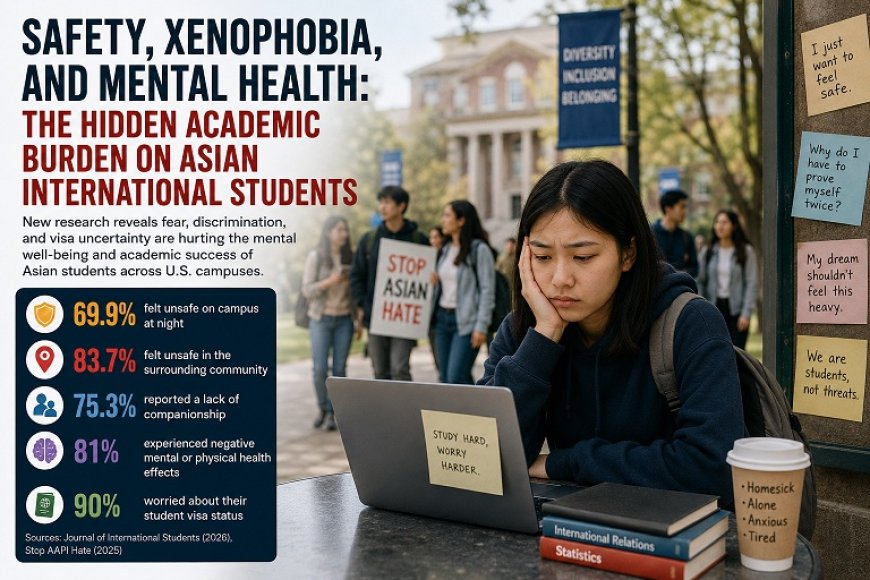
A 2026 study published in the Journal of International Students paints a troubling reality. Nearly 70% of Asian international students reported feeling unsafe on campus after dark, while 83.7% said they felt unsafe in surrounding neighborhoods. Those aren't isolated concerns. Researchers found these safety fears were closely linked with significantly higher stress levels, creating an invisible barrier to learning long before students sit down for an exam.
Stress isn't simply an emotional issue. It affects memory, concentration, sleep quality, motivation, and decision-making—all essential ingredients for academic success. When students spend their evenings worrying about walking home safely from the library, their attention is naturally divided.
The research goes even deeper.
More than 75% of respondents reported lacking companionship, while over 70% experienced feelings of isolation. Experiences of discrimination and racial microaggressions almost tripled the likelihood of severe stress. Financial pressure proved even more damaging, emerging as one of the strongest predictors of psychological distress among participants. Instead of dealing with one challenge at a time, many Asian international students face several simultaneously.
A Campus Climate That Doesn't End at the Campus Gates
The pressures facing Asian international students don't stop once lectures are over.
A 2025 survey conducted by Stop AAPI Hate found that only 4% of international students felt very safe living in the United States. Even more striking, 90% expressed moderate to extreme concern about their student visa status, fearing policy changes, detention, or interruptions that could derail years of education.
Those fears change behavior.
Students reported avoiding public events, limiting political discussions, deleting social media posts, and withdrawing from campus activities because they worried their actions might somehow affect future immigration decisions. Participation—something universities actively encourage—becomes another calculated risk.
That withdrawal has academic consequences.
Students who hesitate to speak in seminars ask fewer questions. Those avoiding networking events miss opportunities to connect with professors or future employers. Group discussions become uncomfortable instead of collaborative. Over time, the educational experience becomes noticeably smaller than the one universities promise in recruitment materials.
This kind of self-censorship rarely appears in GPA statistics, yet it quietly shapes educational outcomes.
The Mental Health Burden Nobody Sees
Mental health has become a growing concern across higher education, but international students often encounter additional barriers before they even seek support.
Language differences, unfamiliar healthcare systems, cultural stigma surrounding counseling, and uncertainty about available services can discourage students from asking for help. When those obstacles are combined with racial discrimination and immigration anxiety, the effects become difficult to ignore.
The research reviewed in the report found that 81% of surveyed international students experienced negative physical or mental health effects linked to safety concerns and policy uncertainty. Anxiety, insomnia, chronic stress, and feelings of isolation appeared repeatedly throughout participant responses.
Poor mental health rarely stays confined to personal life.
Students begin missing classes. Assignments take longer to complete. Concentration fades during lectures. Coursework that once seemed manageable starts piling up, creating even more anxiety. What begins as emotional strain gradually turns into academic decline.
It's a cycle that's difficult to escape without meaningful support.
Why Universities Need to Think Beyond Campus Security
Improving lighting, increasing security patrols, and expanding emergency escort programs are important first steps. But the evidence suggests they aren't enough on their own.
Researchers argue that safety, inclusion, financial stability, and mental health should be treated as interconnected parts of student success rather than separate administrative departments.
For example, financial stress was one of the strongest contributors to high stress levels among Asian international students. Many international students already pay considerably higher tuition than domestic students while facing strict employment restrictions. Working additional hours to cover living expenses often means sacrificing study time, increasing fatigue, and raising the risk of burnout.
Universities also need clearer communication.
Many students surveyed were unaware whether legal support, immigration guidance, or specialized counseling services even existed on their campuses. Resources cannot help students who don't know they're available.
Building stronger peer communities matters just as much.
International student organizations, cultural associations, mentoring programs, and faculty engagement all help reduce isolation while creating practical support networks during periods of stress.
Academic support can also play an important role. Services such as Expertsmind, alongside university tutoring and writing centers, give students additional guidance when coursework becomes difficult to manage, helping them stay engaged with their studies while addressing personal and mental health challenges rather than falling behind altogether.
A Growing Challenge for American Higher Education
The implications extend far beyond individual campuses.
International students contribute billions of dollars annually to the U.S. economy while enriching classrooms through cultural diversity, research, and innovation. If safety concerns, discrimination, and policy uncertainty continue pushing talented students to consider other destinations, American universities risk losing both intellectual capital and global competitiveness.
Some warning signs are already visible.
According to findings referenced in the report, many international students are actively developing backup plans to continue their education or careers outside the United States should immigration conditions worsen. That represents more than personal anxiety—it reflects declining confidence in the country's ability to provide a secure educational environment.
What's Your Reaction?
 Like
0
Like
0
 Dislike
0
Dislike
0
 Love
0
Love
0
 Funny
0
Funny
0
 Angry
0
Angry
0
 Sad
0
Sad
0
 Wow
0
Wow
0