















Specifying Grade 80 And 100 Heavy-Duty Chain for OSHA-Compliant Overhead Lifting
Compare heavy-duty chain Grade 80 vs 100 for OSHA compliance. Learn capacity, inspection, and durability for industrial lifting systems.

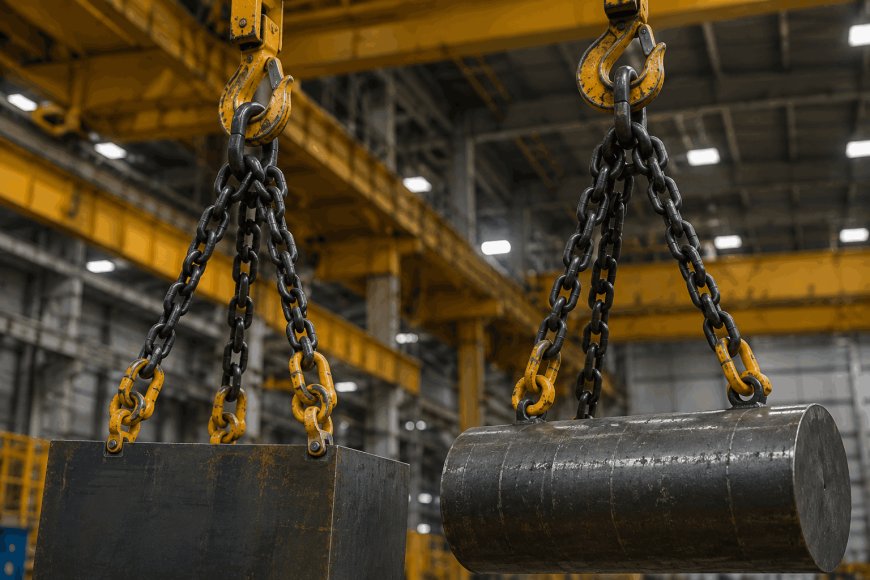
Selecting the right heavy-duty chain is critical for safe and compliant overhead lifting operations. Material grade, inspection practices, and environmental conditions all influence performance and lifecycle reliability.
Understanding how Grade Eighty and Grade One Hundred chains differ helps ensure proper selection and consistent lifting outcomes. For specification reference, review available options for heavy-duty chain.
Performance and Capacity: Heavy-Duty Chain Grade Eighty Vs. Grade One Hundred
Working Load Limits And Weight Ratios
Grade One Hundred chains offer higher working load limits than Grade Eighty chains while maintaining similar weight profiles. Industry benchmarks show a clear capacity advantage, allowing operators to lift heavier loads without increasing rigging weight.
In heavy manufacturing environments, this difference becomes operationally significant. Overhead lifts with fabricated steel assemblies benefit from higher-capacity chains, reducing the need for bulkier configurations.
Abrasion Resistance And Alloy Construction
Both grades use alloy steel designed for strength and durability. However, higher-grade chains typically exhibit greater hardness and resistance in high-friction environments.
Industry data indicate that advanced alloy compositions improve wear resistance during repeated lifting cycles. This supports longer service life in applications with constant load movement and surface contact.
Compliance And Safety Heavy-Duty Chain Inspection Standards
Tagging And Identification Requirements
Compliance standards require all lifting chains to include permanent identification markings. These tags confirm grade, capacity, and manufacturer details necessary for safe operation.
Missing or illegible tags are a common reason for removal from service. Industry guidance emphasizes that unmarked chains cannot be verified and should not be used in overhead lifting applications.
How To Inspect Slings And Hardware
Daily inspection routines are essential for maintaining compliance. Operators should visually check for deformation, cracks, elongation, and surface damage before each lift.
Real-world applications show that consistent pre-use inspections reduce failure risks. Angle reduction factors and choke hitch limitations must also be considered during inspection and planning.
For compliant assemblies and guidance, consult rigging specialists to ensure proper configuration and adherence to lifting standards.
Environmental Resilience: Heavy-Duty Chain Temperature And Corrosion Tolerance
High-Heat Applications And Derating
High-temperature environments reduce the effective capacity of lifting chains. Foundry operations, for example, require chains that can maintain structural integrity under extreme heat exposure.
Industry data indicates that capacity decreases progressively as temperature rises. Selecting the appropriate alloy grade ensures safe operation under these demanding conditions.
Corrosion Resistance And Coatings
Outdoor and marine environments introduce additional challenges, such as moisture and chemical exposure. Powder-coated attachments are increasingly used to improve corrosion resistance compared to standard finishes.
Environmental suitability depends on both base material and protective coatings. Proper selection helps maintain performance and reduces premature degradation.
Cost And ROI: Evaluating Industrial Chain Lifespan And Chain Suppliers
Initial Investment Versus Long-Term Durability
Higher-grade chains often involve a greater initial investment. However, directional benchmarks indicate reduced replacement frequency due to improved durability.
This results in a lower total cost of ownership over time. Industrial operations benefit from fewer disruptions and reduced maintenance requirements.
Vetting, Rigging, and Lifting Partners
Selecting the right supplier is as important as choosing the chain itself. Reliable partners provide certified products, testing documentation, and recertification programs.
In real-world applications, sourcing specialized components such as compacted wire rope assemblies requires technical expertise. Working with experienced suppliers ensures compatibility and compliance across the lifting system.
Verdict: Which Heavy-Duty Chain Is Right For Your Project
Decision Framework For Procurement
Choosing between Grade Eighty and Grade One Hundred depends on load requirements, environmental conditions, and operational risks. Matching working load limits to specific applications improves both safety and efficiency.
Many operations are shifting toward higher-grade chains to reduce weight while increasing capacity. This trend supports modern lifting requirements without compromising reliability.
Final Recommendations And Next Steps
Selecting the correct chain involves evaluating both performance and system compatibility. Hooks, pin latches, and connecting hardware must align with chain specifications to ensure safe lifting.
For specialized rigging solutions and compliant lifting systems, contact Murphy Industrial Products, Inc. Proper selection and expert guidance help ensure safe, efficient operations across industrial environments.
What's Your Reaction?
 Like
0
Like
0
 Dislike
0
Dislike
0
 Love
0
Love
0
 Funny
0
Funny
0
 Angry
0
Angry
0
 Sad
0
Sad
0
 Wow
0
Wow
0