

















What Is Einstein's IQ Estimated to Be According to Modern Researchers
Einstein's extraordinary legacy was built not simply on intelligence, but on curiosity, creativity, perseverance, and a willingness to challenge conventional thinking. His ability to imagine new possibilities and pursue difficult questions transformed science forever.

Introduction
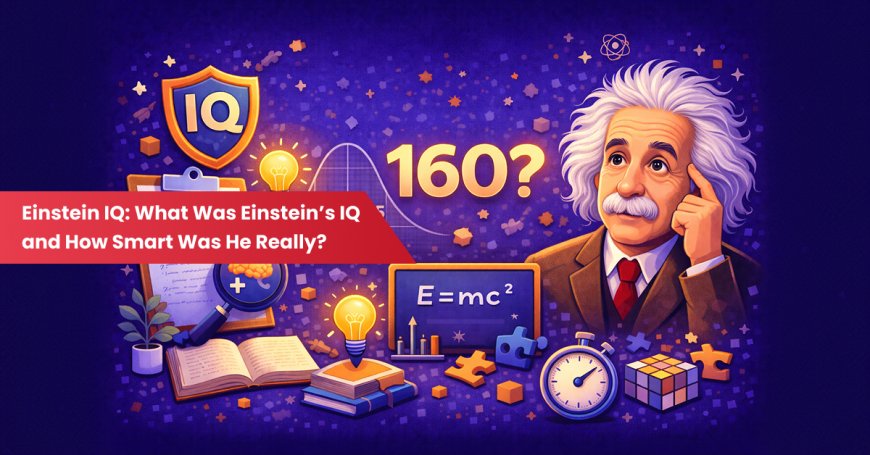
The question what is Einstein's IQ has fascinated people for decades. Albert Einstein is widely recognized as one of the greatest scientific minds in history, and many are curious about how his intelligence would compare to modern standards. A quick online search reveals countless articles claiming his IQ was 160, 180, or even above 200. These numbers are often presented as facts, but the historical evidence tells a different story.
The truth is that Albert Einstein never took a modern standardized IQ test. As a result, there is no official record of his intelligence quotient. The figures commonly associated with his name are estimates created by researchers, psychologists, and science writers based on his achievements rather than actual test results.
This article explores what is Einstein's IQ, why estimates vary, what modern researchers believe, and why his genius cannot be fully explained by a single number.
Did Albert Einstein Ever Take an IQ Test?
The simplest answer is no.
Although intelligence testing existed during Einstein's lifetime, modern IQ assessments had not yet become the standardized psychological tools used today. There is no historical record showing that Einstein ever completed a professionally administered IQ examination.
Because he never took such a test, no verified IQ score exists. Every number associated with Einstein is speculative.
This fact is often overlooked when discussing what is Einstein's IQ, leading many people to believe that a precise score has been officially documented.
Why Do So Many Websites Claim Einstein Had an IQ of 160?
The estimate of 160 has become the most widely accepted unofficial figure.
Modern researchers generally believe that someone capable of Einstein's extraordinary scientific accomplishments would likely score extremely high on an intelligence assessment. Since an IQ of 160 represents exceptional cognitive ability, many writers have adopted it as a reasonable estimate.
However, it remains only an estimate.
There is no surviving document, research paper, or psychological evaluation confirming that Einstein's IQ was exactly 160.
The widespread repetition of this number has transformed speculation into what many mistakenly assume is historical fact.
What Is Einstein's IQ According to Modern Researchers?
When discussing what is Einstein's IQ, most modern researchers avoid assigning an exact number.
Instead, many suggest that if Einstein had completed a contemporary intelligence assessment, his IQ might have fallen somewhere between 160 and 180.
These estimates are based on several observations, including:
-
His groundbreaking scientific discoveries.
-
His exceptional mathematical reasoning.
-
His ability to solve highly abstract problems.
-
His remarkable creativity.
-
His extraordinary pattern recognition.
-
His influence on modern physics.
Even so, researchers emphasize that these estimates cannot be verified because Einstein was never formally tested.
Why Some Sources Claim Einstein's IQ Was Above 200
Some internet articles claim Einstein possessed an IQ exceeding 200.
These claims have little historical support.
Most psychologists consider such numbers highly speculative because accurately estimating someone's IQ without formal testing is impossible.
The higher estimates often appear in sensational articles designed to attract attention rather than present carefully researched historical evidence.
For this reason, readers should treat any precise figure above 200 with considerable skepticism.
What Makes Estimating Einstein's IQ Difficult?
Several factors make estimating Einstein's intelligence extremely challenging.
No Official Test Results
The biggest limitation is obvious.
Without actual testing, researchers cannot calculate an accurate IQ score.
Everything remains hypothetical.
Different IQ Tests Measure Different Skills
Modern intelligence assessments evaluate several cognitive abilities, including:
-
Logical reasoning
-
Working memory
-
Processing speed
-
Visual spatial reasoning
-
Verbal comprehension
-
Fluid reasoning
Since Einstein never completed these assessments, nobody knows exactly how he would have performed across every category.
Intelligence Is Multifaceted
Einstein demonstrated abilities extending beyond conventional intelligence testing.
His imagination, scientific intuition, creativity, and persistence all contributed to his success.
These qualities are difficult to measure using standardized tests.
What Actually Made Einstein a Genius?
Instead of focusing only on what is Einstein's IQ, it is worth examining the qualities that truly defined his brilliance.
Extraordinary Curiosity
Einstein constantly questioned accepted scientific ideas.
Rather than accepting conventional explanations, he explored deeper questions about space, time, energy, and gravity.
His curiosity fueled decades of research.
Creative Thinking
Einstein became famous for his thought experiments.
Instead of relying only on equations, he imagined impossible situations that helped him visualize how the universe might behave.
One famous example involved imagining what it would be like to travel alongside a beam of light.
These imaginative exercises eventually contributed to the development of special relativity.
Persistence
Scientific breakthroughs rarely happen overnight.
Einstein spent years refining his theories and solving difficult problems.
His willingness to continue working despite setbacks played an enormous role in his achievements.
Independent Thinking
Einstein often challenged ideas accepted by leading scientists of his time.
His ability to question long established assumptions allowed him to develop entirely new ways of understanding physics.
What Do IQ Tests Actually Measure?
To better understand what is einstein's iq it helps to know what IQ tests are designed to evaluate.
Most modern assessments measure cognitive abilities such as:
-
Analytical reasoning
-
Abstract thinking
-
Pattern recognition
-
Short term memory
-
Processing speed
-
Verbal reasoning
These skills are strongly associated with academic performance and problem solving.
However, they represent only part of human intelligence.
What IQ Tests Do Not Measure
Standardized intelligence tests have important limitations.
They generally do not measure:
-
Creativity
-
Scientific imagination
-
Emotional intelligence
-
Leadership
-
Artistic ability
-
Wisdom
-
Curiosity
-
Motivation
-
Persistence
Einstein excelled in many of these areas.
His creative thinking was arguably just as valuable as his logical reasoning.
The Myth That Einstein Failed Mathematics
Another popular misconception often appears alongside discussions about what is einstein's iq
Many people believe Einstein struggled with mathematics as a child.
Historical records tell a different story.
Einstein performed exceptionally well in mathematics from an early age.
The myth likely arose from misunderstandings involving different grading systems used in European schools.
Rather than failing math, Einstein demonstrated advanced mathematical ability throughout his education.
Comparing Einstein With Other Famous Geniuses
People often compare Einstein with historical figures such as:
-
Isaac Newton
-
Leonardo da Vinci
-
Nikola Tesla
-
Stephen Hawking
Like Einstein, most of these individuals never completed modern IQ assessments.
As a result, estimates of their intelligence are also speculative.
While comparing estimated IQ scores may be entertaining, such comparisons rarely provide meaningful insight into their actual contributions.
Each transformed their respective fields in unique ways that extend beyond standardized intelligence measurements.
Why the Public Remains Fascinated by Einstein's IQ
Interest in what is Einstein's IQ reflects a broader fascination with genius.
People naturally wonder whether exceptional accomplishments come from extraordinary intelligence, hard work, creativity, or some combination of all three.
Einstein's life suggests that genius cannot be explained by IQ alone.
His discoveries required imagination, determination, intellectual curiosity, and years of careful research.
These qualities cannot be summarized by a single numerical score.
Lessons We Can Learn From Einstein
Einstein's legacy offers valuable lessons that remain relevant today.
First, curiosity drives learning. Asking thoughtful questions often leads to deeper understanding than simply memorizing facts.
Second, creativity matters. Looking at familiar problems from new perspectives can produce remarkable discoveries.
Third, persistence is essential. Even brilliant individuals encounter setbacks before achieving success.
Finally, genuine passion for learning often produces greater results than chasing scores or rankings.
Einstein devoted his life to understanding the universe because he loved scientific discovery, not because he wanted to achieve a particular IQ score.
Should We Focus on Einstein's IQ?
Many experts argue that focusing too heavily on what is Einstein's IQ misses the larger point.
Whether his estimated IQ was 160, 170, or 180 changes very little about his historical significance.
His revolutionary theories transformed modern physics, influenced technology, and reshaped humanity's understanding of space and time.
Those achievements matter far more than any estimated intelligence quotient.
Final Thoughts
So, what is Einstein's IQ according to modern researchers? The most honest answer is that nobody knows for certain. Albert Einstein never completed a verified modern IQ assessment, meaning no official score exists. Although many researchers estimate his IQ may have fallen between 160 and 180, these figures remain educated guesses rather than documented facts.
Einstein's extraordinary legacy was built not simply on intelligence, but on curiosity, creativity, perseverance, and a willingness to challenge conventional thinking. His ability to imagine new possibilities and pursue difficult questions transformed science forever.
Rather than focusing on an unverified IQ number, it is more meaningful to appreciate the qualities that made Einstein exceptional. His lifelong commitment to learning and discovery demonstrates that true genius is measured not only by cognitive ability but also by imagination, determination, and the lasting impact of one's ideas on the world.
What's Your Reaction?
 Like
0
Like
0
 Dislike
0
Dislike
0
 Love
0
Love
0
 Funny
0
Funny
0
 Angry
0
Angry
0
 Sad
0
Sad
0
 Wow
0
Wow
0