

























Why CEO Coaching Networks Are Becoming Essential for Scaling Companies
CEO coaching networks offer valuable peer connections, leadership coaching, and growth strategies for expanding companies.
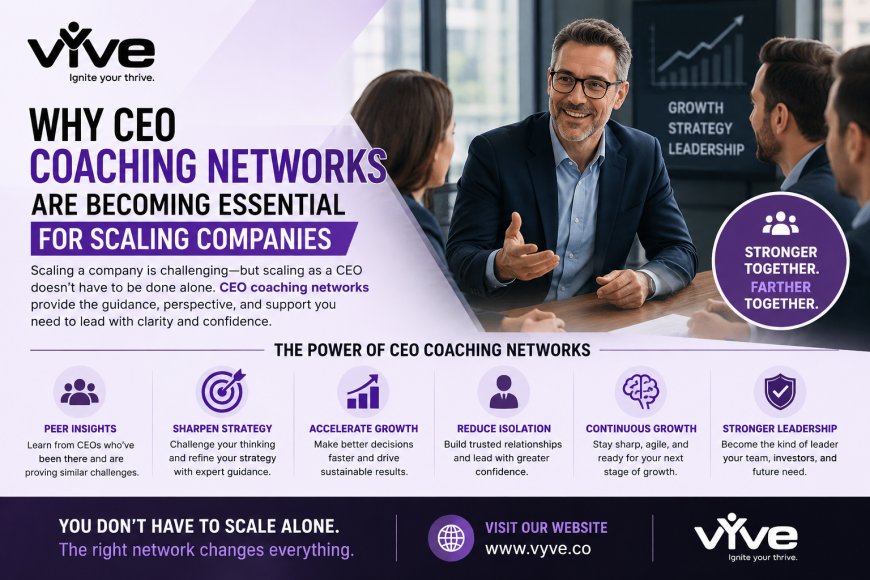
Scaling a company sounds exciting on paper. More revenue, bigger teams, wider reach. But behind the scenes, it often feels like everything is moving faster than clarity can keep up. Decisions get heavier. Time feels shorter. And leadership starts to feel a bit isolated.
That’s exactly why the idea of a CEO coaching network is gaining serious traction among modern founders and executives. It’s not just another support system. It’s becoming a core part of how leaders think, decide, and scale in real time.
Scaling Breaks the Old Leadership Playbook
What worked when a company was small starts to crack during growth phases. At the early stage, founders can rely on instinct and direct control. But scaling introduces complexity that no single leader can fully manage alone.
Suddenly, everything multiplies:
-
More teams to align
-
More decisions with higher risk
-
More stakeholders with competing priorities
-
More uncertainty in execution
This is where things get tricky. Leaders often realize they are making bigger decisions, but with the same or even less clarity than before.
A CEO coaching network steps into this gap by giving leaders access to shared thinking environments where real problems are discussed openly and practically.
Why Individual Thinking Stops Being Enough
Traditional leadership support usually focuses on one-to-one guidance. That has value, especially for personal development. But scaling challenges are rarely personal; they are structural.
At a certain point, leaders don’t just need advice. They need context.
Here’s the gap:
-
Coaching = deep focus on the individual
-
Scaling reality = interconnected business challenges
When markets shift quickly, relying on a single perspective can slow down decision-making. A CEO coaching network introduces a broader lens where multiple experienced leaders contribute insights based on real execution, not theory.
That difference matters more than most people realize.
The Power of Shared Leadership Intelligence
One of the strongest advantages of a coaching network model is exposure to multiple operating realities.
Instead of learning from one mentor, leaders gain access to a room full of peers who are actively building, scaling, and solving problems right now.
A CEO coaching network typically enables conversations like:
-
How different industries handle similar scaling bottlenecks
-
What leadership structures actually work at different growth stages
-
Where founders are over-investing or under-optimizing
-
How decisions play out after implementation
This turns leadership development into something dynamic rather than static.
It’s not about theory. It’s about patterns from real companies facing real pressure.
Decision Fatigue: The Silent Growth Killer
One of the biggest challenges at the CEO level is decision fatigue. As companies grow, the number of decisions doesn’t just increase; it compounds.
And here’s the problem: not every decision has enough internal clarity.
That’s where leaders often get stuck.
A CEO coaching network helps reduce that burden by offering rapid external validation. Instead of carrying uncertainty alone, leaders can test ideas against experienced peers before execution.
This doesn’t mean outsourcing decisions. It means sharpening them.
And in high-growth environments, sharper decisions create momentum.
Why Peer Environments Build Faster Clarity
There’s something powerful about hearing how other CEOs are solving similar problems.
Not because their answers are perfect. But because their experiences act like mirrors.
Inside a CEO coaching network, conversations often unlock clarity through:
-
Contrasting perspectives
-
Real-time problem comparison
-
Honest feedback without hierarchy
-
Shared lessons from failures and wins
This kind of environment accelerates thinking in a way traditional advisory models often don’t.
It’s less about instruction and more about reflection through experience.
Accountability That Doesn’t Feel Forced
Accountability is usually structured in coaching programs through goals and check-ins. That works, but it can sometimes feel rigid or performance-driven.
In a coaching network setup, accountability behaves differently.
When leaders engage regularly with peers:
-
Progress becomes visible naturally
-
Commitments are reinforced socially
-
Execution improves without pressure tactics
-
Conversations stay grounded in reality
A CEO coaching network builds accountability through presence rather than enforcement.
That subtle shift often leads to more consistent follow-through.
Scaling Requires Perspective, Not Just Strategy
Strategy alone doesn’t solve scaling problems. Many companies already have solid strategies that look great on slides but struggle in execution.
What’s missing is perspective.
A CEO coaching network brings that perspective by showing leaders:
-
How similar strategies perform across different industries
-
Where execution gaps typically appear
-
What hidden risks emerge during scaling phases
-
How timing impacts outcomes more than planning
This kind of insight is difficult to get internally because teams are too close to the work.
External peer insight fills that blind spot.
Emotional Isolation at the Top Is Real
One of the least discussed realities of leadership is isolation. The higher you go, the fewer people you can openly discuss challenges with.
Boards offer governance. Teams offer execution. But very few spaces offer honest dialogue without an agenda.
A CEO coaching network helps reduce that isolation by creating a trusted environment where leaders can speak openly without filtering decisions for hierarchy or optics.
That psychological relief often leads to better thinking. When pressure reduces, clarity improves.
Why This Model Is Becoming a Standard, Not a Trend
The shift toward coaching networks is not accidental. It reflects how modern business environments operate.
Companies today are:
-
Scaling faster than traditional leadership structures were designed for
-
Facing unpredictable market conditions
-
Managing hybrid and distributed teams
-
Making decisions with incomplete data more often
In this environment, leadership development must be continuous, not occasional.
A CEO coaching network fits because it is:
-
Real-time
-
Experience-based
-
Peer-driven
-
Adaptable to different industries and stages
It doesn’t replace leadership skills. It strengthens how those skills are applied under pressure.
Final Thoughts
Scaling companies don’t struggle because leaders lack knowledge. They struggle because complexity increases faster than clarity.
That’s where a CEO coaching network becomes essential. It brings structured peer intelligence into leadership decision-making, helping CEOs think more clearly, act more confidently, and scale more effectively.
It’s not about replacing traditional coaching or mentorship. It’s about upgrading the environment where leadership decisions are shaped.
And in today’s fast-moving business world, that environment often makes the difference between stagnation and scalable growth.
Strengthen Your Leadership Advantage
If you're looking to build a sharper leadership perspective and navigate scaling challenges with more clarity and structure, Vyve provides an environment designed to help leaders connect, think, and grow through meaningful peer-driven experiences.
What's Your Reaction?
 Like
0
Like
0
 Dislike
0
Dislike
0
 Love
0
Love
0
 Funny
0
Funny
0
 Angry
0
Angry
0
 Sad
0
Sad
0
 Wow
0
Wow
0