


















How Facility Management Supports Indonesia’s Assets
Explore how facility management supports Indonesia’s infrastructure, commercial buildings, industrial assets, and public facilities through maintenance, integrated services, digital tools, sustainability, and workplace safety.

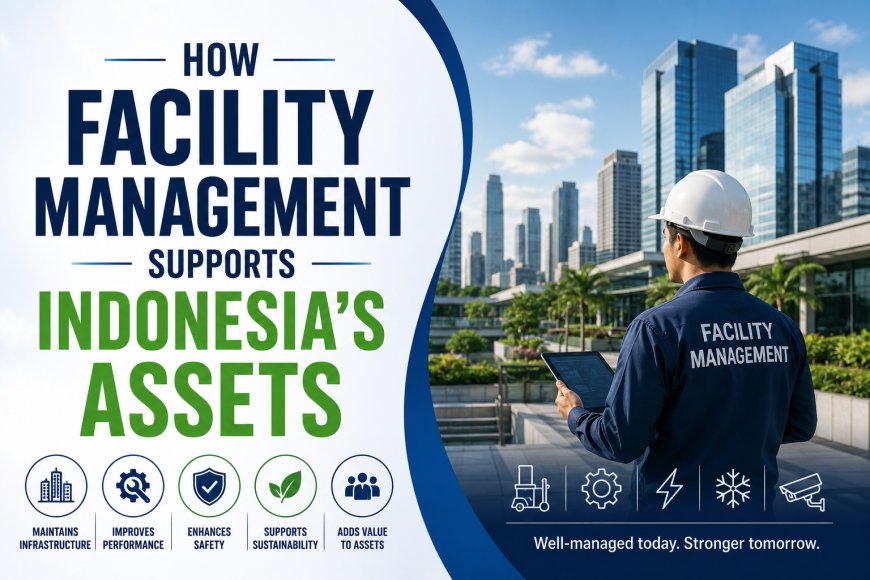
Facility management is becoming increasingly important in Indonesia as commercial buildings, public infrastructure, industrial facilities, healthcare assets, education campuses, hospitality properties, and residential developments require organized operational support. These services cover technical maintenance, cleaning, security, workplace administration, energy management, compliance support, and asset lifecycle planning. As Indonesia modernizes infrastructure and expands formal business activity, facility management helps building owners maintain performance, safety, and service quality.
A published study by MarkNtel Advisors reports that the Indonesia facility management sector was valued at around USD 15.18 billion in 2025. It is projected to grow from USD 16.21 billion in 2026 to USD 22.29 billion by 2032, registering a CAGR of around 5.45% during 2026–32. Hard facility management holds nearly 60% share, while integrated facility management accounts for around 55% in 2026.
Infrastructure Modernization Drives Demand
Indonesia’s facility management demand is strongly linked with infrastructure modernization and sustainable asset management. The report highlights government-led development across transport, public buildings, water infrastructure, industrial estates, and urban services. These assets require long-term operations, preventive maintenance, technical inspection, cleaning, security, and lifecycle optimization after construction is completed.
Facility management providers help owners and operators reduce service gaps across large and complex assets. The Ministry of PPN/Bappenas provides official publications on RPJMN development planning, which supports the wider context of infrastructure planning and public asset development.
Hard Services Lead the Sector
Hard facility management is the leading service type in Indonesia, accounting for around 60% of the sector in 2026. This segment includes HVAC systems, electrical installations, plumbing, building automation, elevators, lighting, fire safety, and other technical building systems. These services are essential because they directly affect building safety, comfort, uptime, and operational continuity.
The report states that the segment is supported by commercial buildings, industrial facilities, healthcare institutions, airports, and public infrastructure that require continuous technical maintenance. As buildings become more advanced, the need for specialized technicians, predictive maintenance, and technical service providers continues to rise.
Integrated FM Gains Preference
Integrated facility management is the leading service delivery model, accounting for nearly 55% share in 2026. This model combines technical maintenance, cleaning, security, workplace management, and energy management under one service provider. It helps building owners reduce vendor complexity while improving accountability and service coordination.
Integrated models are useful for commercial buildings, industrial parks, hospitals, airports, and government facilities. Instead of managing multiple service providers separately, organizations can use centralized contracts and digital reporting systems. This improves performance visibility and supports smoother day-to-day operations.
Administrative FM Benefits from Formalization
The report highlights administrative facility management as an important opportunity area in Indonesia. As the formal business base expands and compliance requirements become more digital, demand rises for reception, records support, procurement assistance, front-office coordination, visitor management, mailroom services, and workplace administration.
Indonesia’s Online Single Submission system supports business licensing through a risk-based digital licensing framework. As more organizations manage formal business processes and documentation, administrative facility management providers can support office operations, document handling, visitor control, and compliance-related workplace coordination.
Smart Services Reshape Operations
Smart, sustainable, and integrated services are redefining Indonesia’s facility management landscape. The report highlights rising adoption of AI-enabled maintenance, workplace analytics, digital facility platforms, and integrated service delivery. These tools help facility teams monitor assets, schedule work, manage teams, and identify issues before they cause disruption.
Digital systems can improve service visibility across multi-site portfolios. Facility managers can track work orders, maintenance history, energy performance, cleaning schedules, security tasks, and compliance activities through connected platforms. This shift helps organizations move from reactive maintenance toward planned, data-driven operations.
Sustainability Expands FM Roles
Sustainability is becoming more important in Indonesia’s facility management sector. Building owners and operators are seeking services that improve energy efficiency, reduce waste, support ESG compliance, and optimize long-term asset performance. Facility providers are increasingly expected to support cleaner operations and responsible workplace management.
The report notes that sustainability-driven operations are one of the key trends shaping the sector. Facility teams can support these goals through preventive maintenance, equipment optimization, waste management, environmental monitoring, and better use of digital reporting tools. This makes FM providers important partners in day-to-day sustainability execution.
Skilled Labor and Costs Create Pressure
The sector faces challenges from rising operating costs and workforce efficiency needs. Facility management depends on skilled technicians, cleaners, security personnel, supervisors, building engineers, and administrative staff. When service costs rise or skilled workers are limited, providers must improve productivity while maintaining consistent quality.
The report identifies rising statutory wage costs as a growth opportunity for automation and workforce-efficiency innovation. Digital workforce tools, predictive maintenance, smart scheduling, and automation can help providers use manpower more effectively. This supports better service delivery while reducing pressure from labor-heavy operations.
Competitive Landscape Is Fragmented
Indonesia’s facility management sector is highly fragmented, with the top five companies collectively accounting for around 10% share. Key companies listed in the report include ISS Facility Services Inc., JLL Inc., CBRE Indonesia, OCS Group Indonesia, PT Shield-On Service Tbk, PT Patra Jasa, PT Spektra Solusindo, Sodexo, Colliers Facility Management Services, and Leads Property Services Indonesia.
Competition is shaped by integrated service capabilities, nationwide coverage, digital facility management tools, ESG-focused services, technical expertise, and long-term contracts. Providers that can combine hard services, workplace support, energy management, and digital platforms are better positioned to serve complex assets.
Recent Developments Support Digital FM
The report highlights several recent developments in Indonesia’s facility management sector. OCS Group Indonesia published its 2025 Sustainability Report, focusing on energy efficiency, waste reduction, carbon management, and responsible workplace operations. JLL was recognized for AI-enabled facility management, predictive maintenance, workplace experience, and sustainability-driven building operations.
The report also notes PT Shield-On Service Tbk’s merger with ALSOK BASS Indonesia Security Services, PT Patra Jasa’s expansion of integrated facility management services, and Sodexo’s strengthening of digital workplace and integrated FM solutions in Asia. These developments show how sustainability, consolidation, and digital tools are shaping the sector.
Workplace Safety Remains Important
Facility management also supports safer workplaces by maintaining building systems, coordinating inspections, managing fire safety, handling emergency planning, and ensuring that work environments remain functional. This is especially important for industrial facilities, hospitals, public buildings, campuses, and commercial spaces where operational risks must be controlled.
The International Labour Organization highlights the importance of occupational safety and health as part of safe working environments. Facility providers support this context through preventive maintenance, risk monitoring, trained staff, and structured operating procedures.
Outlook for Indonesia Facility Management
Indonesia’s facility management sector is expected to grow steadily through 2032, supported by infrastructure modernization, commercial building operations, industrial expansion, integrated service adoption, digital platforms, and sustainability-focused asset management. Hard facility management will continue to lead because technical building systems require continuous maintenance and specialist support.
Future growth will depend on integrated service delivery, digital facility platforms, skilled workforce management, ESG-focused operations, and lifecycle asset optimization. Providers that combine technical expertise, sustainability capabilities, automation, and reliable service quality will remain important to Indonesia’s facility management sector.
What's Your Reaction?
 Like
0
Like
0
 Dislike
0
Dislike
0
 Love
0
Love
0
 Funny
0
Funny
0
 Angry
0
Angry
0
 Sad
0
Sad
0
 Wow
0
Wow
0